Fibreglass vs Concrete Pools: Structural Build Comparison
Compare fibreglass vs concrete pools with our structural build guide. Analyze installation, hydrostatic risks, mix designs, and current costs.

The Core Structural Divide: Shell Engineering
When evaluating fibreglass vs concrete pools, the fundamental difference lies in how the structural vessel is engineered and formed. A concrete pool (specifically shotcrete or gunite) is a site-built, monolithic structure. It relies on a continuous grid of #3 or #4 steel rebar, tied on 10-inch to 12-inch centers, encased in a high-strength cementitious matrix. According to guidelines referenced by the American Concrete Institute (ACI), structural shotcrete for subterranean water containment typically requires a 28-day compressive strength of 4,000 to 5,000 PSI, applied pneumatically at high velocity to achieve a dense, low-slump shell that is 8 to 12 inches thick.
Conversely, a fibreglass pool is a factory-molded composite vessel. The structural integrity does not come from a single material, but from a layered laminate schedule. The interior surface is a 30-to-40-mil layer of UV-stabilized gelcoat, followed by a skin coat of vinyl ester resin to prevent osmotic blistering. The structural core consists of multiple layers of chopped strand mat and woven roving fiberglass, saturated with polyester or vinyl ester resin, often reinforced with polyurethane foam cores in high-stress areas like the deep end hopper and step transitions.
Application Decision Matrix
- Choose Concrete (Gunite/Shotcrete): When site access prohibits heavy crane operations, when the design requires negative edges, vanishing edges, or highly asymmetrical geometric shapes, or when integrating complex structural bond beams with elevated spas.
- Choose Fibreglass: When the site allows for a 70-foot to 100-foot boom crane, when a rapid installation timeline (3-6 weeks) is required, and when the design fits within standard factory molds (typically maxing out at 16 feet wide by 40 feet long).
Excavation, Access, and Site Preparation Realities
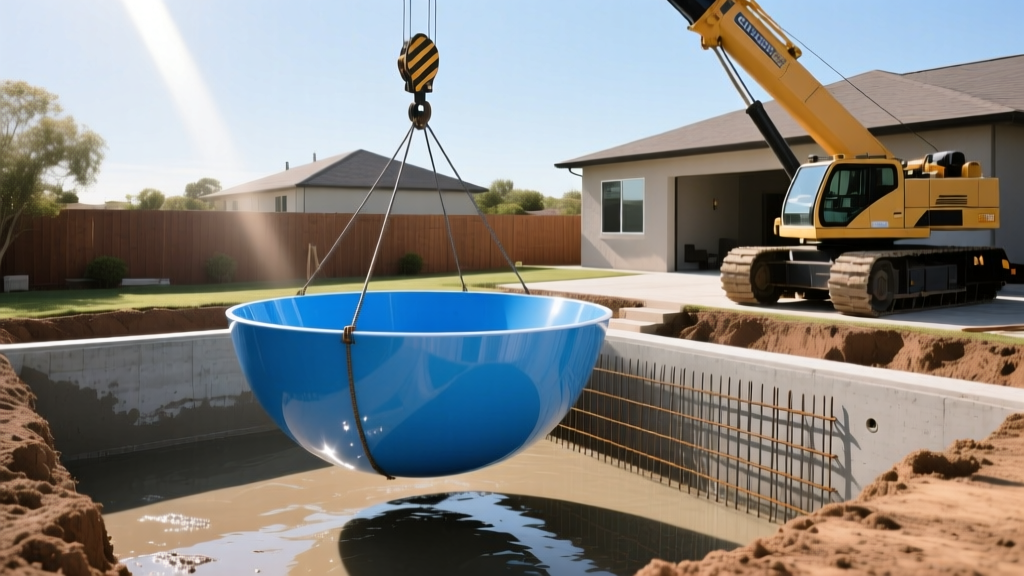
The most frequent point of failure in pool construction occurs before the shell is even installed. Site access dictates the viability of fibreglass. A standard 14x28 foot fibreglass shell weighs between 5,000 and 8,000 pounds and requires a massive crane with an extended boom to lift it over a two-story house. If the crane must operate from a public roadway requiring lane closures, or if the boom reach exceeds 90 feet, crane rental costs can escalate from a baseline of $1,500 to over $5,000 for a single day.
Concrete pools bypass the crane requirement entirely. A concrete pump truck with a 32-meter boom can easily reach most backyards from the street, pumping the shotcrete mix directly into the excavation. However, concrete pools require significantly more extensive forming. Carpenters must build wooden or aluminum forms for the bond beam, steps, and benches before the steel rebar is tied, adding 3 to 5 days of specialized labor to the site preparation phase.
Soil Bearing and Backfill Protocols
The backfill material and compaction methodology differ drastically between the two applications. Fibreglass shells are flexible; if backfilled improperly, the hydrostatic pressure of wet dirt can cause the sidewalls to bow inward or the floor to buckle upward. Industry standards dictate that fibreglass pools must be backfilled with clean, angular 3/8-inch crushed gravel (never pea gravel or native soil). The gravel is placed in 12-inch lifts, and water is simultaneously introduced to flush the stones into the voids, creating a dense, self-compacting structural lock that prevents shell deformation.
Concrete pools, due to their sheer mass and rigidity, can be backfilled with native soil or a flowable fill (slurry) mixture. While native soil is cheaper, structural engineers often specify a sand-cement slurry for the first 3 feet of backfill behind the wall to eliminate future settling that could crack the surrounding concrete deck.
Hydrostatic Pressure and Structural Failure Modes
Understanding how each material handles groundwater is critical for long-term application success. The Pool & Hot Tub Alliance (PHTA) emphasizes the severe risks of hydrostatic uplift in regions with high water tables.
- Fibregress 'Popping': Because a fibreglass shell is relatively lightweight and watertight, an empty fibreglass pool acts like a boat in a high water table. If the hydrostatic relief valve in the main drain sump fails or clogs, the upward pressure of the groundwater can literally push the entire pool shell out of the ground, destroying the deck and plumbing. To mitigate this, builders install perimeter French drains tied to a sump pump system.
- Concrete Spider Cracking: Concrete pools do not 'pop' due to their massive weight (often exceeding 80,000 pounds when cured). However, their primary failure mode is shrinkage cracking. If the shotcrete is not kept continuously wet for a minimum of 7 days post-application, the rapid moisture evaporation causes micro-fissures. While these rarely compromise structural integrity, they can telegraph through the interior plaster finish, causing aesthetic defects and potential leak paths.
Material Specifications and Performance Comparison
| Specification | Shotcrete / Gunite (Concrete) | Moulded Fibreglass |
|---|---|---|
| Shell Thickness | 8 to 12 inches (variable) | 3/16 to 3/8 inch (laminate) |
| Compressive / Tensile Strength | 4,000 - 5,000 PSI (Compressive) | 15,000 - 25,000 PSI (Tensile) |
| Interior Finish | White marcite, quartz aggregate, or pebble | Integrated 30-40 mil UV gelcoat |
| Cure / Set Time | 28 days for full structural cure | Immediate (factory pre-cured) |
| Algae Resistance | Low (porous surface requires high chlorine) | High (non-porous gelcoat inhibits growth) |
| Expected Lifespan (Shell) | 50+ years (requires resurfacing every 12-15 yrs) | 30-50 years (gelcoat may fade/chalk) |
Interior Finishes: Porosity and Chemical Demand
The interior surface of the pool dictates ongoing maintenance and chemical consumption. A concrete pool requires a secondary interior finish applied over the rough shotcrete shell. Standard white marcite (plaster) is the most economical but highly porous, requiring aggressive acid washing and higher chlorine levels to prevent algae colonization. Premium finishes like PebbleTec or quartz aggregates increase the initial cost by $5,000 to $10,000 but extend the resurfacing interval from 7 years to 15-20 years.
Fibreglass pools feature an integrated gelcoat finish that is completely non-porous. This results in a 30% to 40% reduction in ongoing chemical costs compared to concrete. However, gelcoat is susceptible to UV degradation and calcium scaling. If the pool's calcium hardness levels are allowed to drop below 200 ppm, the water will aggressively leach minerals from the gelcoat, leading to permanent osmotic blistering and 'chalking' of the surface.
Real-World Cost Breakdown
Pricing for inground pools fluctuates based on regional labor rates, soil conditions, and material availability. The following estimates reflect average national turnkey costs for a standard 14x28 foot rectangular pool (approximately 400 square feet of water surface) in the current market.
Concrete Pool Cost Allocation
- Excavation & Dirt Haul-off: $8,000 - $14,000 (Concrete requires overcutting the hole by 2-3 feet on all sides for worker access and forming).
- Steel & Shotcrete Shell: $22,000 - $30,000.
- Plumbing & Equipment: $10,000 - $15,000.
- Interior Finish (Pebble): $8,000 - $12,000.
- Coping, Decking & Cleanup: $15,000 - $25,000.
- Total Estimated Range: $85,000 - $130,000+
Fibreglass Pool Cost Allocation
- Excavation & Dirt Haul-off: $6,000 - $10,000 (Tighter excavation footprint).
- Fibreglass Shell & Crane Set: $25,000 - $40,000 (Includes shell manufacturing, freight, and crane rigging).
- Gravel Backfill & Plumbing: $12,000 - $18,000.
- Coping, Decking & Cleanup: $12,000 - $20,000.
- Total Estimated Range: $65,000 - $95,000
Edge Cases: High Water Tables and Custom Topography
For properties situated in coastal regions or areas with shallow bedrock, the application choice narrows significantly. In shallow bedrock scenarios, excavating a deep-end hopper for a fibreglass shell is often impossible without expensive rock-blasting or hydraulic hammering, which can void the manufacturer's structural warranty. In these cases, a concrete pool is preferred, as the shotcrete can be applied directly over a shaved rock substrate, utilizing the bedrock itself as part of the structural foundation.
Conversely, in high water table environments where dewatering during construction is a massive logistical burden, fibregress offers a distinct advantage. Because the shell is lowered into the hole and backfilled with gravel in a single day, the window of vulnerability to groundwater intrusion is reduced from several weeks (in concrete construction) to just a few hours.
Written by
David NakamuraDavid Nakamura is a licensed architect (AIA) and construction technology writer focused on sustainable building methods, mass timber engineering, and high-performance building envelopes. He holds a Master of Architecture from the University of Washington and is a certified Passive House Consultant (CPHC). David spent eight years at the Seattle firm Mithun, where he led the design of three LEED Platinum projects, before founding his own practice specializing in net-zero residential design. He serves on the editorial advisory board of GreenBuilder Magazine and has authored peer-reviewed papers on cross-laminated timber (CLT) connections for the Journal of Structural Engineering. In his spare time, David teaches woodworking at Pratt Fine Arts Center and kayaks the Puget Sound.
More from David Nakamura
View all
Construction Cost
Labor Cost to Build a Deck Per Sq Ft: 2026 Installation Guide
Discover the exact labor cost to build a deck per sq ft in 2026. This installation guide breaks down contractor rates, complexity factors, and hidden fees.
Aug 4, 2026

Construction Cost
How Much Does It Cost to Build a 3 Bedroom House? Financing Guide
Learn exactly how much it costs to build a 3 bedroom house and explore 2026 financing options, construction loan types, and budget frameworks for your build.
Aug 4, 2026

Construction Cost
Cost to Build a Tennis Court: 2026 Guide
How much does it cost to build a tennis court in 2026? Breakdowns for asphalt, concrete, and synthetic surfaces plus fencing and lighting.
Jul 30, 2026