Concrete vs Shotcrete: Mix Design, Costs, and Application Guide
Compare concrete vs shotcrete for your next project. Explore mix designs, application methods, PSI strengths, and 2026 cost breakdowns.

The Core Distinction: Placement Method vs. Material Composition
The technical debate surrounding concrete vs shotcrete frequently stems from a fundamental misunderstanding of material science. Shotcrete is not a distinct building material; it is a specialized placement method. Both standard cast-in-place concrete and shotcrete utilize the same foundational components—Portland cement, water, fine aggregates, and coarse aggregates. However, the rheological requirements for gravity-fed casting versus high-velocity pneumatic projection dictate radically different mix designs, admixture profiles, and aggregate gradations.
- Standard Concrete: Mixed completely at the batch plant or truck, transported, and placed via gravity into formwork, requiring mechanical vibration for consolidation.
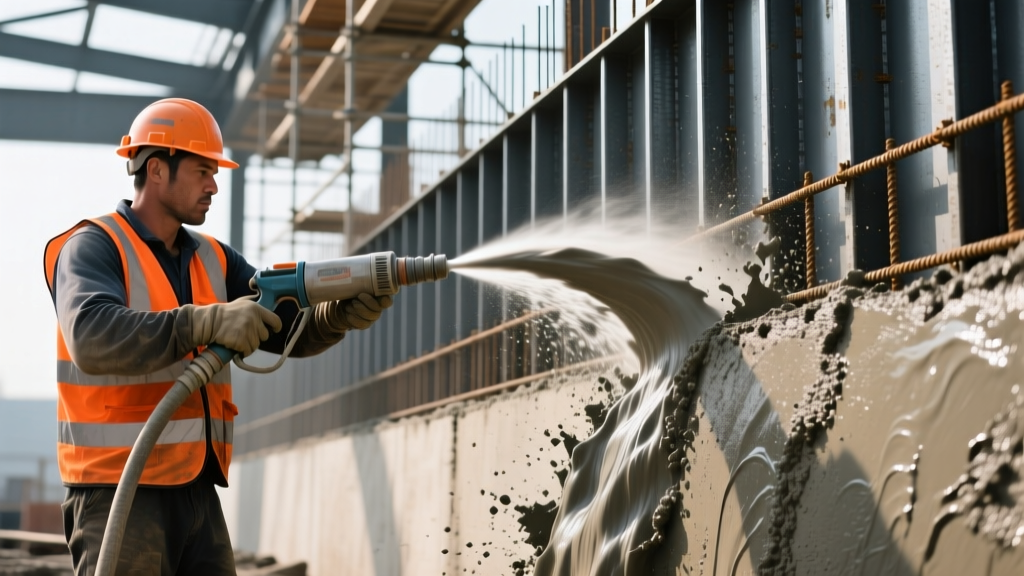
- Shotcrete: Conveyed pneumatically through a hose and projected at high velocity (typically 300 to 400 feet per second) onto a surface, where impact energy provides the consolidation.
Understanding the divergence in mix design is critical for structural engineers, general contractors, and specification writers to avoid catastrophic failures like delamination, excessive rebound, or structural honeycombing.
Standard Cast-in-Place Mix Design Parameters
Standard concrete mix designs are governed by Portland Cement Association (PCA) guidelines and ASTM C94 specifications. The primary goal of a standard mix is workability and flowability, ensuring the material can navigate dense rebar matrices without segregating.
Slump, Water-Cement Ratio, and Aggregate Sizing
For typical structural walls and foundations, the target slump ranges from 4 to 6 inches, often achieved using polycarboxylate ether (PCE) based high-range water reducers (HRWR). The water-cementitious (w/cm) ratio is strictly maintained between 0.40 and 0.50 to balance hydration efficiency with workability. Coarse aggregate sizing is maximized to reduce cement paste volume and minimize shrinkage; 3/4-inch to 1-inch aggregate is standard for most structural applications. Because the mix is highly fluid, internal mechanical vibration is mandatory to expel entrapped air and prevent honeycombing.
Shotcrete Rheology: Designing for Velocity and Adhesion
Shotcrete mix design requires a paradigm shift. The mixture must be cohesive enough to adhere to vertical or overhead surfaces immediately upon impact, yet fluid enough to pass through high-pressure pumping systems or pneumatic hoses without clogging. The American Concrete Institute (ACI) Committee 506 provides the definitive framework for these specialized designs.
Wet-Mix vs. Dry-Mix Processes
The choice between wet-mix and dry-mix shotcrete fundamentally alters the batch design:
- Wet-Mix Shotcrete (ASTM C94): All ingredients, including water, are mixed prior to entering the pump. The mix is pumped to the nozzle where compressed air is introduced to propel it. This method offers superior quality control, lower rebound rates (5% to 10%), and higher production volumes. It requires a highly cohesive mix, often utilizing silica fume (ASTM C1240) at 5% to 10% cement replacement to increase stickiness and reduce rebound.
- Dry-Mix Shotcrete (ASTM C685): Cement and damp sand are pneumatically conveyed to the nozzle, where water is added via a watering ring immediately before projection. This allows the nozzleman to adjust the water content on the fly, making it ideal for remote locations, small repairs, or overhead applications requiring immediate set times. However, it suffers from higher rebound rates (15% to 25%) and dust generation.
Critical Admixtures for Shotcrete
To achieve the necessary structural integrity, shotcrete relies heavily on chemical admixtures that are rarely used in standard flatwork:
- Alkali-Free Accelerators: Products like Sika Sigunit or MasterRoc MS 660 are dosed at the nozzle (typically 3% to 8% by weight of cement) to induce flash-setting, allowing thick overhead layers to be built up without sagging. Unlike older sodium-silicate accelerators, alkali-free variants do not compromise long-term compressive strength or durability.
- Viscosity Modifying Admixtures (VMAs): Used in wet-mix designs to prevent bleeding and segregation under high pump pressures.
- Synthetic Microfibers: Dosed at 1.5 to 3.0 lbs per cubic yard to control plastic shrinkage cracking and improve impact resistance during the pneumatic projection phase.
Mix Design Comparison Matrix
| Parameter | Standard Cast-in-Place | Wet-Mix Shotcrete | Dry-Mix Shotcrete |
|---|---|---|---|
| Max Aggregate Size | 3/4" to 1" | 3/8" to 1/2" | 3/8" to 1/2" |
| Target Slump | 4" to 6" (Highly Fluid) | 3" to 5" (Pumpable/Cohesive) | N/A (Dry until nozzle) |
| Consolidation Method | Mechanical Vibration | Pneumatic Impact Velocity | Pneumatic Impact Velocity |
| Typical Rebound Rate | 0% | 5% to 10% | 15% to 25% |
| 28-Day Compressive Strength | 4,000 to 8,000+ PSI | 5,000 to 10,000+ PSI | 4,000 to 7,000 PSI |
The Economics of Placement: 2026 Cost Breakdown
When evaluating concrete vs shotcrete, material costs are only a fraction of the total installed price. The specialized labor and equipment required for shotcrete significantly alter the project economics.
- Standard Cast-in-Place: Installed costs typically range from $140 to $190 per cubic yard. This includes ready-mix delivery, standard formwork, placement labor, and finishing. Formwork accounts for up to 60% of the total wall cost.
- Shotcrete (Wet-Mix): Installed costs range from $250 to $400 per cubic yard. While shotcrete drastically reduces or eliminates the need for expensive interior formwork, the premium pays for specialized concrete pump rigs, highly trained ACI-certified nozzlemen, and the cost of chemical accelerators and silica fume.
In dry-mix shotcrete applications, the rebound material that bounces off the surface is predominantly coarse aggregate. This means the in-place concrete is effectively richer in cement and sand than the design mix. If this rebound is swept up and reused in the structural layer, it creates severe shrinkage cracking and weak planes. Rebound must be discarded or repurposed for non-structural backfill, representing a direct material loss of up to 20% that must be factored into the procurement budget.
Execution Failures: Shadowing, Sand Pockets, and Delamination
Unlike standard concrete, which relies on formwork and vibration for quality assurance, shotcrete quality is entirely dependent on the nozzleman's technique and surface preparation. Specifiers must mandate strict inspection protocols to catch these specific failure modes:
- Shadowing: When the nozzle is held at an incorrect angle, the high-velocity stream is blocked by the reinforcing steel, leaving a void or "shadow" directly behind the rebar. The nozzle must be kept perpendicular to the surface, and the rebar mat must be properly spaced (minimum 2 inches behind the rebar to allow material wrap-around).
- Sand Pockets: If the nozzle distance is too great, the heavier coarse aggregate falls out of the stream, leaving a weak, sand-heavy layer on the surface. The optimal nozzle distance is strictly 3 to 4 feet from the receiving surface.
- Delamination from Poor Prep: Shotcrete requires a rough, saturated-surface-dry (SSD) substrate. If applied to a smooth, dusty, or bone-dry rock face or existing concrete, the substrate will flash-absorb the water from the cement paste, halting hydration and causing immediate delamination.
Specification Decision Framework: Which Should You Choose?
Selecting between standard concrete and shotcrete requires analyzing site constraints, structural geometry, and budget. Use the following decision framework during the schematic design phase:
- Specify Standard Cast-in-Place When: The project involves massive, repetitive structural elements (e.g., high-rise core walls, large mat foundations, standard suspended slabs) where the high cost of formwork is offset by the low cost of ready-mix placement and finishing. It is also mandatory when architectural finish tolerances are extremely tight.
- Specify Shotcrete When: The project features complex, non-linear geometries (e.g., swimming pools, skateparks, domed roofs), remote slope stabilization, tunnel linings, or tight urban sites where erecting double-sided formwork is physically impossible or economically unviable. Wet-mix shotcrete is the default for structural applications, reserving dry-mix strictly for small-scale repairs or remote rock stabilization where batch trucks cannot reach.
By aligning the mix design with the correct placement methodology, engineers can leverage the unique strengths of both systems, ensuring structural longevity and economic efficiency.
Written by
Sarah WhitfieldSarah Whitfield is a chartered quantity surveyor (MRICS) and construction cost analyst with 15 years of experience in material pricing, procurement strategy, and project budgeting. She earned her degree in Construction Management from the University of Reading (UK) and has worked on projects ranging from $2M custom homes to $180M mixed-use developments across North America and Europe. Sarah currently leads cost estimating for BuildMat Insight, maintaining a proprietary database of 4,000+ material price points updated quarterly. She is a frequent contributor to RSMeans cost data panels and has presented at the International Cost Engineering Council (ICEC) congress. Based in Denver, CO, Sarah is an avid trail runner and volunteer mentor for Women in Construction.
More from Sarah Whitfield
View all
Wood & Lumber
What Are the Different Types of Wood? A Builder's Guide
Compare structural softwoods, finish hardwoods, and engineered lumber. Analyze Janka ratings, MOE values, and 2026 pricing for construction.
Aug 4, 2026

Walls & Panels
Steel Framing vs Wood Framing: Corrosion and Moisture Defense
Compare steel framing vs wood framing for moisture resistance. Learn about galvanized coatings, condensation risks, and corrosion protection strategies.
Jul 21, 2026

Stone & Masonry
How to Cut Stone Veneer: Wet Saw vs Grinder Comparison
Compare the best tools for cutting stone veneer. We review wet saws, angle grinders, and chop saws to help you achieve clean, chip-free cuts.
Jul 21, 2026