Types of Concrete Mix vs. Alternatives: Structural Cost Guide
Compare types of concrete mix against asphalt, steel, and mass timber. Explore 2026 costs, psi ratings, and structural alternatives for your build.

The Material Selection Framework: Beyond Default Specifications
Specifying building materials based on habit rather than performance metrics leads to severe budget overruns and premature structural degradation. When evaluating the various types of concrete mix, project managers must weigh them directly against non-concrete alternatives like asphalt, structural steel, and mass timber. The decision hinges on four variables: compressive strength requirements, lifecycle maintenance, embodied carbon, and localized labor rates. According to the American Concrete Institute (ACI), improper mix selection for specific environmental exposures accounts for over 30% of early-age concrete failures in commercial builds.
Application Matrix: Types of Concrete Mix vs. Alternatives
The following matrix breaks down the optimal use cases, comparing specific concrete mixes against their primary alternative materials based on 2026 national average pricing and structural performance.
| Application | Primary Concrete Mix | Alternative Material | Installed Cost (2026) | Optimal Use Case |
|---|---|---|---|---|
| Heavy-Duty Paving | Standard 4,000 psi OPC Mix | Asphalt (PG 64-22) | Concrete: $8-$11/sq ft Asphalt: $4-$6/sq ft |
Concrete for high-axle loads; Asphalt for rapid deployment. |
| Mid-Rise Framing | High-Strength (8,000+ psi) | Structural Steel (W-Shapes) | Concrete: $22-$28/sq ft Steel: $28-$40/sq ft |
Concrete for fire rating & thermal mass; Steel for long spans. |
| Complex Formwork | Self-Consolidating (SCC) | Traditional Vibrated Mix | SCC: $165-$190/cu yd Vibrated: $135-$150/cu yd |
SCC for dense rebar cages; Vibrated for open, simple slabs. |
| Low-Carbon Walls | Geopolymer (Fly Ash/Slag) | Rammed Earth / Hempcrete | Geo: $180-$220/cu yd Rammed: $35-$50/sq ft |
Geopolymer for structural walls; Rammed earth for aesthetic thermal mass. |
Flatwork & Paving: Standard Mix vs. Asphalt vs. Permeable Pavers
For driveways, municipal roads, and commercial parking lots, the default choice often falls between a standard 4,000 psi Portland cement mix and hot-mix asphalt. While asphalt boasts a lower initial capital expenditure ($4.50/sq ft vs. $9.00/sq ft for concrete), the lifecycle cost tells a different story.
A 4,000 psi concrete pavement with a water-cement (w/c) ratio of 0.42 and proper air-entrainment (5-8% per ASTM C457) will last 30-40 years with minimal maintenance. Asphalt requires mill-and-overlay rehabilitation every 12-15 years. Over a 40-year horizon, concrete paving is 15-22% cheaper when factoring in maintenance downtime and material replacement.
When to Choose Permeable Alternatives
If site drainage is the primary constraint, standard impervious concrete loses to pervious concrete mix or interlocking permeable pavers. Pervious concrete (typically a no-fines mix with a 15-25% void structure) costs roughly 20% more than standard mix but eliminates the need for subterranean retention basins, saving $15,000 to $30,000 on mid-sized commercial site-work. The Federal Highway Administration (FHWA) notes that pervious concrete requires strict compaction controls to avoid raveling, making it unsuitable for high-shear turning lanes.
Mid-Rise Structural Framing: High-Strength Mix vs. Steel vs. Mass Timber
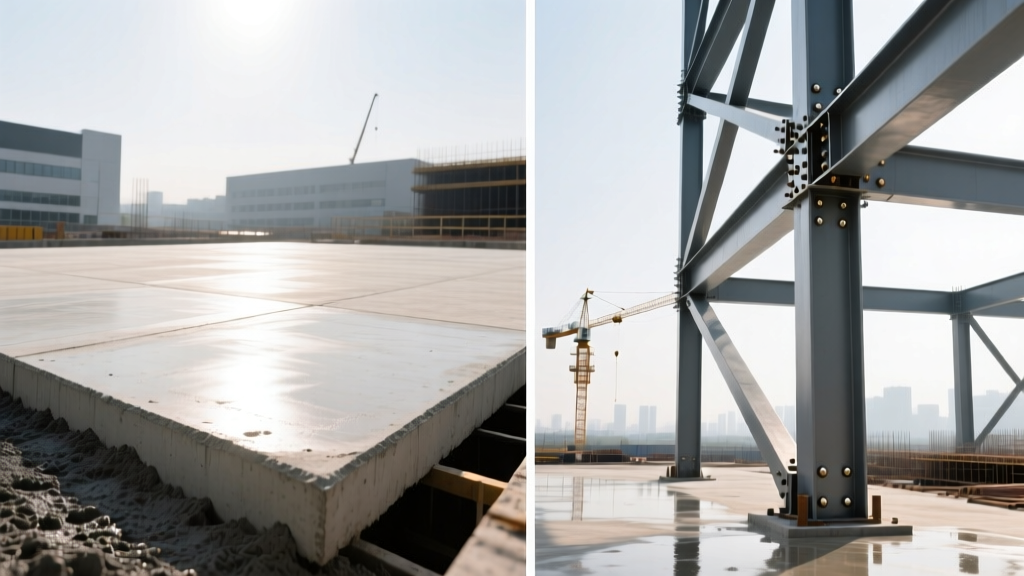
In structures ranging from 4 to 12 stories, the vertical load-bearing system dictates the project timeline and fireproofing budget. High-strength concrete (HPC), utilizing silica fume and high-range water reducers to achieve 8,000 to 12,000 psi, competes directly with structural steel and Cross-Laminated Timber (CLT).
- High-Strength Concrete (HPC): Offers inherent 2-hour to 4-hour fire resistance without additional spray-on fireproofing. Column sizes are larger than steel, reducing net leasable square footage by 2-4%, but the elimination of intumescent coatings saves $4.50 to $7.00 per square foot of structural surface area.
- Structural Steel: Allows for longer, column-free spans (ideal for open-plan offices) and faster erection times. However, supply chain volatility in 2026 has pushed structural steel framing costs up to $38/sq ft in major metros, narrowing the gap with cast-in-place concrete.
- Mass Timber (CLT/Glulam): The premier alternative for developers targeting LEED or WELL certifications due to carbon sequestration. However, mass timber requires specialized acoustic underlayments and concealed sprinkler systems to meet Type IV building codes, adding $8-$12/sq ft in secondary costs.
Complex Formwork: Self-Consolidating Concrete (SCC) vs. Traditional Vibrated
When architectural designs feature intricate form liners, exposed aggregate finishes, or densely reinforced shear walls, traditional concrete mixes require extensive mechanical vibration to prevent honeycombing. Self-Consolidating Concrete (SCC) eliminates the need for vibrators by utilizing polycarboxylate ether (PCE) superplasticizers and optimized aggregate gradations.
Because SCC exerts full hydrostatic pressure on formwork (unlike vibrated concrete which loses pressure as it sets), standard snap-tie systems will fail. You must specify heavy-duty steel or engineered plywood forms with high-tensile tie-rods spaced no more than 12 inches apart. Formwork rental costs will increase by 15-20%, offsetting the labor savings if not planned during the estimating phase.
While SCC carries a material premium of $25 to $40 per cubic yard over standard 4,000 psi mixes, it reduces placement labor time by up to 50%. According to the National Ready Mixed Concrete Association (NRMCA), SCC is mandatory for elements where rebar spacing is less than 3 inches, ensuring complete encapsulation and preventing localized corrosion.
Low-Carbon Enclosures: Geopolymer vs. Rammed Earth vs. Hempcrete
With 2026 building codes aggressively targeting embodied carbon, traditional Ordinary Portland Cement (OPC) is facing competition from alternative binders and bio-based materials.
Geopolymer Concrete
Geopolymer mixes replace OPC entirely with aluminosilicate precursors (like Class F fly ash or ground granulated blast-furnace slag) activated by alkaline solutions (sodium silicate/sodium hydroxide). This reduces the mix's carbon footprint by up to 80%. Geopolymer achieves high early strength and exceptional resistance to sulfate attack, making it ideal for marine environments or wastewater treatment facilities. However, it requires strict temperature control during curing and is currently limited to regional batch plants near industrial byproduct sources.
Bio-Based & Earthen Alternatives
For non-structural or low-rise load-bearing enclosures, rammed earth and hempcrete serve as alternatives to concrete masonry units (CMUs) and cast-in-place walls. Hempcrete (a mix of hemp hurds and a lime binder) offers superior thermal insulation (R-value of ~2.4 per inch) and moisture buffering but possesses negligible compressive strength (typically under 1 MPa), requiring a separate timber or steel structural frame. Rammed earth provides excellent thermal mass but requires specialized pneumatic tamping equipment and highly skilled labor, pushing costs to $45/sq ft of wall area.
Critical Failure Modes & Edge Cases
Selecting the wrong mix or alternative material often results in catastrophic, expensive failures. Avoid these common specification errors:
- Using Standard Mix in Sulfate-Rich Soils: If soil tests reveal high sulfate concentrations, standard Type I cement will undergo thaumasite sulfate attack, turning the concrete into a soft, mushy mass. Fix: Specify Type V cement or a slag-blended geopolymer mix with a w/c ratio below 0.40.
- Asphalt Overlays on Unstable Subgrades: Asphalt is a flexible pavement; it will mirror any cracking in the sub-base (reflective cracking). Fix: If the subgrade has a low California Bearing Ratio (CBR < 5), rigid concrete pavement bridged over geogrid reinforcement is the only viable long-term alternative.
- Ignoring Shrinkage in High-Strength Mixes: HPC mixes with high cementitious content and low w/c ratios experience severe autogenous shrinkage, leading to early-age micro-cracking. Fix: Incorporate internal curing using pre-wetted lightweight fine aggregates or shrinkage-reducing admixtures (SRAs) per ACI 209 guidelines.
Procurement & Specification Checklist
Before finalizing your material schedule, verify the following parameters with your structural engineer and ready-mix supplier:
- Confirm the maximum aggregate size (MSA) aligns with your rebar spacing and formwork depth (typically 1/3 the slab depth or 3/4 the clear spacing between rebars).
- Request Environmental Product Declarations (EPDs) for all proposed concrete mixes to verify embodied carbon claims against local green building mandates.
- For alternative materials like mass timber or rammed earth, verify that local fire marshals have approved the specific assembly details, as regional interpretations of the IBC vary wildly.
Written by
James ThorntonJames Thornton is a construction industry veteran with 25 years of hands-on experience in wood framing, lumber grading, and residential building codes. He started as a framing carpenter in rural Oregon, earned his ICC Residential Building Inspector certification, and eventually became a senior plan reviewer for the City of Portland Bureau of Development Services. James holds a B.S. in Wood Science & Technology from Oregon State University and is a certified lumber grader through the West Coast Lumber Inspection Bureau (WCLIB). He has inspected over 3,000 residential construction sites and authored the city's internal guide on advanced framing techniques (2x6 at 24" O.C.). James lives in Bend, OR, where he builds custom timber-frame cabins and competes in lumberjack sports.
More from James Thornton
View all
Insulation
Best Home Insulation Materials: Complete 2026 Guide
Compare top home insulation materials for 2026. Find R-values, installed costs per square foot, and best uses for fiberglass, spray foam, and mineral wool.
Aug 4, 2026

Sustainable Building
Certify Your Green Building Material for LEED and WELL
Step-by-step guide to certifying a green building material for LEED v5 and WELL v2. Master EPDs, HPDs, and VOC limits for 2026 project specifications.
Aug 4, 2026

Stone & Masonry
Veneer Stacked Stone Panels: Interior Design & Style Showcase
Discover how veneer stacked stone panels transform interiors. Explore modern design profiles, material pairings, and technical installation specs.
Aug 4, 2026