Concrete vs Asphalt Price by Mix Type: 2026 Cost Guide
Compare the 2026 concrete vs asphalt price by mix design. Explore material costs, installation rates, and lifecycle economics for paving projects.
The Core Economics: Initial Concrete vs Asphalt Price
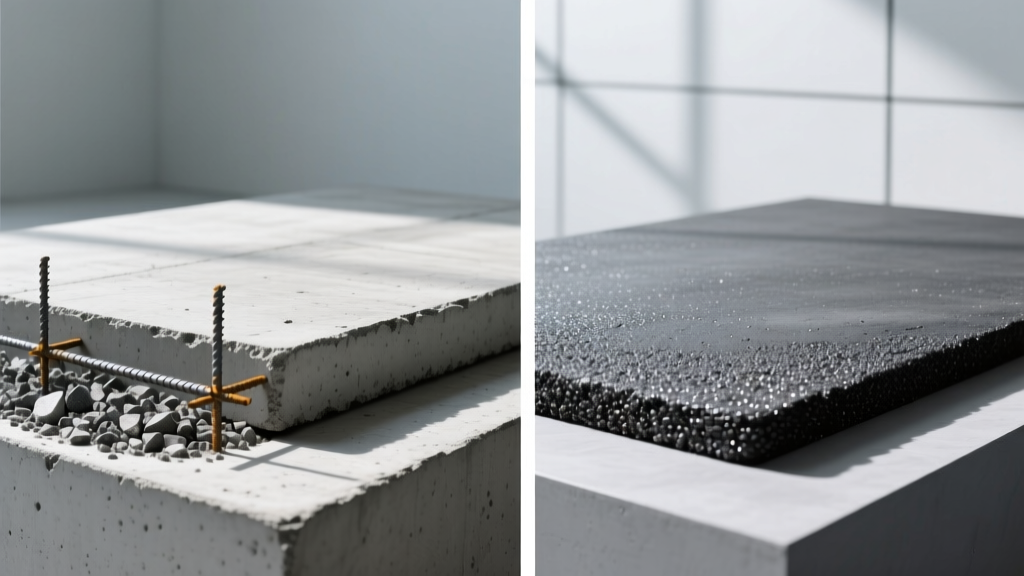
Evaluating the concrete vs asphalt price requires looking past simplistic per-square-foot averages. In 2026, the baseline cost divergence remains stark: standard asphalt paving typically ranges from $4.50 to $7.00 per square foot installed, while standard concrete paving ranges from $9.00 to $14.00 per square foot. However, these baseline figures assume rudimentary mix designs. When structural demands, environmental exposure, and traffic loads require engineered mix modifications, the pricing gap narrows significantly, and in some high-performance scenarios, advanced asphalt mixes can exceed the cost of standard concrete.
- Standard Hot Mix Asphalt (HMA): $110 – $135 per ton
- Standard Ready-Mix Concrete (4,000 PSI): $140 – $165 per cubic yard
How Mix Design Dictates the Final Price Tag
The true cost of any paving project is locked in during the mix design phase. Both concrete and asphalt rely on precise ratios of aggregates, binders, and chemical or mineral modifiers. Altering these ratios to meet specific engineering criteria directly impacts the final invoice.
Concrete Mix Variables and Cost Multipliers
Concrete pricing is heavily influenced by compressive strength (measured in PSI), the water-cement (w/c) ratio, and the inclusion of Supplementary Cementitious Materials (SCMs). A standard 4,000 PSI mix is sufficient for residential driveways and light commercial parking. However, heavy-duty industrial yards or municipal intersections require 5,000 to 6,000 PSI mixes, which demand a lower w/c ratio and higher cement content, adding $15 to $30 per cubic yard.
To mitigate costs and improve durability, modern mix designs frequently incorporate SCMs like Class F fly ash or ground granulated blast-furnace slag (GGBFS). Replacing 20% to 30% of Portland cement with slag not only reduces the carbon footprint but can lower material costs by $5 to $10 per cubic yard while improving long-term strength and workability. Conversely, adding macro-synthetic fibers for secondary reinforcement or utilizing air-entraining admixtures (mandatory in freeze-thaw climates to achieve 5% to 8% air content) will add $8 to $18 per cubic yard to the batch ticket.
Asphalt Mix Variables and Cost Multipliers
Asphalt pricing hinges on the Performance Grade (PG) of the bitumen binder and the aggregate structure. Standard PG 64-22 binder is the workhorse for moderate climates. Upgrading to a polymer-modified binder (PMA) like PG 76-22 to resist rutting in high-heat, heavy-traffic zones increases the liquid asphalt cost by 15% to 25%.
Mix structure also drives price. Standard dense-graded HMA is the most economical. However, Stone Matrix Asphalt (SMA) or Open-Graded Friction Course (OGFC) mixes require higher binder content (up to 6.5% compared to the standard 5%), cellulose stabilizing fibers, and strictly graded coarse aggregates. According to the Asphalt Institute, SMA mixes can cost 15% to 20% more per ton than standard HMA due to these premium materials. On the cost-saving side, incorporating 20% to 30% Reclaimed Asphalt Pavement (RAP) reduces the need for virgin binder and aggregates, shaving $8 to $15 off the per-ton price.
2026 Material & Installation Cost Matrix
The following matrix breaks down the installed costs for various mix designs, factoring in standard 2026 labor rates, subgrade preparation, and equipment mobilization. Data aligns with regional averages tracked by the Federal Highway Administration and industry suppliers.
| Mix Design Type | Primary Application | Material Cost (Unit) | Installed Cost (Per Sq Ft) |
|---|---|---|---|
| Standard HMA (PG 64-22) | Residential driveways, low-volume roads | $110 - $135 / ton | $4.50 - $6.50 |
| Polymer-Modified SMA | Intersections, heavy truck routes | $145 - $170 / ton | $7.00 - $9.50 |
| Standard Concrete (4,000 PSI) | Commercial parking, sidewalks | $140 - $165 / cy | $9.00 - $12.00 |
| Heavy-Duty Concrete (6,000 PSI + Fiber) | Ports, logistics hubs, aircraft aprons | $185 - $220 / cy | $14.00 - $18.50 |
Lifecycle Cost Analysis: Beyond the Initial Quote
Focusing exclusively on the initial concrete vs asphalt price ignores the maintenance realities of pavement management. The National Ready Mixed Concrete Association emphasizes that while concrete demands a higher upfront capital expenditure, its lifecycle maintenance profile is vastly different from asphalt.
Asphalt Lifecycle Realities
- Curing Time: 24-48 hours for light traffic; full cure in 6-12 months.
- Routine Maintenance: Requires crack sealing annually and sealcoating every 3 to 5 years ($1.50 - $2.50 per sq ft per application).
- Lifespan: 15 to 20 years before requiring structural overlay or full-depth reclamation.
- Failure Modes: Rutting under static heavy loads, oxidation, and base-layer water infiltration.
Concrete Lifecycle Realities
- Curing Time: 7 days for 65% strength; 28 days for full design strength.
- Routine Maintenance: Joint resealing every 7 to 10 years; occasional pressure washing. No sealcoating required.
- Lifespan: 30 to 40+ years with proper subgrade drainage and joint maintenance.
- Failure Modes: Joint spalling, subgrade settlement causing slab cracking, and freeze-thaw scaling if air-entrainment is inadequate.
Edge Cases: When Asphalt Beats Concrete (and Vice Versa)
The decision matrix extends beyond simple economics into operational constraints and environmental factors.
When Asphalt is the Superior Choice
- Tight Timelines: Asphalt can be driven on the next day. If a commercial facility cannot afford a 7-day shutdown for concrete curing, asphalt is the only viable option.
- Extreme Cold Climates: While concrete requires air-entrainment to survive freeze-thaw cycles, asphalt's inherent flexibility allows it to withstand minor subgrade frost heaves without catastrophic brittle failure.
- Utility Access: Trenching and patching asphalt for underground utility repairs is significantly cheaper and blends in better than saw-cutting and replacing concrete slabs.
When Concrete is the Superior Choice
- Heavy Static Loads: Logistics yards where loaded semi-trailers park for extended periods will cause asphalt to rut and deform, especially in summer heat. Concrete's rigid structure distributes point loads effectively without deformation.
- Fuel and Chemical Spills: Diesel, oil, and hydraulic fluid leaks rapidly degrade asphalt binder, causing raveling and potholes. Concrete is highly resistant to petroleum-based chemical attacks.
- Nighttime Visibility and Lighting: Concrete's high albedo (light reflectance) reduces the need for high-intensity parking lot lighting, cutting long-term electrical costs and improving security camera visibility.
Expert Verdict: Choosing the Right Pavement Mix
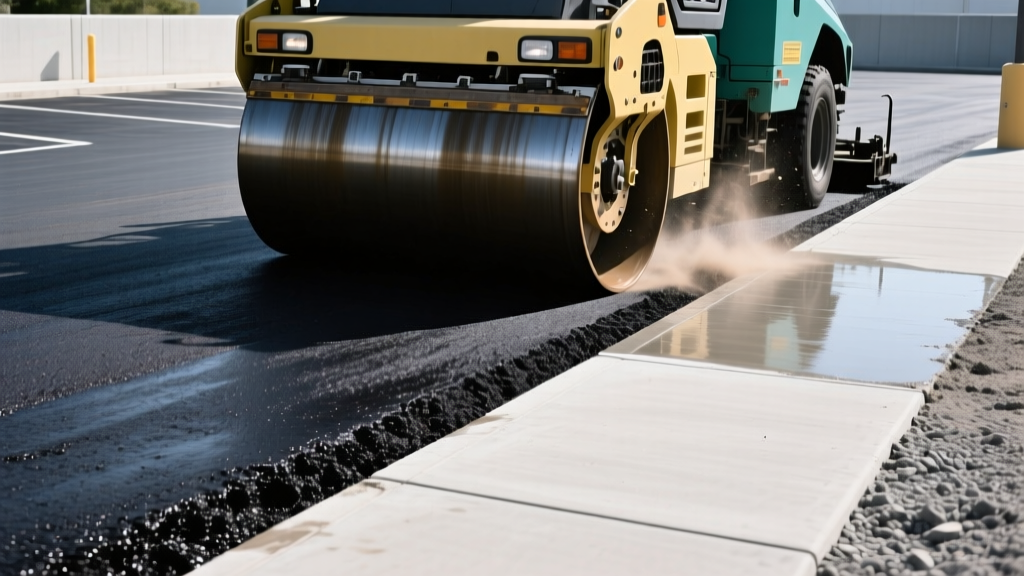
The concrete vs asphalt price debate is ultimately resolved by matching the mix design to the specific operational demands of the site. For high-traffic, heavy-load commercial and industrial applications, the premium paid for a 5,000+ PSI concrete mix with slag substitution and macro-fibers pays for itself within the first decade through eliminated sealcoating and overlay costs. Conversely, for municipal roadways, residential developments, and projects requiring rapid return-to-service, a polymer-modified SMA or RAP-enhanced HMA provides the optimal balance of structural integrity, ride quality, and initial capital efficiency. Always mandate a site-specific geotechnical report to ensure your subgrade preparation matches the structural requirements of your chosen mix design.
Written by
Marcus ChenMarcus Chen is a licensed structural engineer (PE) and building materials analyst with over 12 years of experience across residential, commercial, and industrial construction. He holds a Master of Science in Civil Engineering from UC Berkeley and spent six years at Thornton Tomasetti before transitioning to independent consulting and technical writing. Marcus specializes in material selection for seismic-prone regions, concrete reinforcement strategies, and lifecycle cost analysis. His work has been cited by the American Concrete Institute (ACI) and the Structural Engineers Association of California (SEAOC). When he is not on a job site or at his desk, you will find him hiking the Sierra Nevada or restoring a 1920s craftsman bungalow in Oakland, CA.
More from Marcus Chen
View all
Construction Cost
How Much Did the Eiffel Tower Cost to Build?
How much did the Eiffel Tower cost to build in 1889? We adjust for inflation and compare its budget to modern skyscraper construction.
Aug 4, 2026

Fire Resistance
What Is a Fire Resistant Material? Testing & Certification Guide
Discover what is a fire resistant material through ASTM and UL testing. Learn how fire ratings, certifications, and assemblies work in construction.
Aug 4, 2026

Construction Cost
How Much Did the Burj Khalifa Cost to Build?
How much did the Burj Khalifa cost to build? We break down the $1.5B project and extract 5 money-saving strategies for your next build.
Jul 30, 2026