Concrete Nailer Taxonomy: Selecting Pneumatic, Gas, or Powder
Compare concrete nailer types including pneumatic, gas, and powder-actuated tools. Learn substrate matching, fastener metallurgy, and TCO.
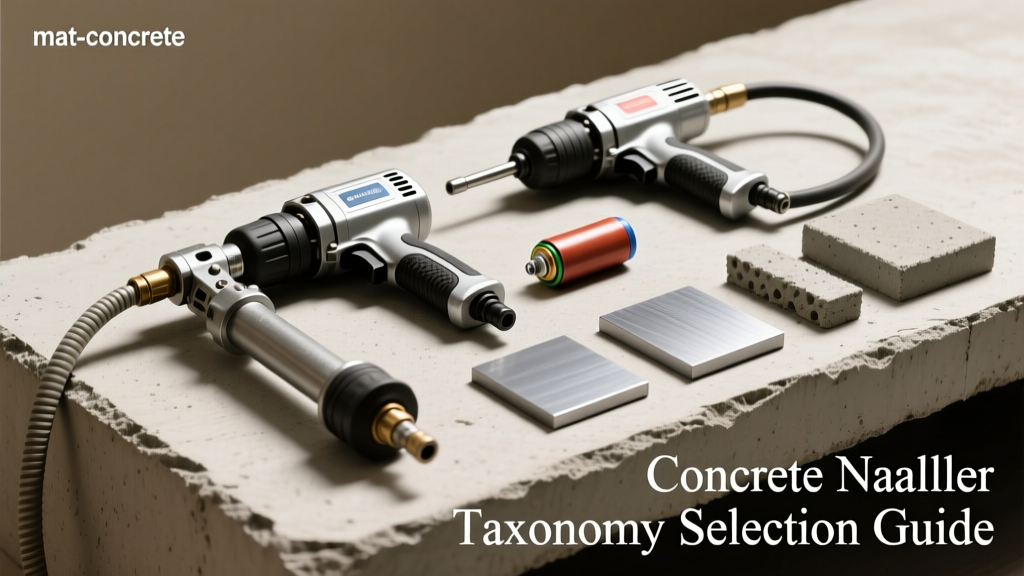
The Fastener Taxonomy: Understanding Concrete Nailer Types
Selecting the correct concrete nailer is not a one-size-fits-all decision. The structural integrity of sill plates, metal framing tracks, and subfloor assemblies relies entirely on matching the driving mechanism to the substrate's compressive strength and the project's volume requirements. Modern concrete fastening systems fall into three distinct taxonomic categories: pneumatic, gas-combustion (cordless), and powder-actuated. Each operates on fundamentally different physics, dictating its ideal use case, consumable cost, and safety profile.
Pneumatic Concrete Nailers (Air-Driven)
Pneumatic concrete nailers, such as the Paslode CN150 or Bostitch MCN-150, utilize compressed air to drive hardened steel masonry nails. These tools require a continuous air supply, typically operating between 90 and 120 PSI. They are the undisputed standard for high-volume, repetitive fastening tasks where a compressor is already on-site, such as securing pressure-treated sill plates to slab foundations in residential framing.
- Power Source: External air compressor (minimum 4 CFM at 90 PSI recommended).
- Fastener Type: Coil-collated masonry nails (smooth or fluted shank).
- Best Application: High-volume wood-to-concrete framing, sill plates, and furring strips.
- Limitation: Tethered to a hose, reducing mobility on large commercial sites or multi-story climbs.
Gas-Combustion & Battery-Hybrid Nailers
Cordless concrete nailers eliminate the compressor requirement, utilizing either gas-combustion cells or advanced battery-spring mechanisms. The Hilti BX 3 ME, powered by the Nuron 22V lithium-ion platform, represents the current apex of this category. Instead of a gas explosion, it uses a battery-driven spring mechanism to drive pins into concrete and steel. Older gas-combustion models rely on a spark-ignited fuel cell (like butane/propane mixes) to create a controlled explosion. While highly mobile, gas-driven tools can suffer from misfires in extreme cold (below 15°F) due to fuel cell vaporization issues.
- Power Source: Lithium-ion battery (spring-driven) or fuel cell + battery spark.
- Fastener Type: Strip-collated specialized concrete and steel pins.
- Best Application: Commercial metal stud track fastening, MEP (mechanical, electrical, plumbing) hanger installation, and overhead concrete work.
- Limitation: High initial tool cost and proprietary consumable ecosystems.
Powder-Actuated Fastening Tools (PAT)
Powder-actuated tools use a controlled chemical explosion from a blank powder load to drive a hardened steel pin. Tools like the Ramset TrakFast or Hilti DX 5 are categorized by caliber (.22 or .27) and feed type (strip or single load). The power level is dictated by color-coded loads. For standard 3,000 PSI residential concrete, a brown (Level 2) or green (Level 3) .22 caliber load is typically sufficient. Red (Level 5) loads are reserved for high-strength structural concrete or steel-to-steel fastening.
- Power Source: .22 or .27 caliber powder loads.
- Fastener Type: Individual or strip-collated hardened steel drive pins with washers.
- Best Application: Heavy-duty structural steel connections, dense commercial concrete, and retrofit anchoring.
- Limitation: Requires specialized OSHA-mandated safety training; high risk of substrate spalling if misapplied.
Substrate Matching: A Decision Matrix
The compressive strength (PSI) and cure time of the concrete substrate dictate which nailer taxonomy will provide adequate holding power without causing catastrophic substrate failure.
| Substrate Condition | Estimated PSI | Recommended Nailer Type | Fastener Shank Requirement |
|---|---|---|---|
| Standard Residential Slab (28+ days) | 2,500 - 3,500 PSI | Pneumatic or Battery-Hybrid | Fluted (for tensile withdrawal) |
| Commercial Structural Slab | 4,000 - 6,000 PSI | Battery-Hybrid or Powder-Actuated | Smooth or Knurled (for shear) |
| High-Strength / Post-Tensioned | 8,000+ PSI | Powder-Actuated (High Load) | Specialized hardened steel pin |
| Lightweight / Aerated Concrete | < 2,000 PSI | Pneumatic (Low PSI setting) | Wide-gauge fluted or screw anchor |
Fastener Metallurgy: Beyond the Tool
The tool is only half the equation; fastener metallurgy and shank geometry determine the ultimate pull-out and shear values. Standard masonry nails are manufactured from high-carbon steel, hardened to a Rockwell C-scale (HRC) of 48-52 to prevent bending upon impact with aggregate.
Shank Geometry: Smooth shank nails excel in shear applications (e.g., securing metal track where lateral movement is the primary force). Fluted or twisted shanks act like taps, cutting into the concrete matrix to provide superior tensile withdrawal resistance, making them mandatory for wood sill plates subject to wind uplift.
Corrosion Protection: Standard electro-galvanized (zinc-plated) pins are suitable for interior, climate-controlled environments. For exterior applications, pressure-treated wood (which contains corrosive copper azole or ACQ preservatives), or high-humidity MEP environments, 316 stainless steel concrete pins or hot-dipped galvanized fasteners are required to prevent galvanic corrosion and subsequent joint failure.
Real-World Failure Modes and Edge Cases
The 'Green Concrete' Trap
Never use powder-actuated tools or high-impact pneumatic nailers on 'green' concrete (cured for less than 28 days). Green concrete retains high moisture content and has not reached its design tensile strength. The kinetic shockwave from a powder load will cause massive internal spalling, blowing out a crater the size of a fist and resulting in zero holding power. Always verify cure time or use mechanical cast-in-place anchors for early-stage fastening.
Edge Spalling and the 3-Inch Rule
Concrete is exceptionally weak in tension. When a nail is driven too close to the edge of a slab or wall, the radial expansion of the shank creates tensile stresses that exceed the concrete's capacity, causing the edge to fracture. Industry standards mandate a minimum edge distance of 3 inches for standard drive pins and 2 inches for specialized low-impact cordless fasteners. If fastening closer to an edge is structurally required, pre-drilling a pilot hole slightly larger than the shank diameter relieves the expansion pressure.
Aggregate Strike and Deflection
Concrete is a heterogeneous mix of cement paste and hard aggregate (river rock or crushed stone). If a nail strikes a piece of quartz or granite aggregate directly, the nail will either shatter, bend, or deflect at a dangerous angle. To mitigate this, contractors utilizing powder-actuated tools should perform a 'test fire' with a center-punch. If the punch leaves a deep crater, the concrete is soft; if it barely dents, you are hitting aggregate or high-strength mix, requiring a reduction in powder load color to prevent pin shatter.
Total Cost of Ownership (TCO) and Consumables
When evaluating concrete nailers, contractors must look beyond the initial tool acquisition cost and calculate the 'cost per drive' (CPD), which includes the fastener, the propellant (air, gas, or powder), and tool maintenance.
| Tool Category | Avg. Tool Cost (2026) | Propellant Cost per Shot | Fastener Cost per Shot | Total Cost Per Drive (CPD) |
|---|---|---|---|---|
| Pneumatic (e.g., Paslode) | $350 - $450 | ~$0.002 (Compressor fuel) | $0.04 - $0.06 | $0.05 |
| Gas-Combustion Cordless | $400 - $600 | $0.08 - $0.12 (Fuel Cell) | $0.08 - $0.12 | $0.18 |
| Battery-Spring (e.g., Hilti BX 3) | $650 - $800 | ~$0.01 (Battery depreciation) | $0.15 - $0.22 | $0.19 |
| Powder-Actuated (.22 Cal) | $150 - $300 | $0.12 - $0.18 (Powder Load) | $0.10 - $0.15 | $0.27 |
While pneumatic systems offer the lowest CPD, the labor cost of dragging hoses and maintaining compressors on large commercial sites often offsets the material savings. Battery-spring systems command a premium on fasteners but drastically reduce labor time and overhead trip hazards.
Safety, Compliance, and Operator Certification
Powder-actuated tools are heavily regulated due to the inherent risks of ballistic projectiles. According to OSHA Standard 1926.302(e), no employee shall use a powder-actuated tool unless they have been specifically trained and are qualified by passing a written and practical exam. Operators must carry their qualification card on-site at all times.
Furthermore, all powder-actuated tools must be equipped with a protective shield or guard at the muzzle end to contain flying fragments in the event of a fastener ricochet or substrate blowout. Operators are required to wear ANSI Z87.1-approved safety glasses and hearing protection. For detailed guidelines on concrete material properties and curing times that affect fastener performance, refer to the technical resources provided by the American Concrete Institute (ACI).
Frequently Asked Questions
Can I use a standard framing nailer on concrete?
No. Standard framing nailers lack the kinetic force to penetrate concrete, and standard steel nails will instantly bend or shatter. You must use a dedicated masonry nailer with hardened, high-carbon steel fluted nails.
Why do my concrete nails keep bending?
Bending usually occurs for two reasons: the concrete PSI exceeds the nail's hardness rating (requiring a switch to powder-actuated pins or pre-drilling), or the nail is striking large aggregate. Shifting the fastener location by one inch usually resolves aggregate deflection.