How Much Did It Cost to Build Alligator Alcatraz Enclosures?
Discover the exact construction costs, materials, and engineering required to build an Alligator Alcatraz maximum-security reptile enclosure in 2026.

The Engineering of Level-4 Crocodilian Containment
In the specialized field of zoo and sanctuary construction, the term 'Alligator Alcatraz' is not a myth; it is the industry colloquialism for a Level-4 maximum containment enclosure. These structures are engineered specifically for apex, highly aggressive, or massive Alligator mississippiensis and Crocodylus acutus specimens that routinely destroy standard exhibits. When facility directors and wildlife contractors evaluate how much did it cost to build Alligator Alcatraz-style pens, the baseline for a 2,000-square-foot maximum-security facility in 2026 ranges from $145,000 to $265,000. This is nearly triple the cost of a standard AZA-compliant herbivore or small reptile exhibit of the same footprint.
Standard zoo enclosures often fail when housing bull alligators exceeding 10 feet in length. These animals possess a bite force exceeding 2,000 pounds per square inch, highly acidic waste that degrades standard building materials, and an innate ability to excavate soil and scale seemingly vertical surfaces. Building an 'Alcatraz' spec pen requires redundant security layers, specialized metallurgy, and heavy-duty aquatic filtration.
The Alligator Alcatraz Line-Item Cost Matrix
The following breakdown reflects 2026 material and labor rates for a 2,000 sq. ft. maximum-security enclosure, including a 1,000 sq. ft. water feature and a 1,000 sq. ft. reinforced concrete basking and staging area.
| Construction Phase | Material Specifications | Estimated Cost Range |
|---|---|---|
| Excavation & Anti-Dig Apron | Earthwork, 4-foot deep L-shaped concrete footer | $22,000 - $34,000 |
| Primary Concrete Shell | 5,000 PSI mix, fiberglass rebar, 100% solids epoxy | $48,000 - $72,000 |
| Overhead Security & Mesh | 316 SS welded mesh, cantilevered steel overhangs | $35,000 - $55,000 |
| Commercial Water Filtration | Drum filters, MBBR bio-filters, UV sterilization | $28,000 - $45,000 |
| Environmental & Heating | Hydronic basking pads, heavy-duty ceramic emitters | $12,000 - $22,000 |
| Permitting & Engineering | Structural engineering, AZA compliance reviews | $10,000 - $18,000 |
| Total Estimated Cost | Turnkey Maximum-Security Facility | $155,000 - $246,000 |
Earthwork and the Anti-Dig Apron
Alligators are capable diggers, particularly when attempting to reach water tables or create nesting burrows. A standard concrete slab poured directly on grade will be undermined within a single season. The 'Alcatraz' standard requires an anti-dig apron: a concrete footer that extends 4 feet vertically into the soil and then bends 3 feet horizontally outward (forming an 'L' shape) beneath the enclosure floor. This requires extensive trenching and tying the apron rebar directly into the main wall reinforcement cage. Skimping on this $22,000+ earthwork phase is the leading cause of catastrophic containment breaches in private sanctuaries.
The 5,000 PSI Concrete Shell
Standard 3,000 PSI concrete used in residential retaining walls is entirely unsuitable for apex crocodilian enclosures. Alligator urine and feces are highly acidic, and the constant moisture accelerates the leaching of lime from standard concrete mixes, leading to rapid spalling and structural degradation. According to guidelines referenced by the American Concrete Institute (ACI) for water-retaining and aggressive chemical environments, facilities must utilize a minimum 5,000 PSI concrete mix with a low water-to-cement ratio (0.40 or less). Furthermore, steel rebar is prone to rust-jacking in these wet environments; modern 'Alcatraz' builds increasingly use GFRP (Glass Fiber Reinforced Polymer) rebar to eliminate corrosion entirely. Once cured, the concrete must be sealed with a 100% solids, marine-grade epoxy coating to create an impermeable, easily sanitized barrier.
Overhead Security: Mesh and Cantilevers
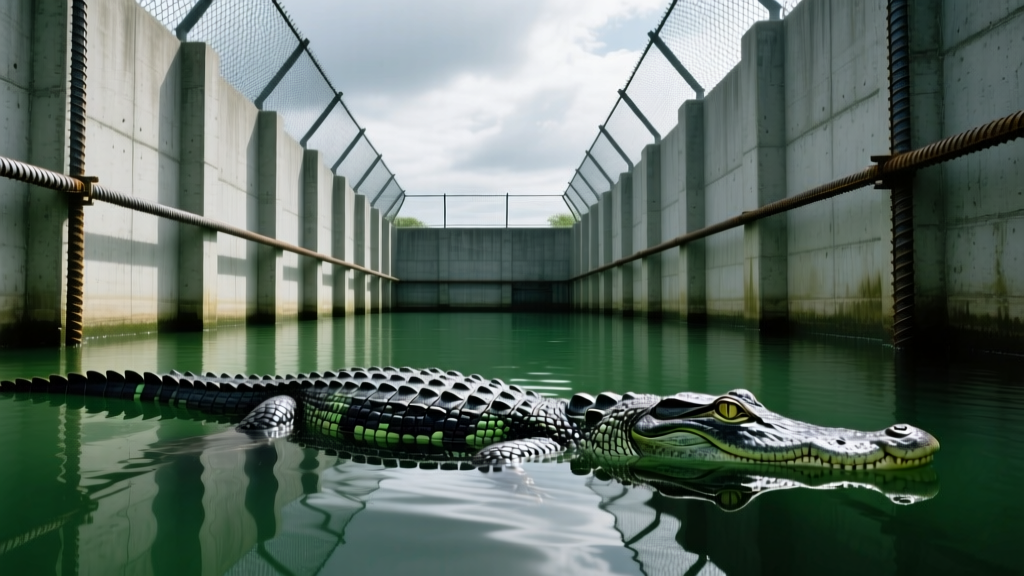
The most fatal error in reptile enclosure construction is the use of galvanized chain-link fencing. A 10-foot bull alligator can easily snap 9-gauge chain link with its jaws or degrade it through constant friction and moisture exposure. Maximum containment requires 316 marine-grade stainless steel woven or welded mesh, with a minimum wire diameter of 1/4 inch (0.25 inches). Every intersection must be TIG-welded; mechanical weaving allows enough flex for a determined animal to pry the joints apart over time.
Expert Insight: Vertical walls alone are insufficient. Alligators can utilize corner bracing, filtration pipes, or even accumulated snow/debris to climb. Every 'Alcatraz' enclosure must feature a 2-foot inward-cantilevered overhang at the top of the perimeter wall, angled at 45 degrees, clad in the same 316 SS mesh to prevent scaling.
High-Bioload Water Filtration Systems
Alligators are messy feeders and produce a massive biological load. A standard pool filter will clog within 48 hours and fail to process the ammonia spikes generated by rotting food matter and waste. The filtration system for a maximum-security enclosure must mirror commercial aquaculture standards. This includes:
- Rotary Drum Filters: For immediate mechanical removal of solid waste and uneaten prey before it breaks down.
- MBBR (Moving Bed Biofilm Reactor): To provide the massive surface area required for nitrifying bacteria to convert lethal ammonia into nitrites, and then into nitrates.
- UV Sterilization: High-output ultraviolet clarifiers to neutralize waterborne pathogens and control algae blooms in the high-nutrient environment.
Facility managers should consult the Association of Zoos and Aquariums (AZA) Crocodilian Care Manual for specific water quality parameters, as maintaining pH between 7.0 and 8.0 and keeping ammonia at 0 ppm is critical for the animal's renal health and the longevity of the concrete infrastructure.
Thermal Regulation and Basking Infrastructure
Apex alligators require precise thermal gradients to digest large meals and maintain immune function. Overhead ceramic heat emitters (CHEs) are standard, but they only heat the surface. For massive specimens, 'Alcatraz' builds incorporate hydronic heating systems embedded directly into the concrete basking pads. PEX tubing is tied to the rebar grid before the concrete pour, connected to a commercial water heater and circulation pump. This provides deep, penetrating belly heat that mimics natural sun-baked earth, preventing the thermal burns associated with animals pressing too closely to localized overhead heat sources.
Regional Permitting and Labor Variances
The final cost multiplier is geographic. Building this facility in Florida or Texas, where crocodilian husbandry is common, benefits from a localized labor force experienced in wildlife containment and streamlined state permitting processes. Conversely, constructing an 'Alcatraz' spec pen in California or the Northeast introduces severe cost premiums. Specialized concrete contractors must be imported, environmental runoff permitting for the high-bioload water system is heavily scrutinized by local EPA equivalents, and winterization requirements (such as insulated, heated indoor staging areas) can add $40,000 to $60,000 to the final ledger.
Project Summary: The Cost of Compromise
When evaluating how much did it cost to build Alligator Alcatraz enclosures, the $155,000 to $246,000 price tag reflects the absolute minimum for ethical, escape-proof containment of apex specimens. Cutting costs on the 5,000 PSI concrete mix, the 316 SS mesh, or the anti-dig apron does not save money; it simply defers the cost to future emergency repairs, animal injury, or catastrophic public safety liabilities. Maximum containment is a non-negotiable engineering standard, not an optional upgrade.
Written by
Sarah WhitfieldSarah Whitfield is a chartered quantity surveyor (MRICS) and construction cost analyst with 15 years of experience in material pricing, procurement strategy, and project budgeting. She earned her degree in Construction Management from the University of Reading (UK) and has worked on projects ranging from $2M custom homes to $180M mixed-use developments across North America and Europe. Sarah currently leads cost estimating for BuildMat Insight, maintaining a proprietary database of 4,000+ material price points updated quarterly. She is a frequent contributor to RSMeans cost data panels and has presented at the International Cost Engineering Council (ICEC) congress. Based in Denver, CO, Sarah is an avid trail runner and volunteer mentor for Women in Construction.
More from Sarah Whitfield
View all
Wood & Lumber
What Are the Different Types of Wood? A Builder's Guide
Compare structural softwoods, finish hardwoods, and engineered lumber. Analyze Janka ratings, MOE values, and 2026 pricing for construction.
Aug 4, 2026

Walls & Panels
Steel Framing vs Wood Framing: Corrosion and Moisture Defense
Compare steel framing vs wood framing for moisture resistance. Learn about galvanized coatings, condensation risks, and corrosion protection strategies.
Jul 21, 2026

Stone & Masonry
How to Cut Stone Veneer: Wet Saw vs Grinder Comparison
Compare the best tools for cutting stone veneer. We review wet saws, angle grinders, and chop saws to help you achieve clean, chip-free cuts.
Jul 21, 2026