2026 Cost to Build a Locker Room Per Square Foot: Budget Guide
Plan your athletic facility budget with our 2026 locker room cost per square foot guide. Breakdowns for materials, HVAC, and value engineering.

The True Baseline: Breaking Down the Per Square Foot Cost
Accurate budget planning for athletic and commercial wet areas requires moving beyond outdated metrics. While many facility directors benchmarked the 2025 cost to build locker room per square foot at a median of $235, the 2026 construction landscape demands a revised approach. Escalations in specialized MEP (Mechanical, Electrical, and Plumbing) requirements, combined with a definitive industry shift away from corrosive metals in wet zones, have restructured the baseline. Today, a realistic budget must account for high-latent-load HVAC systems and advanced moisture mitigation to prevent catastrophic lifecycle failures.
According to current Gordian RSMeans Data, the cost to build a locker room per square foot in 2026 is heavily stratified by the facility's end-use tier. Below is the definitive breakdown for new construction, excluding land acquisition and external site work.
| Facility Tier | Target Demographic | 2026 Cost per Sq Ft | Defining Specifications |
|---|---|---|---|
| Economy / Municipal | High schools, local YMCA, community rec centers | $160 - $240 | Porcelain tile, powder-coated steel lockers, standard VAV HVAC, basic bench seating. |
| Mid-Tier / Collegiate | NCAA D2/D3, private clubs, corporate wellness | $260 - $450 | HDPE phenolic lockers, poured polyurethane flooring, dedicated outdoor air systems (DOAS), custom millwork benches. |
| Elite / Professional | NCAA D1, NFL/NBA/NHL, luxury health clubs | $500 - $850+ | Epoxy terrazzo, solid surface vanities, integrated digital lockers, localized climate control, premium acoustic treatments. |
Material Specifications: Where the Budget Actually Goes
The largest variance in locker room budgeting stems from material selection in high-moisture zones. Specifying the wrong materials to save on initial CapEx inevitably leads to premature OpEx spikes in maintenance and replacement.
Locker Systems: HDPE vs. Powder-Coated Steel
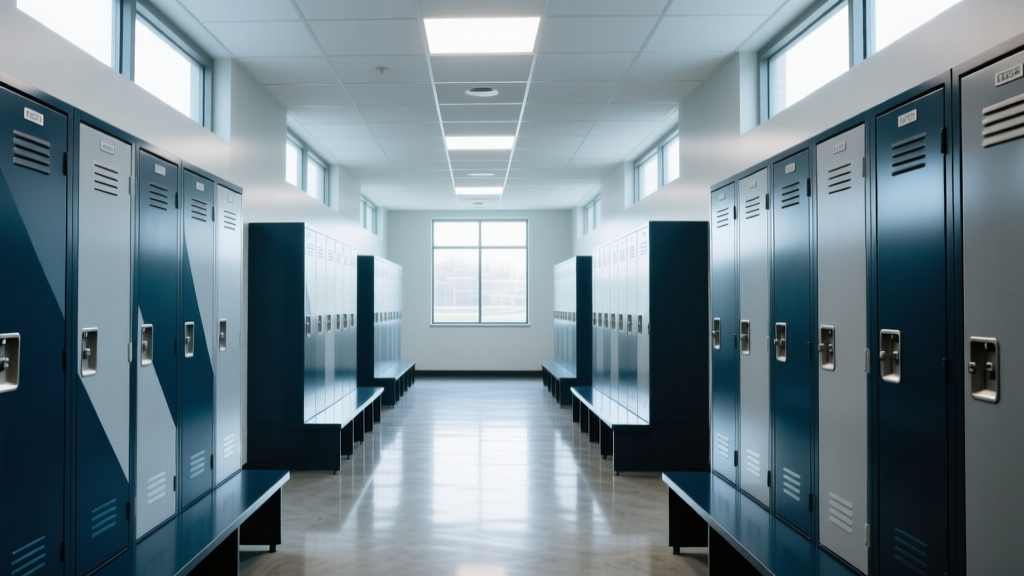
The industry standard has decisively shifted toward High-Density Polyethylene (HDPE) solid plastic lockers, such as those manufactured by Scranton Products or Tufftec.
- HDPE Phenolic Lockers: Costing between $450 and $850 per tier (depending on width and tier configuration), HDPE is impervious to moisture, will not rust, and requires zero painting. The 20-year lifecycle cost is significantly lower due to the elimination of corrosion-related replacements.
- Powder-Coated Steel: Priced at $150 to $250 per tier, steel remains the default for strict economy budgets. However, in wet environments, even high-quality powder coating will eventually chip, leading to rust propagation within 5 to 7 years.
Flooring Systems: Navigating Wet Area Durability
Flooring must balance slip resistance (DCOF > 0.42 per ANSI A326.3) with impermeability.
- Poured Polyurethane: ($7 - $11 per sq ft installed). Seamless, highly chemical resistant, and offers excellent underfoot comfort. Ideal for mid-tier shower and locker zones.
- Epoxy Terrazzo: ($14 - $22 per sq ft installed). The gold standard for elite facilities. It offers a seamless, non-porous surface with a 40+ year lifespan, but requires specialized subcontractors and extensive subfloor preparation.
- Porcelain Tile with Epoxy Grout: ($9 - $15 per sq ft installed). If tile is specified, you must mandate 100% solids epoxy grout (e.g., Mapei Kerapoxy) rather than standard cementitious grout to prevent mold infiltration and staining.
The Hidden Budget Killers: MEP and Moisture Mitigation
HVAC: Managing High Latent Loads
Locker rooms and showers generate massive latent (moisture) loads. Standard Variable Air Volume (VAV) systems are fundamentally inadequate for modern facilities. Current ASHRAE Standard 62.1 guidelines dictate rigorous ventilation rates for wet areas.
Facilities must budget for a Dedicated Outdoor Air System (DOAS) equipped with an Energy Recovery Ventilator (ERV) or desiccant wheel. This allows the system to aggressively dehumidify incoming air without overcooling the space. Expect specialized locker room HVAC to add $18 to $28 per square foot to your mechanical budget, a non-negotiable expense for preventing condensation on ceilings and inside locker cavities.
Waterproofing: Beyond the Tile Backer
Standard drywall with a coat of waterproof paint is a guaranteed failure point. For all shower enclosures and wet transition zones, specify a bonded waterproof sheet membrane system, such as Schluter Kerdi or LATICRETE Hydro Ban. While adding $4 to $6 per square foot in material costs, these systems create a continuous, impenetrable barrier that protects the structural framing from vapor drive and hydrostatic pressure.
Value Engineering Matrix: Smart Substitutions
When the initial estimating phase exceeds the capital allocation, facility planners must execute strategic value engineering. The goal is to reduce initial costs without compromising the 20-year lifecycle of the facility. The National Intramural-Recreational Sports Association (NIRSA) frequently advises focusing on operational durability over aesthetic luxury in high-traffic zones.
| Component | Premium Choice (Target) | Value Alternative (Substitution) | Est. Savings | Performance Trade-off |
|---|---|---|---|---|
| Countertops | Quartz or Solid Surface (Corian) | High-Pressure Laminate (HPL) with phenolic core | $12 - $18 / linear ft | HPL is highly durable if edges are properly sealed; vulnerable to standing water pooling. |
| Lighting | Architectural linear LED pendants | IP65-rated LED vapor-tight troffers | $40 - $65 / fixture | Less aesthetic appeal, but provides superior moisture protection and uniform lux levels. |
| Shower Partitions | Floor-to-ceiling phenolic privacy stalls | HDPE standard height partitions with privacy strips | $300 - $500 / stall | Slightly reduced privacy and acoustic dampening, but maintains 100% moisture resistance. |
| Millwork | Custom marine-grade plywood vanities | Pre-fabricated stainless steel trough sinks | 15% - 20% of millwork budget | Industrial aesthetic, but eliminates wood rot risks and reduces plumbing rough-in complexity. |
Step-by-Step Capital Allocation Framework
To ensure your budget remains balanced throughout the design-build process, utilize this percentage-based allocation framework. This model assumes a mid-tier collegiate or private club facility (approx. 4,000 sq ft) and helps prevent over-investing in finishes while under-funding infrastructure.
- Sitework and Shell Integration (10-15%): Includes tying into existing campus or municipal water/sewer lines, which often require heavy civil work if the facility is an addition.
- MEP Infrastructure (30-35%): The most critical phase. Includes DOAS HVAC units, high-capacity water heaters (consider commercial heat pump water heaters for energy rebates), and complex drainage sloping.
- Interior Finishes and Moisture Mitigation (25-30%): Encompasses waterproofing membranes, flooring systems, wall protection (e.g., FRP or ceramic tile up to 8 feet), and acoustic ceiling treatments.
- FF&E (Furniture, Fixtures, and Equipment) (15-20%): HDPE lockers, benches, towel valets, digital access control systems, and sanitary accessories.
- Contingency and Commissioning (10%): Mandatory for wet areas. Commissioning (Cx) ensures the HVAC balancing and waterproofing flood tests are verified before walls are closed in.
Frequently Asked Questions on Locker Room Budgeting
How much does it cost to add a digital access control system to lockers?
Upgrading from standard key locks to RFID or Bluetooth digital locks (such as those by Digilock or Trilogy) adds approximately $85 to $140 per door. For a 200-locker facility, expect an added FF&E budget of $17,000 to $28,000, plus the cost of central management software licensing.
Are heat pump water heaters viable for large locker room showers?
Yes, and they are highly recommended for 2026 builds. Commercial CO2 heat pump water heaters can reduce water heating energy costs by up to 50% compared to natural gas boilers. While the initial equipment cost is 30% to 40% higher, local utility rebates and federal energy incentives often offset the premium, yielding a 3-to-5-year ROI.
What is the most common cause of budget overruns in locker room construction?
Unforeseen subsurface plumbing conflicts and inadequate structural reinforcement for heavy flooring systems. Epoxy terrazzo and large-format porcelain tiles require extremely rigid subfloors (L/360 deflection limits) to prevent grout cracking. Failing to specify structural stiffening during the schematic design phase leads to expensive change orders during framing.
Written by
David NakamuraDavid Nakamura is a licensed architect (AIA) and construction technology writer focused on sustainable building methods, mass timber engineering, and high-performance building envelopes. He holds a Master of Architecture from the University of Washington and is a certified Passive House Consultant (CPHC). David spent eight years at the Seattle firm Mithun, where he led the design of three LEED Platinum projects, before founding his own practice specializing in net-zero residential design. He serves on the editorial advisory board of GreenBuilder Magazine and has authored peer-reviewed papers on cross-laminated timber (CLT) connections for the Journal of Structural Engineering. In his spare time, David teaches woodworking at Pratt Fine Arts Center and kayaks the Puget Sound.
More from David Nakamura
View all
Construction Cost
Labor Cost to Build a Deck Per Sq Ft: 2026 Installation Guide
Discover the exact labor cost to build a deck per sq ft in 2026. This installation guide breaks down contractor rates, complexity factors, and hidden fees.
Aug 4, 2026

Construction Cost
How Much Does It Cost to Build a 3 Bedroom House? Financing Guide
Learn exactly how much it costs to build a 3 bedroom house and explore 2026 financing options, construction loan types, and budget frameworks for your build.
Aug 4, 2026

Construction Cost
Cost to Build a Tennis Court: 2026 Guide
How much does it cost to build a tennis court in 2026? Breakdowns for asphalt, concrete, and synthetic surfaces plus fencing and lighting.
Jul 30, 2026