Automatic Car Wash Cost to Build: In-Bay vs Tunnel
Compare the automatic car wash cost to build for in-bay rollovers versus express tunnels. Analyze CapEx, equipment, and ROI metrics.
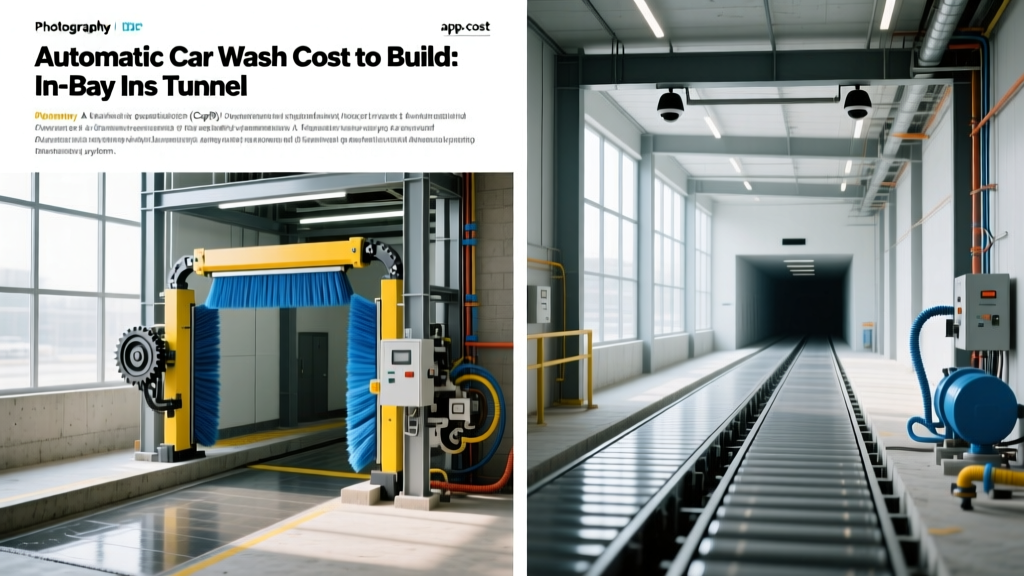
The Core Dilemma: In-Bay vs. Tunnel Car Wash Models
Estimating the automatic car wash cost to build requires moving beyond generic averages and dissecting the two dominant automated models: the In-Bay Automatic (IBA) rollover and the Express Exterior Tunnel. The capital expenditure (CapEx) divergence between these two formats is massive, driven primarily by land acquisition, site engineering, and mechanical complexity. While an IBA can be deployed on a compact infill lot as an ancillary revenue stream for a gas station, an express tunnel is a high-volume, destination retail operation requiring specialized municipal infrastructure and significant front-end capital.
Capital Expenditure (CapEx) Breakdown: Where the Money Goes
The total cost to build an automatic car wash spans five primary categories: land and site work, building construction, wash equipment, water/utility infrastructure, and technology integration. According to the U.S. Small Business Administration, accurately forecasting these startup costs is critical for securing commercial real estate financing, as lenders typically require a detailed line-item breakdown before approving SBA 7(a) or 504 loans for specialized facilities.
| Cost Category | In-Bay Automatic (Dual Bay) | Express Tunnel (100-ft) | Full-Service Tunnel (120-ft) |
|---|---|---|---|
| Land & Site Prep (Grading, Paving) | $150,000 - $350,000 | $400,000 - $900,000 | $600,000 - $1,200,000 |
| Building, Canopies & Stacking Lanes | $200,000 - $400,000 | $800,000 - $1,500,000 | $1,200,000 - $2,200,000 |
| Wash Equipment & Installation | $300,000 - $500,000 | $850,000 - $1,400,000 | $1,200,000 - $2,000,000 |
| Water Reclaim, Pumps & Utilities | $60,000 - $110,000 | $150,000 - $280,000 | $200,000 - $350,000 |
| POS, Entry Terminals & Tech | $15,000 - $30,000 | $40,000 - $75,000 | $60,000 - $110,000 |
| Total Estimated CapEx | $725,000 - $1,390,000 | $2,240,000 - $4,155,000 | $3,260,000 - $5,860,000 |
Equipment Deep Dive: Rollover vs. Conveyor Systems
The mechanical heart of the facility dictates not only the initial build cost but the long-term maintenance and throughput capabilities. The International Carwash Association (ICA) notes that equipment selection must align strictly with the target demographic's vehicle profile and the site's physical constraints.
In-Bay Automatic (Rollover) Equipment
IBA systems are stationary-vehicle, moving-gantry machines. They are categorized into touchless (high-pressure water and chemicals) and friction (cloth or foam brushes).
- Touchless Systems: Models like the PDQ LaserWash 360 or Coleman Wash Systems Optima rely on precisely calibrated robotic nozzles. A single touchless unit costs between $160,000 and $220,000. They require higher chemical concentrations and more robust water heating systems, increasing utility OpEx.
- Friction Systems: Machines like the MacNeil Wash Systems Vortex or Istobal M'NEX utilize contoured foam brushes. These units range from $130,000 to $180,000. They offer superior cleaning for heavy road grime but require stricter maintenance schedules to prevent brush-induced micro-scratching on modern clear coats.
Express Tunnel Equipment
Tunnels utilize a continuous conveyor chain (typically a ProLink or similar heavy-duty belt) that pulls the vehicle through a series of stationary arches. A 100-foot express tunnel requires a highly orchestrated sequence of pre-soak arches, high-pressure rinse manifolds, mitter brushes, top-blasters, and contour dryers.
- Conveyor & Drive Systems: The foundational belt and guide rail system costs $150,000 to $250,000.
- Wash Arches & Applicators: Manufacturers like Sonny's The CarWash Factory or MacNeil supply modular arches. A complete 100-foot wash sequence (excluding dryers) averages $450,000 to $700,000.
- Drying Systems: Modern contour dryers (e.g., Sonny's AirForce) track the vehicle's profile to optimize airflow, costing $120,000 to $200,000 for a multi-nozzle array.
Hidden Costs & Infrastructure Requirements
First-time developers frequently underestimate the subterranean and municipal costs associated with automatic car washes. The physical building is often cheaper than the concrete and plumbing beneath it.
⚠️ Critical Warning: Municipal Tap Fees and Reclaim Mandates
Before purchasing land, request the municipality's water and sewer tap fee schedule. In many metropolitan areas, commercial water tap fees for a high-volume tunnel can exceed $150,000. Furthermore, many jurisdictions now mandate closed-loop water reclamation systems. According to the U.S. Environmental Protection Agency (EPA), water reuse technologies are increasingly regulated at the local level to preserve municipal aquifers. A commercial-grade water reclaim system (such as those from Aqua Chemicals or Ecolab) capable of recovering 85% of wash water adds $75,000 to $140,000 to the build cost, plus the excavation of massive subterranean settling tanks.
The Stacking Lane Imperative
For tunnel washes, the building footprint is secondary to the stacking lane. A 100-foot tunnel processing 120 cars per hour requires a minimum 150-foot to 200-foot stacking lane to prevent vehicles from backing up into the public roadway. This demands an additional 8,000 to 12,000 square feet of heavily reinforced, sloped concrete paving, adding $100,000 to $180,000 in site work costs.
Operational Expenses (OpEx) & ROI Comparison
The automatic car wash cost to build is only half the financial equation; operational leverage determines long-term viability.
- Labor: An IBA is fundamentally an unmanned or semi-manned operation, requiring 0 to 2 employees per shift (primarily for site maintenance and chemical restocking). An express tunnel requires 5 to 12 employees per shift to manage the loading dock, POS terminals, and post-wash towel stations. At current labor rates, a tunnel's payroll burden can exceed $400,000 annually.
- Utilities & Chemicals: Tunnels achieve economies of scale. While a tunnel uses more total water per hour, the chemical and water cost per vehicle drops significantly compared to an IBA, which must heat and pressurize water for a single vehicle at a time.
- Throughput Ceiling: A dual-bay IBA maxes out at roughly 30-40 cars per hour. A standard express tunnel easily processes 100-140 cars per hour. If your market research indicates a peak weekend demand exceeding 600 vehicles, an IBA will artificially cap your revenue potential due to queue abandonment.
Decision Framework: Which Model Fits Your Site?
Use this structural decision matrix to align your real estate parameters with the correct wash model:
Choose an In-Bay Automatic (IBA) if:
- Your usable land parcel is under 15,000 square feet.
- The site is an infill lot or an appendage to an existing fuel/convenience retail center.
- Local labor markets are prohibitively expensive or severely constrained.
- Your total capitalization limit is strictly under $1.5 million.
Choose an Express Tunnel if:
- You have acquired a minimum of 30,000 to 40,000 square feet with high-visibility arterial road frontage.
- Market feasibility studies show a catchment area of 50,000+ households within a 10-minute drive time.
- You intend to build a subscription-based recurring revenue model (unlimited wash clubs), which requires high-speed throughput to service members efficiently.
- You have secured commercial financing in the $3M to $5M range.
Frequently Asked Questions
How long does it take to build an automatic car wash?
From groundbreaking to grand opening, an In-Bay Automatic typically takes 6 to 9 months to construct. An express tunnel is a more complex commercial build, requiring 12 to 18 months due to extensive underground plumbing, heavy equipment rigging, and municipal utility integration.
Do touchless car washes cost more to operate than friction washes?
Yes. Touchless systems rely on higher water temperatures (often requiring commercial boiler systems running at 140°F+) and more aggressive, concentrated chemical formulations to break the static bond of dirt without physical agitation. This results in a 15% to 25% higher utility and chemical cost per vehicle compared to friction-based foam brush systems.
What is the ROI timeline for a new express tunnel?
Assuming a well-executed unlimited wash club marketing strategy and favorable site demographics, a modern express tunnel typically reaches operational break-even within 18 to 24 months, with investors targeting a full capital return (ROI) within 5 to 7 years. This is highly dependent on land costs and local market saturation.
Written by
Marcus ChenMarcus Chen is a licensed structural engineer (PE) and building materials analyst with over 12 years of experience across residential, commercial, and industrial construction. He holds a Master of Science in Civil Engineering from UC Berkeley and spent six years at Thornton Tomasetti before transitioning to independent consulting and technical writing. Marcus specializes in material selection for seismic-prone regions, concrete reinforcement strategies, and lifecycle cost analysis. His work has been cited by the American Concrete Institute (ACI) and the Structural Engineers Association of California (SEAOC). When he is not on a job site or at his desk, you will find him hiking the Sierra Nevada or restoring a 1920s craftsman bungalow in Oakland, CA.
More from Marcus Chen
View all
Construction Cost
How Much Did the Eiffel Tower Cost to Build?
How much did the Eiffel Tower cost to build in 1889? We adjust for inflation and compare its budget to modern skyscraper construction.
Aug 4, 2026

Fire Resistance
What Is a Fire Resistant Material? Testing & Certification Guide
Discover what is a fire resistant material through ASTM and UL testing. Learn how fire ratings, certifications, and assemblies work in construction.
Aug 4, 2026

Construction Cost
How Much Did the Burj Khalifa Cost to Build?
How much did the Burj Khalifa cost to build? We break down the $1.5B project and extract 5 money-saving strategies for your next build.
Jul 30, 2026