Average Cost to Build an App for Construction Estimating: Scope Guide
Calculate the average cost to build an app for construction estimating. Break down MVP, mid-size, and enterprise scopes with 2026 feature pricing.

The True Average Cost to Build an App for Construction Estimating
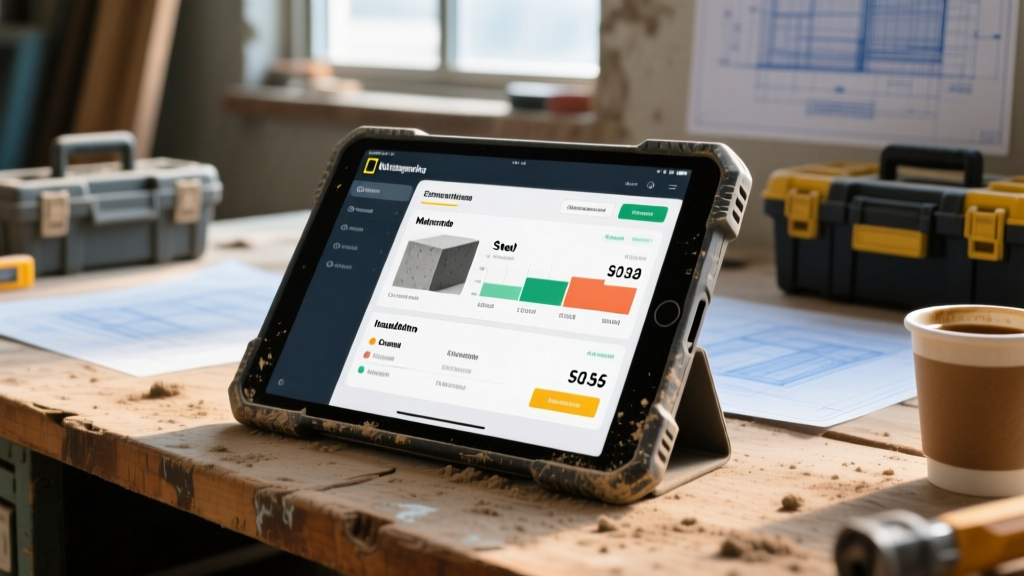
When general contractors, custom home builders, and specialty subcontractors evaluate proprietary software, the primary question is always financial: what is the average cost to build an app tailored specifically for construction estimating and takeoffs? Unlike generic SaaS products, a custom estimating application requires specialized architecture to handle offline job-site conditions, complex material database syncing, and heavy CAD/PDF rendering.
In 2026, the average cost to build an app for construction estimating ranges from $45,000 for a localized Minimum Viable Product (MVP) to $350,000+ for a fully integrated enterprise platform. This variance is entirely dictated by the size and scope of the feature set. Below is a comprehensive size and scope calculator framework to help construction firm owners and operations managers budget accurately for custom estimating software development.
Size & Scope Calculator: Pricing Tiers for Contractor Apps
Development costs are calculated by multiplying the estimated engineering hours by the blended hourly rate of your development team. For US-based nearshore teams (e.g., Latin America), expect blended rates of $75–$110/hour. For US-domestic teams, rates average $140–$220/hour. The matrix below outlines the three primary scope tiers for estimating applications.
| App Tier | Target User Base | Core Scope & Features | Est. Dev Hours | Average Cost Range (Nearshore) |
|---|---|---|---|---|
| MVP (Tier 1) | Single crew or small GC (1-10 users) | Basic line-item estimating, manual material entry, PDF markup, local device storage, simple PDF export. | 500 - 800 | $45,000 - $85,000 |
| Mid-Size (Tier 2) | Regional contractor (10-50 users) | Cloud sync, offline-first architecture, QuickBooks integration, supplier API price pulling, multi-user bid collaboration. | 1,200 - 2,000 | $110,000 - $210,000 |
| Enterprise (Tier 3) | National firm / Franchise (50+ users) | LiDAR automated takeoffs, RSMeans database integration, ERP syncing, custom assembly builders, AI-assisted plan reading. | 2,500 - 4,500+ | $250,000 - $450,000+ |
Feature Cost Breakdown: The Scope Multipliers
To build a precise budget, you must isolate the specific construction-tech features that drive up engineering hours. Standard CRUD (Create, Read, Update, Delete) screens are inexpensive; construction-specific hardware integrations and data-heavy workflows are where costs multiply.
1. Offline-First Architecture & Conflict Resolution
Job sites frequently lack reliable cellular service. An estimating app cannot rely on continuous cloud connectivity. Building an "offline-first" app requires implementing local databases (like SQLite or Realm) and complex sync logic using Conflict-free Replicated Data Types (CRDTs). When an estimator updates a material quantity offline, and a project manager updates the same line item on the server, the app must resolve the conflict without data loss. Cost Impact: Adds 150–250 engineering hours ($15,000–$25,000) compared to standard cloud-only apps.
2. Supplier API & Material Database Integration
Hardcoding material prices guarantees outdated estimates. Mid-size and enterprise apps integrate with live supplier APIs (e.g., Beacon, Home Depot Pro, or specialized lumber yard ERPs) and standardized databases like RSMeans. This requires building secure OAuth pipelines, webhooks for price-change alerts, and fallback caching mechanisms if the supplier API goes down. Cost Impact: Adds 120–200 hours ($12,000–$20,000).
3. LiDAR and AR Takeoffs
Modern estimating leverages hardware to eliminate manual measuring. By integrating Apple's ARKit and Android's ARCore, estimators can use iPad Pro or iPhone Pro LiDAR sensors to scan a room and automatically generate square footage and linear foot takeoffs for drywall, flooring, and paint. Cost Impact: Adds 250–400 hours ($25,000–$40,000) due to complex 3D spatial mapping and point-cloud data processing.
4. Heavy PDF and CAD Rendering Engine
Construction blueprints (Arch D or Arch E size PDFs, or DWG files) are massive. Native mobile PDF viewers will crash when loading a 150-page structural drawing set. Developers must implement custom tiling engines that render only the visible viewport of the blueprint, alongside a vector-based markup layer for highlighting takeoff areas. Cost Impact: Adds 180–300 hours ($18,000–$30,000).
Many contractors request "full QuickBooks integration" without defining the scope. Pushing a finalized estimate into QuickBooks Online as a single invoice takes roughly 40 hours to build. However, syncing individual estimate line items to specific QuickBooks Classes, Items, and Customer Jobs—and handling bi-directional sync when a bookkeeper changes a code—can easily consume 250+ hours. Define your accounting sync as strictly one-way (push-only) for your MVP to save $20,000+.
Hidden Cost Traps in Construction Tech Development
Beyond the initial build, construction software carries specific operational and compliance costs that frequently catch contractors off guard.
- SOC 2 Compliance & Security: If your app handles sensitive client financial data, bid amounts, or proprietary contractor margins, enterprise clients will demand SOC 2 Type II compliance. Achieving this requires implementing strict RBAC (Role-Based Access Control), audit logging, and encryption at rest. Budget an additional $25,000–$40,000 for compliance engineering and third-party auditing.
- Backend Scaling for File Storage: Blueprint storage scales rapidly. Using standard AWS S3 storage is cheap, but the data egress fees (downloading those massive blueprints to field tablets) and CDN (CloudFront) caching costs can hit $1,500–$3,000/month for a mid-sized firm. Implementing aggressive local caching on the device level is mandatory to control cloud bills.
- App Store Enterprise Distribution: If the app is strictly for internal employees, bypassing the public Apple App Store via Apple Business Manager (Custom Apps distribution) requires an Apple Developer Enterprise Program membership ($299/year) and strict MDM (Mobile Device Management) setup.
Build vs. Buy Decision Matrix
Before committing $150,000 to custom development, evaluate whether existing SaaS platforms (like Procore, Buildertrend, or Houzz Pro) meet 80% of your needs. Use this framework to decide:
| Criteria | Buy Existing SaaS (e.g., Buildertrend) | Build Custom Estimating App |
|---|---|---|
| Estimating Workflow | Standardized; forces you to adapt to their logic. | Bespoke; matches your exact assembly and labor-burden formulas. |
| Time to Value | Immediate (Days to weeks for onboarding). | Delayed (6 to 12 months for MVP launch). |
| Long-Term Cost (5 Yrs) | $50k - $150k (Scaling per-user SaaS licensing fees). | $200k - $400k (Upfront build + 20% annual maintenance). |
| Competitive Advantage | None; your competitors use the exact same software. | High; proprietary speed and accuracy in bidding. |
Ongoing Maintenance: The 20% Rule
The average cost to build an app is only the entry fee. In 2026, the industry standard for annual maintenance is 18% to 22% of the initial development cost. For a $150,000 mid-size estimating app, expect to pay $27,000–$33,000 annually. This covers:
- OS Updates: Apple and Google release major OS updates annually. Changes to background processing permissions or local storage limits frequently break offline-sync logic, requiring immediate patching.
- API Deprecations: Third-party APIs (like QuickBooks or supplier databases) version their endpoints. When an API v2 is deprecated, your backend engineers must rewrite the integration layer.
- Server & Infrastructure: Monthly AWS/Google Cloud hosting, database management, and CI/CD pipeline hosting (e.g., GitHub Actions, Vercel).
By mapping your exact feature requirements against the size and scope calculator above, construction executives can move beyond vague software estimates and secure hard numbers for their proprietary estimating technology investments.
Written by
Marcus ChenMarcus Chen is a licensed structural engineer (PE) and building materials analyst with over 12 years of experience across residential, commercial, and industrial construction. He holds a Master of Science in Civil Engineering from UC Berkeley and spent six years at Thornton Tomasetti before transitioning to independent consulting and technical writing. Marcus specializes in material selection for seismic-prone regions, concrete reinforcement strategies, and lifecycle cost analysis. His work has been cited by the American Concrete Institute (ACI) and the Structural Engineers Association of California (SEAOC). When he is not on a job site or at his desk, you will find him hiking the Sierra Nevada or restoring a 1920s craftsman bungalow in Oakland, CA.
More from Marcus Chen
View all
Construction Cost
How Much Did the Eiffel Tower Cost to Build?
How much did the Eiffel Tower cost to build in 1889? We adjust for inflation and compare its budget to modern skyscraper construction.
Aug 4, 2026

Fire Resistance
What Is a Fire Resistant Material? Testing & Certification Guide
Discover what is a fire resistant material through ASTM and UL testing. Learn how fire ratings, certifications, and assemblies work in construction.
Aug 4, 2026

Construction Cost
How Much Did the Burj Khalifa Cost to Build?
How much did the Burj Khalifa cost to build? We break down the $1.5B project and extract 5 money-saving strategies for your next build.
Jul 30, 2026