Average Cost to Build a House in GA: 2026 Regional Price Guide
Discover the average cost to build a house in GA for 2026. Explore regional pricing, red clay foundation costs, and coastal building codes.
Georgia's Construction Landscape: What to Expect in 2026
Building a custom home in Georgia offers distinct advantages, from diverse topography to a generally business-friendly regulatory environment. However, the average cost to build a house in GA is not a monolithic figure. It fluctuates wildly depending on whether you are breaking ground in the dense urban corridors of Metro Atlanta, the hurricane-prone coastal plains of Savannah, or the rocky, mountainous terrain of North Georgia. According to recent data from the U.S. Census Bureau, the South region continues to lead the nation in new residential construction starts, but localized material supply chains and labor availability dictate your final ledger.
• Statewide Average Base Cost: $145 to $215 per square foot (excluding land).
• Standard 2,000 sq. ft. Home: $290,000 to $430,000.
• Primary Cost Drivers: Expansive red clay soil mitigation, high-SEER2 HVAC requirements, and county-specific water/sewer impact fees.
Breaking Down the Average Cost to Build a House in GA
To accurately budget your project, you must separate hard costs (materials and labor) from soft costs (permits, engineering, and design). The table below outlines the estimated hard construction costs across different home tiers in Georgia for 2026.
| Home Tier | Cost per Sq. Ft. | 2,000 Sq. Ft. Total | Typical Specifications |
|---|---|---|---|
| Budget / Spec | $145 - $165 | $290k - $330k | Vinyl siding, asphalt shingles, slab-on-grade, standard builder-grade cabinets. |
| Mid-Range Custom | $175 - $215 | $350k - $430k | HardiPlank siding, dimensional roof, engineered hardwood, quartz counters. |
| High-End Luxury | $250 - $350+ | $500k - $700k+ | Masonry exteriors, standing seam metal roof, smart home integration, custom millwork. |
The Red Clay Factor: Foundation Realities in the Piedmont
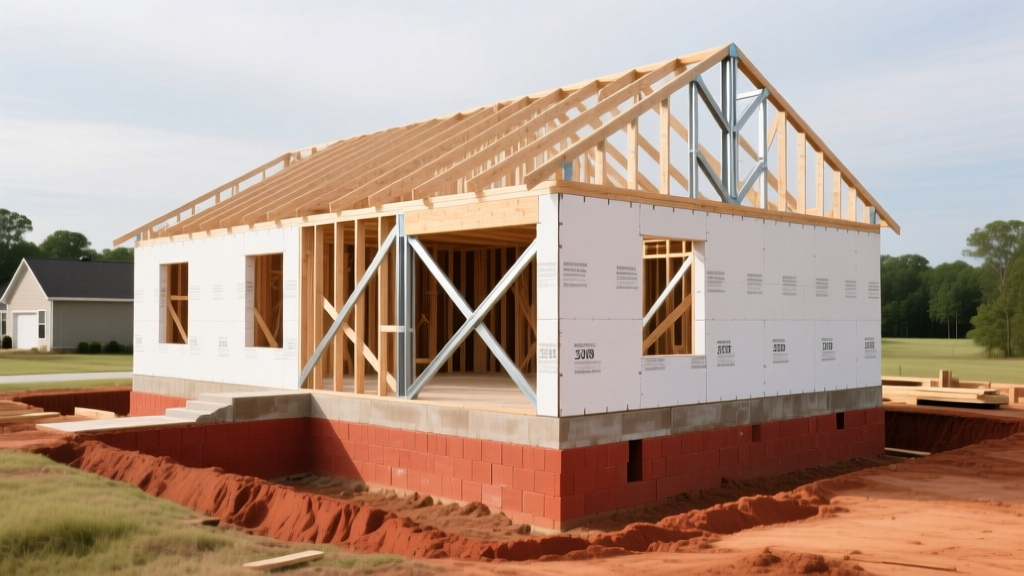
One of the most critical, yet frequently underestimated, variables in Georgia construction is the soil. The Georgia Piedmont region (encompassing Atlanta, Athens, and Macon) is dominated by expansive red clay. This soil type swells significantly when wet and shrinks during droughts, exerting immense hydrostatic pressure on concrete foundations.
Required Soil Mitigation Strategies
- Geotechnical Engineering Report: Mandatory for most custom builds. Expect to pay $1,500 to $3,000 for soil boring and analysis.
- Void Cartons (Carton Forms): Used beneath grade beams and slab-on-grade foundations to create a gap that accommodates soil expansion. Adds $2.50 to $4.00 per square foot of foundation area.
- Post-Tension Slabs: Steel cables are tensioned after the concrete cures, compressing the slab and preventing cracking from soil movement. Adds roughly $1.50 to $2.50 per square foot compared to standard rebar-reinforced slabs.
- Over-excavation and Backfill: In severe cases, contractors must remove 2 to 4 feet of native clay and replace it with compacted engineered fill, which can add $5,000 to $12,000 to your site-work budget.
Climate-Specific MEP and Envelope Costs
Georgia's climate demands rigorous attention to Mechanical, Electrical, and Plumbing (MEP) systems, as well as the building envelope. The Georgia Department of Community Affairs (DCA) enforces strict energy and building codes that directly impact your bottom line.
"In Georgia, your HVAC system isn't just about comfort; it's about moisture management. Undersizing the latent heat removal capacity will lead to mold issues inside the wall cavities within the first three years of occupancy." — Senior HVAC Design Engineer, Atlanta Metro Area.
HVAC Sizing and Efficiency: While the federal minimum is 14 SEER2, building science experts in Georgia strongly recommend 16 SEER2 or higher systems with variable-speed blowers to handle extreme summer humidity. Budget an additional $3,500 to $6,000 over base builder-grade units for a high-efficiency heat pump system with advanced dehumidification.
Insulation and Air Sealing: To prevent humid outdoor air from infiltrating the cooling envelope, closed-cell spray foam insulation (like Icynene or Demilec) is increasingly standard in mid-to-high-tier builds. Expect to pay $1.20 to $1.50 per board foot. For a standard 2,500 sq. ft. home, this translates to $8,000 to $12,000, but it drastically reduces long-term energy loads and prevents condensation on interior drywall.
Regional Variations: Metro vs. Coastal vs. Rural
The average cost to build a house in GA shifts dramatically based on your specific county and topography.
1. Metro Atlanta (Fulton, Cobb, Gwinnett, Cherokee)
Labor premiums are highest here due to the cost of living and high demand for skilled trades. Furthermore, suburban counties impose steep impact fees. For example, water and sewer tap fees in rapidly growing northern suburbs can range from $3,500 to over $7,000 per lot. Site preparation is also costly due to dense tree-save ordinances and rocky sub-surfaces requiring blasting or heavy mechanical excavation.
2. Coastal Georgia (Chatham, Glynn, Camden)
Building near the coast introduces stringent wind-load and flood-zone requirements. According to standards tracked by the National Association of Home Builders, coastal resilience adds significant upfront costs. You must budget for:
- Hurricane Strapping and Tie-Downs: Continuous load path framing is mandatory. Adds $1,500 to $3,000 in hardware and specialized labor.
- Impact-Resistant Glazing: Windows and doors must meet Miami-Dade or equivalent high-velocity hurricane zone (HVHZ) standards. Impact windows cost 30% to 50% more than standard dual-pane Low-E glass.
- Elevated Foundations: If located in an AE or VE flood zone, your home must be elevated on piling or stem walls above the Base Flood Elevation (BFE), adding $15,000 to $35,000 to foundation costs.
3. North Georgia Mountains (Fannin, Gilmer, Union)
The primary cost drivers here are logistics and site work. Steep slopes require extensive retaining walls (often modular block or poured concrete, costing $40 to $75 per square foot of wall face). Furthermore, the lack of municipal water and sewer means you must install a private well ($5,000 to $12,000 depending on bedrock depth) and a septic system ($8,000 to $15,000 for engineered drip-dispersal systems required in poor-draining mountain soils).
Hidden Soft Costs and Regulatory Hurdles
First-time custom builders often fixate on the cost of lumber and concrete, ignoring the soft costs that can consume 15% to 25% of the total project budget.
- Architectural and Engineering Fees: Custom plans typically cost 5% to 10% of the hard construction costs. For a $400,000 build, expect to pay $20,000 to $40,000 for full architectural, structural, and MEP engineering drawings.
- Lot Clearing and Grading: In Georgia, clearing a single acre of dense pine and hardwood forest, including stump grinding and grading for drainage, averages $4,000 to $8,000.
- Driveway and Utilities: Running a temporary power pole, trenching for underground utilities, and pouring a 50-foot concrete driveway can easily add $10,000 to $18,000 before the house framing even begins.
- Builder Overhead and Profit (O&P): A reputable custom home builder in Georgia will charge 15% to 20% O&P on top of the hard and soft costs to manage the project, secure subcontractor warranties, and carry builder's risk insurance.
Actionable Framework: Budgeting Your GA Build
To ensure your project remains financially viable, follow this sequential budgeting framework before purchasing land or signing a builder contract:
Step 2: Calculate the "True" Cost Per Square Foot. Take your builder's base quote and add 20% for site work, utility taps, and landscaping. A $180/sq. ft. quote quickly becomes $216/sq. ft. when site development is factored in.
Step 3: Allocate a 10% Contingency for Weather and Supply Chain. Georgia's spring and summer thunderstorms can delay foundation pours and framing by weeks, increasing carrying costs on your construction loan. Maintain a strict 10% cash reserve to cover loan interest extensions and sudden material price spikes.
Understanding the nuanced, regional variables that dictate the average cost to build a house in GA is the difference between a financially successful project and a stalled job site. By anticipating the realities of expansive soils, strict coastal wind codes, and county-level impact fees, you can engineer a budget that reflects the true cost of building in the Peach State.
Written by
David NakamuraDavid Nakamura is a licensed architect (AIA) and construction technology writer focused on sustainable building methods, mass timber engineering, and high-performance building envelopes. He holds a Master of Architecture from the University of Washington and is a certified Passive House Consultant (CPHC). David spent eight years at the Seattle firm Mithun, where he led the design of three LEED Platinum projects, before founding his own practice specializing in net-zero residential design. He serves on the editorial advisory board of GreenBuilder Magazine and has authored peer-reviewed papers on cross-laminated timber (CLT) connections for the Journal of Structural Engineering. In his spare time, David teaches woodworking at Pratt Fine Arts Center and kayaks the Puget Sound.
More from David Nakamura
View all
Construction Cost
Labor Cost to Build a Deck Per Sq Ft: 2026 Installation Guide
Discover the exact labor cost to build a deck per sq ft in 2026. This installation guide breaks down contractor rates, complexity factors, and hidden fees.
Aug 4, 2026

Construction Cost
How Much Does It Cost to Build a 3 Bedroom House? Financing Guide
Learn exactly how much it costs to build a 3 bedroom house and explore 2026 financing options, construction loan types, and budget frameworks for your build.
Aug 4, 2026

Construction Cost
Cost to Build a Tennis Court: 2026 Guide
How much does it cost to build a tennis court in 2026? Breakdowns for asphalt, concrete, and synthetic surfaces plus fencing and lighting.
Jul 30, 2026