Cost to Build a House in Pittsburgh: 2026 Money-Saving Guide
Discover the true cost to build a house in Pittsburgh in 2026. Learn local money-saving strategies for foundations, materials, and seasonal timing.

2026 Baseline: The True Cost to Build a House in Pittsburgh
Calculating the exact cost to build a house in Pittsburgh requires looking beyond national averages. Western Pennsylvania's unique topography, strict adherence to the Pennsylvania Uniform Construction Code (UCC), and distinct seasonal shifts create a localized pricing matrix that catches many out-of-state builders and first-time developers off guard. As of early 2026, the baseline cost to build a house in Pittsburgh ranges from $165 to $245 per square foot for semi-custom production builds, while fully custom architectural homes on challenging terrain frequently exceed $325 per square foot.
2026 Pittsburgh Construction Data Snapshot
- Average 2,000 sq. ft. Build Cost: $330,000 - $490,000 (excluding land)
- Average Lot Preparation (Sloped): $18,000 - $35,000
- Frost Line Depth Requirement: 44 inches minimum
- Prevailing Labor Premium: 12-18% higher than national rural averages
According to regional data tracked by the U.S. Census Bureau Building Permits Survey, Allegheny County and its surrounding suburbs (like Cranberry Township, Mt. Lebanon, and Murrysville) continue to see high demand for new single-family starts. However, squeezing the maximum ROI out of your budget requires a hyper-local approach to value engineering.
Topography and Soil: Slashing Foundation and Excavation Costs
The most notorious budget killer in Pittsburgh real estate is the region's topography. The city and its immediate suburbs are defined by steep hillsides, river valleys, and dense, clay-heavy soil intermixed with shale bedrock. If you are evaluating vacant land, the slope of the lot will dictate your foundation costs more than the square footage of the home.
The Slope Penalty: Retaining Walls vs. Walk-Out Designs
Building on a steep incline often necessitates engineered retaining walls and extensive cut-and-fill excavation. A structurally sound, engineer-stamped segmental retaining wall over six feet high can cost between $150 and $250 per square foot of face area. To save tens of thousands of dollars, pivot your architectural strategy:
- Opt for Walk-Out Basements: Instead of fighting the slope with retaining walls, design a walk-out or look-out basement. This utilizes the natural grade, reduces the need for massive earth retention, and provides premium natural light to the lower level, effectively increasing your livable square footage without expanding the home's footprint.
- Helical Piers on Shale: In areas where excavating through dense shale to reach the 44-inch frost line is prohibitively expensive, consult a geotechnical engineer about helical piers. While the upfront material cost is higher, the elimination of heavy rock-breaking equipment and massive concrete pours can yield a net savings of 15% to 20% on difficult sites.
Pittsburgh's heavy clay soil retains water and expands during freeze-thaw cycles. Never downgrade your perimeter drainage system to save money. Mandate the installation of a 4-inch perforated PVC French drain wrapped in filter fabric, surrounded by washed #57 limestone gravel. Skipping this $2,500 upgrade risks catastrophic hydrostatic pressure damage to your foundation walls.
Material Substitutions: Achieving the 'PGH Look' for Less
Pittsburgh architecture heavily favors traditional masonry, brick facades, and natural stone accents. However, the labor cost for union-affiliated or highly skilled masons in Western Pennsylvania commands a steep premium. You can achieve the exact same aesthetic durability by utilizing advanced composite materials.
| Material Type | Installed Cost (per sq. ft.) | Longevity & Maintenance | Best Local Application |
|---|---|---|---|
| Traditional Clay Brick | $14.00 - $22.00 | 100+ years; requires tuckpointing | Historic district infills, luxury custom |
| James Hardie Fiber Cement | $8.50 - $13.00 | 30-50 years; paint every 15 years | Primary exterior cladding, damp valleys |
| Manufactured Stone Veneer (MSV) | $11.00 - $16.00 | 50+ years; zero maintenance | Skirting, accent pillars, chimney chases |
| Premium Vinyl Siding | $5.50 - $8.00 | 25-40 years; wash annually | Rear elevations, budget-conscious builds |
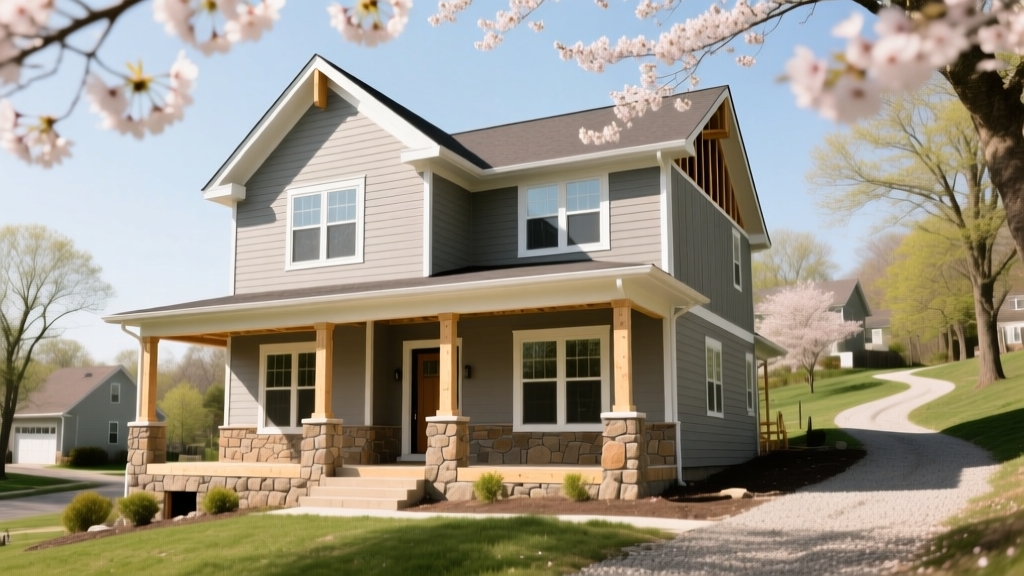
By utilizing Manufactured Stone Veneer (MSV) like Cultured Stone or ProVia for the lower third of the exterior and James Hardie fiber cement for the upper levels, you replicate the classic Pittsburgh streetscape aesthetic while reducing exterior cladding costs by up to 35%. Furthermore, fiber cement resists the moisture rot that plagues wood siding in the humid Monongahela and Ohio river valleys.
Climate-Smart Scheduling: Beating the Allegheny Winter
When planning the cost to build a house in Pittsburgh, the calendar is just as important as the blueprint. Western Pennsylvania experiences a brutal freeze-thaw cycle from late November through March. Attempting to pour foundations or frame exteriors during this window introduces severe winter construction premiums.
The Hidden Costs of Winter Building
If your schedule forces you to pour concrete when ambient temperatures drop below 40°F, you must pay for cold-weather concreting protocols. This includes:
- Chemical Accelerators: Adding calcium chloride or non-chloride accelerating admixtures costs an additional $8 to $15 per cubic yard.
- Insulating Blankets: Renting and placing thermal curing blankets over fresh footings and slabs adds $0.50 to $1.00 per square foot.
- Ground Thawing: If the subgrade freezes before the pour, contractors must use hydronic thawing mats or temporary enclosures with diesel heaters, which can add $3,000 to $8,000 to a single foundation phase.
Code Compliance and Hidden Regional Fees
Local municipalities enforce the PA UCC rigorously, and specific environmental factors in Allegheny, Washington, and Westmoreland counties mandate additional construction line items that do not exist in other parts of the country.
Radon Mitigation: A Non-Negotiable Expense
The Environmental Protection Agency (EPA) classifies nearly all of Western Pennsylvania as Radon Zone 1, indicating predicted average indoor radon levels greater than 4 pCi/L. While a passive radon venting system (rough-in) costs about $400 to $600 during the foundation pour, retrofitting an active mitigation system with an inline fan after the slab is cured costs between $1,500 and $2,500. Always install the passive sub-slab depressurization piping during the initial concrete pour. It is the single easiest way to save $1,000+ on future environmental compliance.
Tap-In Fees and Utility Moratoriums
Before purchasing land, verify the status of municipal water and sewer tap-ins. In rapidly expanding northern suburbs like Cranberry and Mars, tap-in fees can range from $12,000 to $18,000 per lot, and some authorities periodically issue moratoriums on new connections due to treatment plant capacity limits. If your lot requires a private septic system and well due to municipal limits, budget an additional $20,000 to $30,000 for engineered sand-mound septic systems, which are frequently required due to the region's shallow bedrock and poor percolation rates.
Frequently Asked Questions: Pittsburgh Construction Costs
Is it cheaper to build or buy an existing home in Pittsburgh?
In 2026, buying an existing home is generally cheaper upfront, with median existing home prices in Allegheny County hovering around $230,000. However, older Pittsburgh homes (many built before 1950) often require massive capital expenditures for updated knob-and-tube wiring, terracotta sewer line replacements, and asbestos abatement. Building new costs more initially but locks in modern energy efficiency and zero maintenance costs for the first decade.
How much do architectural and engineering fees add to the budget?
For a custom build, expect to pay 8% to 12% of the total construction cost for architectural plans, structural engineering, and geotechnical soil testing. On a $400,000 build, this translates to $32,000 to $48,000. Never skip the geotechnical soil test (approx. $1,500); discovering a subterranean shale shelf or high water table mid-excavation will result in change orders that dwarf the cost of the initial test.
What is the most cost-effective heating system for a new Pittsburgh build?
Given the local utility rates and cold winters, a dual-fuel system (an electric air-source heat pump paired with a natural gas furnace backup) offers the best lifecycle cost. According to efficiency data cited by the National Association of Home Builders (NAHB), optimizing your building envelope with 2x6 exterior walls filled with closed-cell spray foam and R-60 attic insulation will reduce your heating load so drastically that the initial premium for high-end HVAC equipment is eliminated.
Written by
Sarah WhitfieldSarah Whitfield is a chartered quantity surveyor (MRICS) and construction cost analyst with 15 years of experience in material pricing, procurement strategy, and project budgeting. She earned her degree in Construction Management from the University of Reading (UK) and has worked on projects ranging from $2M custom homes to $180M mixed-use developments across North America and Europe. Sarah currently leads cost estimating for BuildMat Insight, maintaining a proprietary database of 4,000+ material price points updated quarterly. She is a frequent contributor to RSMeans cost data panels and has presented at the International Cost Engineering Council (ICEC) congress. Based in Denver, CO, Sarah is an avid trail runner and volunteer mentor for Women in Construction.
More from Sarah Whitfield
View all
Wood & Lumber
What Are the Different Types of Wood? A Builder's Guide
Compare structural softwoods, finish hardwoods, and engineered lumber. Analyze Janka ratings, MOE values, and 2026 pricing for construction.
Aug 4, 2026

Walls & Panels
Steel Framing vs Wood Framing: Corrosion and Moisture Defense
Compare steel framing vs wood framing for moisture resistance. Learn about galvanized coatings, condensation risks, and corrosion protection strategies.
Jul 21, 2026

Stone & Masonry
How to Cut Stone Veneer: Wet Saw vs Grinder Comparison
Compare the best tools for cutting stone veneer. We review wet saws, angle grinders, and chop saws to help you achieve clean, chip-free cuts.
Jul 21, 2026