Average Cost to Build a House in North Carolina by Region & Size
Discover the average cost to build a house in North Carolina. Compare regional pricing, material costs, and labor rates across NC in 2026.
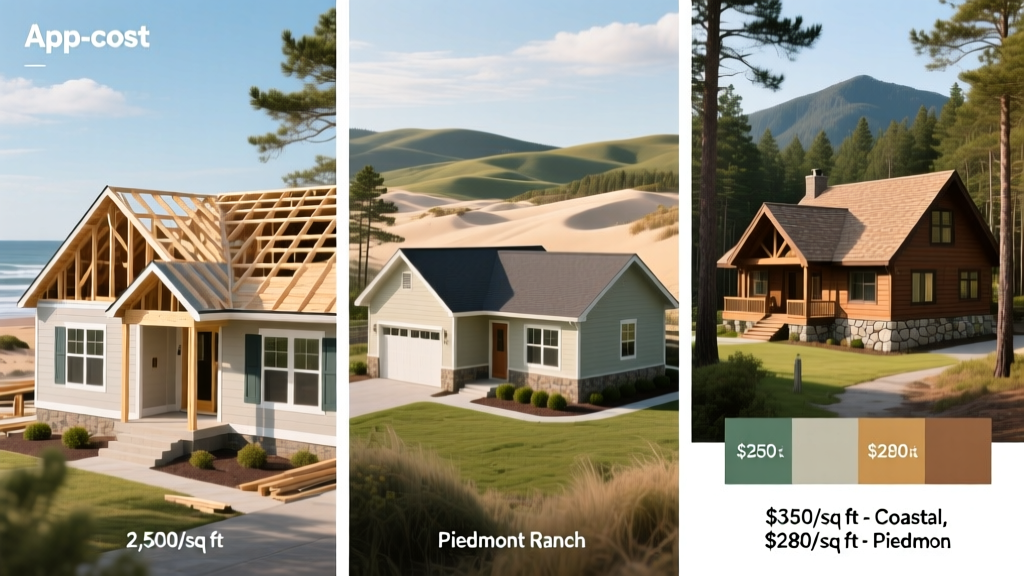
The True Average Cost to Build a House in North Carolina
Calculating the average cost to build a house in North Carolina requires moving beyond generic national estimates. As of 2026, the baseline cost for a standard, builder-grade single-family home in the state ranges from $155 to $225 per square foot, excluding land acquisition and site preparation. For a typical 2,000-square-foot residence, this translates to a hard construction cost between $310,000 and $450,000.
• Statewide Average per Sq Ft: $185
• Entry-Level Build (Production): $140 - $165 / sq ft
• Custom Build (Mid-Range): $190 - $260 / sq ft
• Luxury/High-Performance: $300+ / sq ft
According to data tracked by the National Association of Home Builders (NAHB), regional disparities in North Carolina are among the widest in the Southeast. A production build in a rural county operates on a completely different margin structure than a custom coastal build governed by stringent wind-load codes.
Regional Cost Matrix: Charlotte vs. Raleigh vs. Asheville vs. Coast
North Carolina's diverse topography creates distinct micro-markets. Labor availability, material transport logistics, and local municipal codes drastically alter the final ledger. Below is a comparative matrix detailing the estimated cost per square foot and primary cost drivers across the state's four major building regions.
| Region | Avg Cost / Sq Ft | Labor Index | Primary Cost Drivers |
|---|---|---|---|
| Triangle (Raleigh/Durham) | $180 - $245 | High | Permitting delays, high land premiums, subcontractor demand. |
| Metrolina (Charlotte) | $170 - $230 | Moderate-High | Urban infill logistics, strict tree-canopy ordinances, brick masonry standards. |
| Mountains (Asheville) | $200 - $280 | Moderate | Steep slope grading, retaining walls, well/septic installations, winter build delays. |
| Coastal (Wilmington/OBX) | $220 - $320 | High | Elevated foundations, hurricane strapping, impact windows, corrosion-resistant fasteners. |
The North Carolina Home Builders Association (NCHBA) frequently highlights that coastal and mountain builds suffer from site-work shock. In the Outer Banks, driving helical piles or constructing reinforced block crawl spaces to meet FEMA and state floodplain requirements can add $35,000 to $60,000 to the foundation budget alone before a single wood stud is framed.
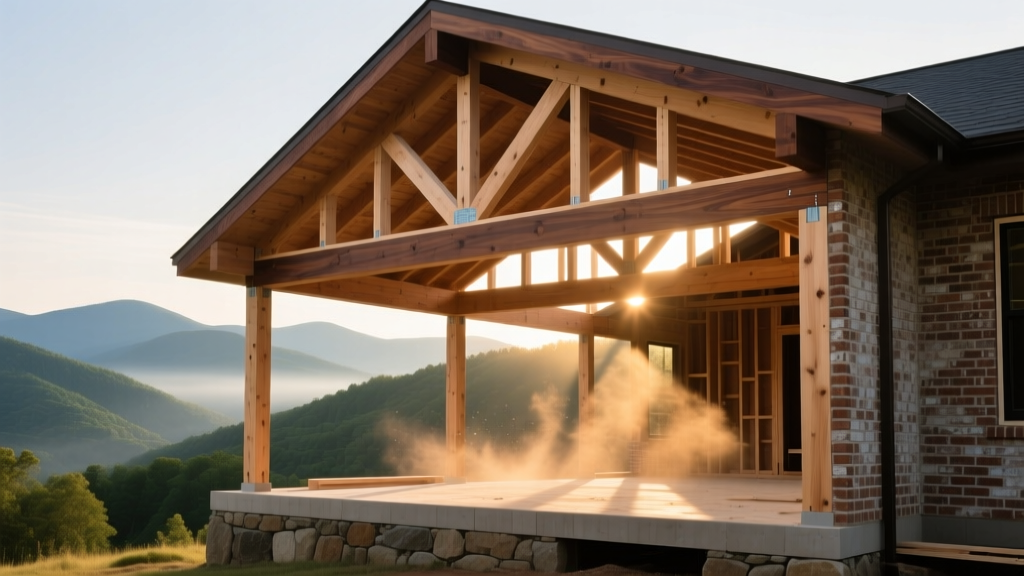
Size and Scope: How Square Footage Shifts the Baseline
Economies of scale apply heavily to residential construction. As the footprint increases, the cost per square foot generally decreases because high-ticket fixed items (HVAC systems, kitchen appliances, primary bathroom fixtures, and site mobilization) are distributed over a larger area.
| Home Size | Estimated Total Cost (Piedmont Region) | Cost per Sq Ft | Typical Configuration |
|---|---|---|---|
| 1,500 sq ft | $285,000 - $330,000 | $190 - $220 | 3 Bed / 2 Bath, Slab Foundation, Vinyl Siding |
| 2,000 sq ft | $350,000 - $420,000 | $175 - $210 | 3 Bed / 2.5 Bath, Crawlspace, Brick Front |
| 2,800 sq ft | $475,000 - $580,000 | $169 - $207 | 4 Bed / 3 Bath, Hardwoods, Full Brick Ext. |
| 3,500+ sq ft | $630,000 - $850,000+ | $180 - $242 | Custom finishes, luxury appliances, multi-zone HVAC |
Note that the cost per square foot for homes over 3,500 square feet begins to climb again. This is because buyers building at this scale typically upgrade to high-end structural materials, custom millwork, and advanced smart-home wiring, which outpaces the economy of scale.
Material and Labor Breakdown for NC Builders
Exterior Cladding: Brick vs. Fiber Cement
In the Piedmont and central regions, traditional brick veneer remains the dominant exterior cladding, driven by neighborhood architectural covenants and buyer preference. Expect to pay $9.50 to $13.00 per square foot of wall area for a standard modular brick installation. However, in mountain and coastal regions, James Hardie fiber cement siding is the superior choice. It resists the woodpecker damage common in heavily wooded mountain lots and stands up to salt spray and high-humidity warping far better than vinyl or wood. Fiber cement installation runs $8.00 to $11.50 per square foot.
HVAC and Moisture Control
North Carolina's climate demands aggressive moisture management. A standard 87% AFUE gas furnace won't suffice for the humid summers. Builders must spec a minimum 15 SEER2 heat pump system. Furthermore, the NC Building Code heavily scrutinizes crawl space moisture. Budget $3,500 to $5,500 for a fully sealed, conditioned crawl space with a 12-mil polyethylene vapor barrier, perimeter French drains, and a dedicated dehumidifier. Skipping this step in eastern NC is a guaranteed path to structural rot and mold litigation.
Hidden Costs Unique to North Carolina Construction
Out-of-state buyers and first-time custom builders frequently overlook region-specific line items that inflate the final invoice.
- Wood Destroying Organism (WDO) Treatment: Termites are a severe threat in NC. A pre-construction soil treatment (like Termidor) and physical termite barriers add $1,200 to $2,500 to the foundation phase.
- Septic and Well Systems: In rural counties (e.g., Moore, Chatham, or mountain counties), municipal utilities are unavailable. An engineered septic system for poor-draining clay soils can cost $12,000 to $22,000, while a 300-foot deep well drilling and pump setup runs $8,000 to $14,000.
- Coastal Wind Mitigation: Homes built in the 130 mph wind zone (coastal counties) require structural sheathing upgrades, continuous load-path hurricane straps, and impact-resistant glazing. This structural hardening adds roughly 8% to 12% to the total framing and dry-in budget.
- Driveway and Grading: Mountain lots often require extensive cut-and-fill grading and retaining walls. A 100-foot paved driveway with a 15% grade and a segmental block retaining wall can easily exceed $25,000.
Expert Verdict: Maximizing Your Build Budget in NC
If your goal is to maximize square footage without sacrificing structural integrity, target the suburban fringes of the Piedmont (such as Gaston, Rowan, or Johnston counties). Land costs remain below $40,000 per acre, labor markets are less saturated than in the immediate Triangle, and the topography is generally flat, eliminating expensive grading and retaining wall costs. Conversely, if building on the coast or in the mountains, allocate a strict 15% contingency fund specifically for site-work and environmental code compliance. Understanding these hyper-local variables is the only way to accurately forecast the true average cost to build a house in North Carolina.
Written by
David NakamuraDavid Nakamura is a licensed architect (AIA) and construction technology writer focused on sustainable building methods, mass timber engineering, and high-performance building envelopes. He holds a Master of Architecture from the University of Washington and is a certified Passive House Consultant (CPHC). David spent eight years at the Seattle firm Mithun, where he led the design of three LEED Platinum projects, before founding his own practice specializing in net-zero residential design. He serves on the editorial advisory board of GreenBuilder Magazine and has authored peer-reviewed papers on cross-laminated timber (CLT) connections for the Journal of Structural Engineering. In his spare time, David teaches woodworking at Pratt Fine Arts Center and kayaks the Puget Sound.
More from David Nakamura
View all
Construction Cost
Labor Cost to Build a Deck Per Sq Ft: 2026 Installation Guide
Discover the exact labor cost to build a deck per sq ft in 2026. This installation guide breaks down contractor rates, complexity factors, and hidden fees.
Aug 4, 2026

Construction Cost
How Much Does It Cost to Build a 3 Bedroom House? Financing Guide
Learn exactly how much it costs to build a 3 bedroom house and explore 2026 financing options, construction loan types, and budget frameworks for your build.
Aug 4, 2026

Construction Cost
Cost to Build a Tennis Court: 2026 Guide
How much does it cost to build a tennis court in 2026? Breakdowns for asphalt, concrete, and synthetic surfaces plus fencing and lighting.
Jul 30, 2026