Cost to Build a Billboard: Complete 2026 Cost Breakdown
Discover the exact cost to build a billboard in 2026. This detailed breakdown covers monopole foundations, steel erection, and digital LED face pricing.

The Anatomy of Billboard Construction Costs
Constructing an outdoor advertising structure is a heavy civil and commercial building project that requires precise structural engineering, heavy equipment logistics, and strict regulatory compliance. The cost to build a billboard in 2026 ranges from $28,000 for a basic wooden static structure to over $350,000 for a steel monopole equipped with a dual-sided digital LED face. The industry standard for highway advertising is the 14x48-foot bulletin (672 square feet per face) mounted on a steel monopole.
2026 Quick Cost Reference (14x48 Bulletin)
- Static Wood/Steel Hybrid: $28,000 - $45,000
- Steel Monopole (Static Faces): $55,000 - $85,000
- Steel Monopole (Digital LED Faces): $220,000 - $350,000+
- Average Cost Per Square Foot (Static): $40 - $62 / sq. ft.
According to the Outdoor Advertising Association of America (OAAA), the shift toward digital inventory has accelerated, but static structures remain the backbone of rural and secondary highway networks due to their lower initial capital expenditure and minimal electrical requirements.
Phase 1: Pre-Construction, Zoning, and Engineering
Before breaking ground, developers must navigate a complex web of local and federal regulations. The Federal Highway Administration (FHWA) enforces the Highway Beautification Act, which strictly controls outdoor advertising along the Interstate and National Highway Systems. You can review specific federal corridor guidelines via the FHWA Outdoor Advertising Control portal.
Soft Costs and Permitting
- Zoning and Variance Permits: $1,500 - $8,000. Many municipalities require conditional use permits or variances if the site is near residential zones.
- Geotechnical Soil Testing: $2,500 - $5,000. A soil boring report (typically two borings to 30 feet) is mandatory to determine the bearing capacity for the foundation.
- Structural Engineering & Stamped Plans: $4,000 - $9,000. Engineers must design the structure to withstand local wind shear and dead loads, adhering strictly to ASCE 7-22 minimum design loads for buildings and other structures.
Phase 2: Foundation and Monopole Erection
The foundation and the pole represent the most labor- and equipment-intensive phases of the build. A standard 60-foot exposed steel monopole must resist massive overturning moments generated by 110+ mph wind loads hitting the 672-square-foot sail area.
Drilled Pier Foundations
Most modern monopoles utilize a drilled shaft (pier) foundation rather than a spread footing. This involves drilling a 48-inch to 60-inch diameter hole, 20 to 30 feet deep, depending on soil composition.
| Foundation Component | Specifications (Standard 14x48) | Estimated 2026 Cost |
|---|---|---|
| Excavation & Drilling | Auger drilling, 48" dia. x 25' deep, soil removal | $4,500 - $7,000 |
| Rebar Cage | Epoxy-coated #8 and #11 vertical bars, #5 spirals | $3,200 - $4,800 |
| Concrete Pour | 25-35 cubic yards, 4,000 PSI mix with pump truck | $6,000 - $9,500 |
| Anchor Bolt Assembly | Galvanized 2.5" to 3" diameter J-bolts, template set | $2,500 - $4,000 |
Steel Monopole and Crane Logistics
The monopole is typically a hot-dipped galvanized steel tube with a 36-inch to 48-inch outside diameter (OD) and a 3/8-inch to 1/2-inch wall thickness. Transporting a 60-foot, 12,000-pound pole requires an oversized load permit and a specialized flatbed trailer.
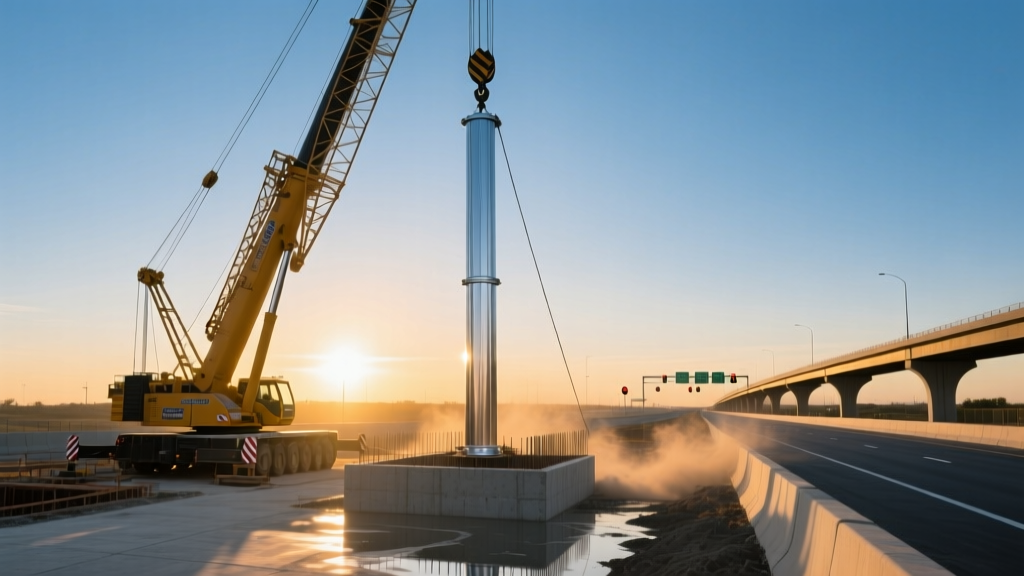
Erection requires a 100-ton to 150-ton hydraulic all-terrain crane with a main boom extension of at least 120 feet. Crane rental, including the operator and rigging crew, costs between $3,500 and $5,500 per day. The physical lift and plumb-setting of the pole onto the anchor bolts takes approximately 3 to 5 hours.
Phase 3: Sign Face Assembly and Electrical
Once the pole is plumb and the foundation has cured (usually 7 to 14 days for initial set, though construction can proceed with caution), the sign face skeleton is bolted to the pole's top flange or saddle brackets.
Static Face Construction
A static 14x48 face is constructed using structural steel stringers and catwalks. The substrate is typically 1-inch Medium Density Overlay (MDO) plywood or corrugated steel pans. MDO plywood provides a perfectly smooth surface for the tensioned vinyl billboard skin. The catwalk system, required for safe maintenance and vinyl changes, adds roughly 1,500 pounds of dead load and must feature OSHA-compliant guardrails and toe-boards.
Electrical Service and Illumination
Lighting a static billboard requires mounting LED gooseneck fixtures along the top catwalk. Modern 150W LED floodlights provide the same foot-candle illumination as older 400W metal halide lamps, cutting energy costs by over 60%. A standard static setup requires a 100-amp to 200-amp, 120/240V single-phase electrical service brought to the base of the pole via underground conduit.
If you are upgrading to or building a digital LED face (e.g., Daktronics or Watchfire 16mm or 20mm pitch cabinets), the electrical requirement jumps massively. Digital faces require a 400-amp, 480V 3-phase commercial service. Trenching and installing a 3-phase commercial drop from the local utility can add $15,000 to $40,000 to the project, depending on the distance to the nearest utility transformer.
Static vs. Digital Billboard Construction Matrix
Understanding the structural differences between static and digital builds is critical for accurate cost forecasting. Digital cabinets introduce immense weight and wind-load variables.
| Feature | Static Vinyl (14x48) | Digital LED (14x48) |
|---|---|---|
| Face Weight | ~4,500 lbs (per face) | ~12,000 lbs (per face) |
| Monopole Requirement | Standard 36" - 42" OD | Heavy-duty 48" - 60" OD, thicker wall |
| Foundation Depth | 20 - 25 feet | 30 - 45 feet (or reinforced spread footing) |
| Electrical Service | 200A / 120-240V Single Phase | 400A / 480V 3-Phase Commercial |
| Wind Permeability | Solid sail area (unless wind-slotted) | Solid sail area (louvers required for cooling) |
Hidden Costs and Edge Cases
"The most frequently underestimated cost in billboard construction is site access. If a heavy auger drill rig and a 150-ton crane cannot access the pad due to soft soil, steep grading, or overhead utility lines, you will be forced to use a smaller crane with a luffing jib, which can double the daily equipment rental rate and extend the erection timeline by several days."
Additional Cost Factors to Budget For:
- Access Road Construction: $3,000 - $12,000 for grading and laying crushed aggregate (ABC stone) to support 80,000-pound crane outriggers.
- Aviation Obstruction Lighting: If the structure exceeds 200 feet in height or is near an airport approach zone, the FAA requires L-810 or L-864 red beacon lighting, adding $3,500 to $6,000.
- Wind-Slotting: In hurricane-prone coastal regions (e.g., Florida, Gulf Coast), engineers may require the static sign face to be "slotted" (leaving gaps between panels) to reduce wind drag. This requires custom-fabricated steel pans instead of standard plywood, increasing face costs by 15% to 20%.
- Land Lease Legal Fees: Securing a 20-to-30-year ground lease with the property owner requires specialized real estate legal counsel, typically costing $2,000 to $4,500 upfront.
Step-by-Step Construction Timeline
From breaking ground to final illumination, a standard static monopole project follows a rigid sequence to ensure structural integrity and safety.
- Site Prep & Layout (Day 1): Clearing, grading, and marking underground utilities (Call 811).
- Drilling & Rebar Setting (Days 2-3): Augering the shaft, lowering the engineered rebar cage, and setting the anchor bolt template.
- Concrete Pour (Day 4): Pumping 4,000 PSI concrete. The foundation must cure for a minimum of 7 days before taking the full structural load.
- Pole Delivery & Staging (Day 10): The galvanized monopole is delivered and laid out on the ground for pre-assembly of the base flange and climbing pegs.
- Crane Lift & Erection (Day 11): The crane lifts the pole, sets it over the anchor bolts, and the ironworkers secure the leveling nuts and top caps.
- Face & Catwalk Assembly (Days 12-16): Bolting the stringers, catwalks, and MDO substrate to the pole saddle.
- Electrical & Lighting (Days 17-19): Pulling wire through the internal pole conduit, mounting LED gooseneck fixtures, and final utility meter connection.
- Vinyl Installation & Inspection (Day 20): Tensioning the first vinyl advertisement and passing the final municipal structural inspection.
Accurately estimating the cost to build a billboard requires looking beyond the steel and concrete. By accounting for geotechnical variables, heavy lift logistics, and evolving digital power requirements, developers can prevent severe budget overruns and ensure their outdoor advertising assets are engineered to generate revenue for decades.
Written by
Priya KapoorPriya Kapoor is a real estate market analyst and construction economics researcher with expertise in housing affordability, development feasibility, and infrastructure investment. She holds a Master of Regional Planning from Cornell University and previously worked as a senior analyst at CBRE's Investment Properties group, where she modeled returns for $4B in mixed-use development pipelines. Priya now runs an independent research practice advising developers, municipalities, and REITs on construction cost forecasting and market timing. She publishes the quarterly "BuildMat Market Pulse" report tracking material price indices across 12 commodity categories. Based in Austin, TX, Priya serves on the board of Habitat for Humanity Austin and is a marathon runner.
More from Priya Kapoor
View all
Construction Cost
Cost to Build a 1600 Sq Ft Home in 2026: Full Breakdown
Accurate 2026 cost to build a 1600 sq ft home—material, labor, and regional pricing breakdowns included. Plan your budget with real-time estimates.
Aug 11, 2026

Wood & Lumber
Name the Types of Wood for Pressure Treatment and Preservation
Learn how to name the types of wood best suited for pressure treatment. Compare species treatability, chemical retention levels, and 2026 preservation costs.
Aug 4, 2026

Stone & Masonry
Stone Veneer Suppliers Lindenhurst: 2026 Cost Analysis
Analyze 2026 stone veneer costs in Lindenhurst, NY. Compare local supplier pricing, delivery fees, and Suffolk County installation labor rates.
Aug 4, 2026