Cost to Build an Ice Rink: 2026 Budget Planning Guide
Plan your backyard ice rink budget with 2026 pricing for traditional liners, synthetic tiles, and refrigerated systems, including hidden site prep costs.

The Three Capital Tiers of Residential Rinks
Constructing a residential ice rink requires navigating three distinct capital tiers, each dictated by local climate, property topography, and year-round usability requirements. Budget planning for this project extends far beyond the visible skating surface; it encompasses site grading, water volume logistics, mechanical infrastructure, and long-term material degradation. For a standard 40x80 foot (3,200 square feet) residential footprint, capital requirements range from a $1,500 seasonal DIY build to a $65,000+ permanent refrigerated installation.
According to facility guidelines outlined by USA Hockey, standardizing your footprint to match common hockey dimensions (or proportional fractions thereof) optimizes material purchasing and reduces custom fabrication costs. Below is a granular breakdown of the three primary construction methodologies.
Tier 1: Traditional Flooded Rinks (Climate-Dependent)
The traditional flooded rink relies on sub-freezing ambient temperatures to freeze a contained body of water. This is the most common and cost-effective approach for northern climates, but it requires precise material selection to prevent catastrophic water loss and board failure.
Material Specifications and Cost Breakdown
| Component | Specification | Estimated Cost (40x80) | Lifespan |
|---|---|---|---|
| Liner | 10-mil Woven Polyethylene (White) | $850 - $1,100 | 1-3 Seasons |
| Boards | 1/2" HDPE or 3/4" Marine Plywood | $1,200 (Ply) / $4,500 (HDPE) | 2 Yrs (Ply) / 15+ Yrs (HDPE) |
| Brackets | Heavy-Gauge Steel Stake Brackets | $600 - $900 | 20+ Years |
| Kickplates | 1/8" Aluminum or HDPE (8" height) | $400 - $750 | 10+ Years |
When sourcing liners, avoid standard 5-mil hardware store tarps. The ice expansion and contraction cycle will shred unreinforced poly. Industry leaders like NiceRink manufacture woven, UV-treated 10-mil to 20-mil liners specifically engineered to withstand the sheer forces of freezing water. White liners are mandatory; black or blue liners absorb solar radiation, causing the ice to melt from the bottom up on sunny winter days.
Tier 2: Synthetic Interlocking Rinks (Year-Round)
For regions lacking sustained freezing temperatures, or for homeowners demanding year-round stickhandling practice, synthetic ice is the optimal solution. Modern synthetic ice is manufactured from high-molecular-weight polyethylene (HMWPE) infused with proprietary glide conditioners.
Subfloor and Panel Economics
Premium European-engineered tiles, such as those produced by Glice Synthetic Ice, utilize a dovetail or puzzle-edge connection system that prevents lateral separation and moisture intrusion. Expect to pay between $24 and $38 per square foot for commercial-grade 1/2-inch or 3/4-inch thick panels.
Synthetic ice panels will permanently deform if installed over uneven ground. You must budget for a rigid subfloor. The most cost-effective method is laying 3/4-inch tongue-and-groove OSB (Oriented Strand Board) over a 6-mil vapor barrier and a 1-inch layer of XPS (extruded polystyrene) foam insulation. For a 3,200 sq ft rink, the subfloor materials alone will add $2,500 to $4,000 to your total budget.
Operational Trade-off: Synthetic ice creates higher friction than real ice, which dulls skate blades approximately 30% faster. Budget for a specialized skate sharpening machine (e.g., Sparx or Blademaster) or factor in increased local sharpening fees.
Tier 3: Refrigerated Chiller Systems (The Luxury Build)
A refrigerated backyard rink utilizes a mechanical chiller to pump a chilled propylene glycol and water mixture through a network of PEX tubing embedded in the ground or a concrete slab. This allows for ice creation in marginal climates (e.g., ambient temperatures up to 50°F) and extends the season by several months.
Mechanical and Piping Specifications
- Chiller Unit: A 40x80 ft rink requires a 2-ton to 3-ton air-cooled or water-cooled chiller. Capital cost: $8,500 - $16,000.
- Tubing Network: 3/8-inch or 1/2-inch PEX-AL-PEX (oxygen barrier) tubing must be laid at strict 3-inch or 4-inch on-center spacing. This requires approximately 9,500 linear feet of tubing. Cost: $3,500 - $5,000.
- Electrical Infrastructure: Chillers require dedicated 220V/50A circuits. Trenching and panel upgrades typically add $2,000 - $4,500.
- Base Construction: While tubing can be buried in compacted sand, a 4-inch reinforced concrete slab provides superior thermal transfer and structural longevity. Concrete work for 3,200 sq ft averages $19,000 - $28,000.
Site Preparation: The Grading Imperative
The single most common cause of budget overruns and abandoned rink projects is improper site grading. Water seeks its own level. If your 40x80 yard has a 6-inch slope from one end to the other, the water depth at the low end will be 6 inches deeper than at the high end.
- Topography Assessment: Use a transit level or rotary laser level to map the elevation changes across the proposed footprint.
- The 2-Inch Rule: For traditional flooded rinks, the site must be graded to within 2 inches of perfect level across the entire pad. This ensures a uniform 4-inch water depth, requiring only standard 12-inch to 18-inch boards.
- Earthmoving Costs: If the slope exceeds 4 inches, you must either rent a mini-excavator and laser-guided grading attachment ($400/day) or hire a professional grading contractor ($1,500 - $3,500).
- Retaining Walls: If grading is impossible due to tree roots or property lines, you must engineer reinforced retaining walls on the low side, which can easily double your lumber and bracket budget.
Expert Freezing Protocol: Never flood a traditional rink until the ground is frozen solid and ambient temperatures are forecast to remain below 20°F (-6°C) for a minimum of 48 hours. Flooding on unfrozen ground results in mud-slush, which creates a porous, uneven ice surface that requires aggressive scraping and multiple resurfacing passes to fix.
Hidden Budget Variables & Operational Costs
Budget planning must account for the ongoing operational realities of maintaining an ice surface. First-time builders frequently overlook the following capital and operational drains:
Water Volume and Municipal Fees
A 40x80 ft rink flooded to a depth of 4 inches holds approximately 7,900 gallons of water. If you are on municipal water, this initial fill will cost between $40 and $90 depending on local tiered water rates. However, the hidden cost is the sewer charge. Many municipalities bill sewer usage based on water meter readings. You must contact your water authority beforehand to request a "sewer charge adjustment" or "irrigation credit" for water that evaporates or freezes rather than entering the municipal sewer system. Failure to do so can result in a $150+ surprise on your utility bill.
Resurfacing Equipment
Skating shaves the ice, creating snow and ruts. A standard garden hose will not produce a smooth surface once the base ice is established. Budget for a specialized resurfacer. Manual push-resurfacers (essentially a steel blade and water tank on wheels) cost $300 to $600. For pristine, Zamboni-like results, motorized residential resurfacers cost $2,500 to $4,500.
Liability and Insurance
An ice rink is an attractive nuisance and a high-liability feature. Before breaking ground, consult your homeowner's insurance provider. Some carriers require an umbrella liability policy or a specific rider to cover injuries sustained on the ice, which can add $150 to $300 to your annual premium.
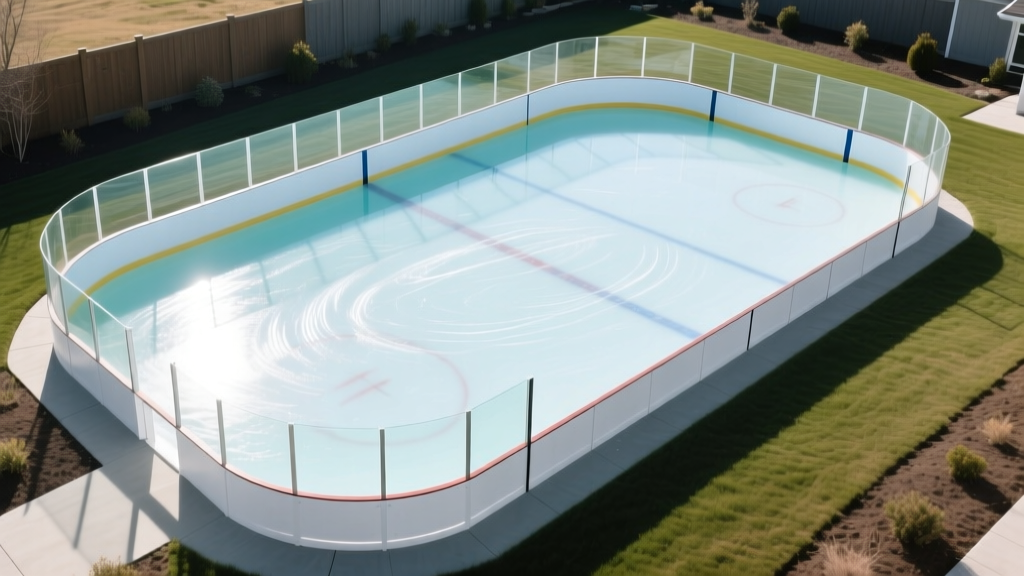
Budget Planning Matrix: Which Rink Fits Your Capital?
| Rink Type | Total Capital (40x80) | Climate Requirement | Maintenance Intensity | Best Use Case |
|---|---|---|---|---|
| Traditional Flooded | $1,800 - $6,500 | Sustained sub-20°F | High (Daily flooding/scraping) | Northern climates, seasonal family recreation |
| Synthetic HMWPE | $45,000 - $75,000 | None (Year-Round) | Low (Sweeping, conditioning) | Warm climates, dedicated hockey training |
| Refrigerated Chiller | $35,000 - $65,000+ | Marginal (Up to 50°F) | Moderate (Mechanical monitoring) | Luxury estates, extended season skating |
Accurate budget planning for an ice rink requires matching your capital allocation to your local climate realities. Investing $50,000 in a refrigerated system in a region that naturally sustains 10°F winters for three months is a poor return on investment, just as attempting a traditional flooded rink in a region with frequent freeze-thaw cycles will result in perpetual frustration and wasted water. Define your environmental constraints first, then allocate capital toward the structural and mechanical components that guarantee a stable, durable surface.
Written by
James ThorntonJames Thornton is a construction industry veteran with 25 years of hands-on experience in wood framing, lumber grading, and residential building codes. He started as a framing carpenter in rural Oregon, earned his ICC Residential Building Inspector certification, and eventually became a senior plan reviewer for the City of Portland Bureau of Development Services. James holds a B.S. in Wood Science & Technology from Oregon State University and is a certified lumber grader through the West Coast Lumber Inspection Bureau (WCLIB). He has inspected over 3,000 residential construction sites and authored the city's internal guide on advanced framing techniques (2x6 at 24" O.C.). James lives in Bend, OR, where he builds custom timber-frame cabins and competes in lumberjack sports.
More from James Thornton
View all
Insulation
Best Home Insulation Materials: Complete 2026 Guide
Compare top home insulation materials for 2026. Find R-values, installed costs per square foot, and best uses for fiberglass, spray foam, and mineral wool.
Aug 4, 2026

Sustainable Building
Certify Your Green Building Material for LEED and WELL
Step-by-step guide to certifying a green building material for LEED v5 and WELL v2. Master EPDs, HPDs, and VOC limits for 2026 project specifications.
Aug 4, 2026

Stone & Masonry
Veneer Stacked Stone Panels: Interior Design & Style Showcase
Discover how veneer stacked stone panels transform interiors. Explore modern design profiles, material pairings, and technical installation specs.
Aug 4, 2026