How Much Does It Cost to Build a Basketball Gym? Size & Scope Guide
Calculate exactly how much it costs to build a basketball gym. Break down size, scope, materials, and 2026 construction pricing for 1 to 3-court facilities.

This guide is written for school district facility planners, municipal recreation directors, and private athletic club developers who need reliable budget estimates for new basketball gymnasium construction projects in 2026.
The cost to build a basketball gymnasium ranges from $2.4 million to $5.4 million for a standard single-court facility (approximately 16,000 square feet), translating to $150 to $350 per square foot depending on finish level, structural system, and regional labor rates. A two-court gymnasium spanning 30,000 square feet typically costs between $4.5 million and $10 million. Full-size competition venues exceeding 45,000 square feet with spectator seating, locker rooms, and broadcast infrastructure regularly surpass $12 million. These figures encompass site work, structural shell, mechanical and electrical systems, interior finishes, and sport flooring but exclude land acquisition.
Key Takeaways
- Single-court gymnasium (16,000 sq ft): $2.4M–$5.4M total
- Two-court gymnasium (30,000 sq ft): $4.5M–$10M total
- Cost per square foot: $150–$350 depending on scope and finish level
- Typical construction timeline: 12–18 months from groundbreaking to occupancy
- Largest cost drivers: structural system choice, HVAC capacity, spectator seating, and regional labor markets
Gymnasium Construction Cost by Size and Scope
Gymnasium construction costs scale with floor area, ceiling height, and the number of auxiliary spaces. The following breakdown categorizes facilities into three common tiers based on 2026 construction pricing data from Dodge Construction Network.
Single-Court Gymnasium (12,000–18,000 Square Feet)
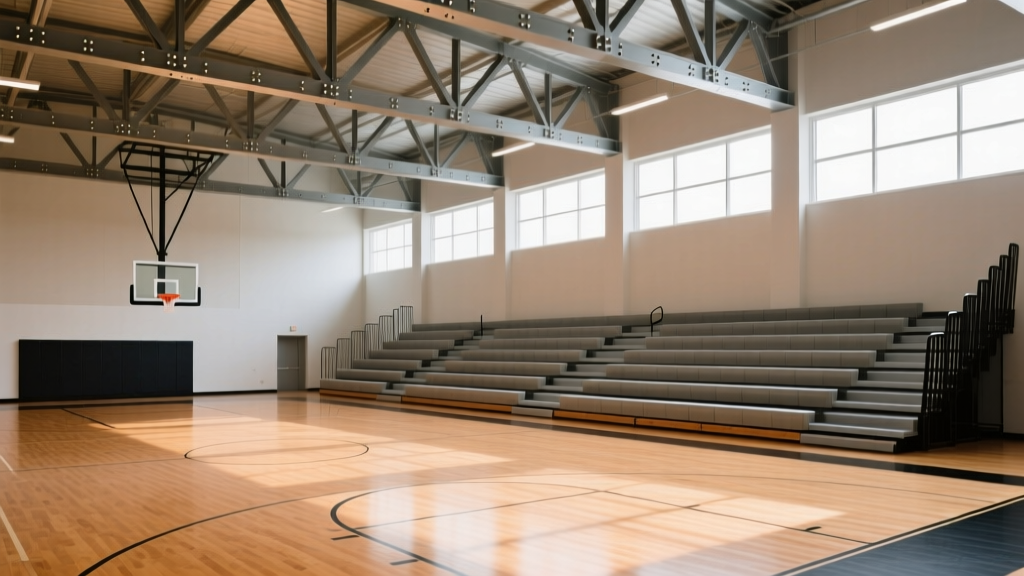
A single-court facility accommodates one full-size basketball court (94 feet by 50 feet) with minimal perimeter buffer space. These buildings typically feature clear-span steel framing with ceiling heights of 24 to 28 feet. Total project costs fall between $1.8 million and $5.4 million. Basic configurations with exposed steel, polished concrete floors in non-court areas, and minimal HVAC run near $150 per square foot. Upgraded versions with maple hardwood, forced-air climate control, bleacher seating for 500, and finished locker rooms approach $300 to $350 per square foot.
Two-Court Gymnasium (25,000–35,000 Square Feet)
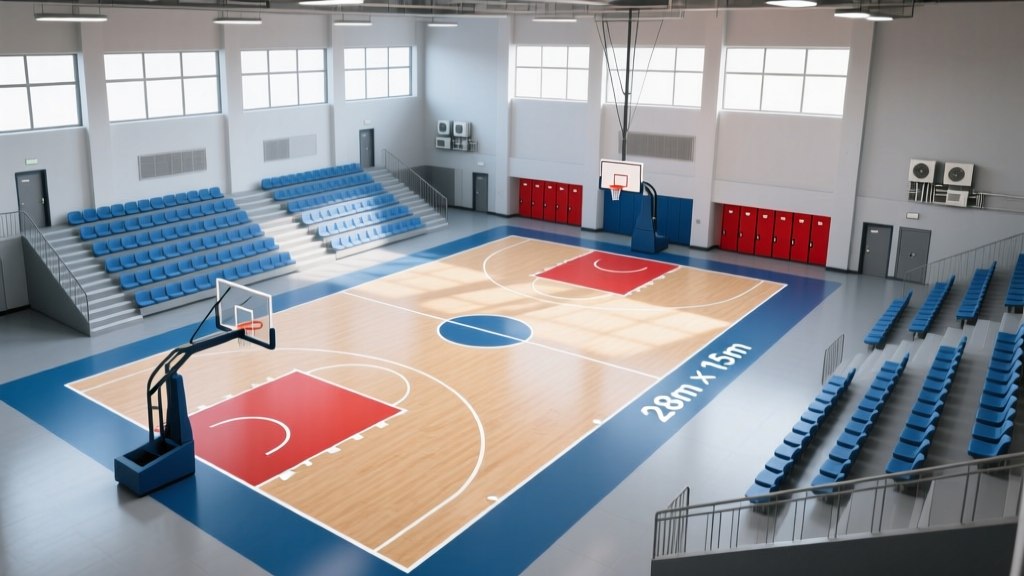
Multi-court facilities serve high schools, community colleges, and recreation centers that need simultaneous programming. These buildings span 25,000 to 35,000 square feet and include two full courts, expanded spectator areas (800–2,000 seats), team rooms, concession space, and public restrooms. Expect total costs between $4.5 million and $10 million. According to the American Institute of Steel Construction, clear-span steel trusses for widths exceeding 120 feet add 8% to 12% to structural costs compared to narrower single-court spans.
Competition Arena (40,000–60,000+ Square Feet)
Large-scale competition venues include permanent tiered seating for 3,000 or more spectators, broadcast lighting rigs, VIP suites, press areas, training rooms, and full concession infrastructure. Project budgets start at $12 million and can exceed $30 million for university-level arenas. The National Federation of State High School Associations specifies minimum court clearance dimensions and lighting standards that influence both the building envelope and mechanical system sizing, directly affecting total cost.
Major Cost Variables Explained
Understanding which factors most influence your gymnasium budget helps planners make informed trade-off decisions early in the design process.
Structural System Selection
The two dominant structural approaches for gymnasium construction are pre-engineered metal buildings and conventional steel-frame with masonry infill. Pre-engineered metal buildings cost approximately $45 to $75 per square foot for the structural shell, while conventional steel-frame construction with masonry walls runs $80 to $130 per square foot for the same scope. Pre-engineered systems offer faster erection timelines (typically 4 to 6 months for the shell) but limit architectural expression. Conventional framing supports more complex facades and easier future expansion.
Mechanical, Electrical, and Plumbing Systems
Basketball gymnasiums demand substantial HVAC capacity due to high occupancy loads and large interior volumes. Mechanical system costs average $18 to $28 per square foot for gymnasium spaces. A 30,000-square-foot facility might spend $540,000 to $840,000 on HVAC alone. Electrical systems, including LED sports lighting that meets the Illuminating Engineering Society's recommended 50 foot-candle minimum for competitive play, add $12 to $20 per square foot. Plumbing costs vary widely depending on whether the facility includes locker rooms with showers; a full locker suite adds $150,000 to $350,000 to the project.
Sport Flooring and Court Finishes
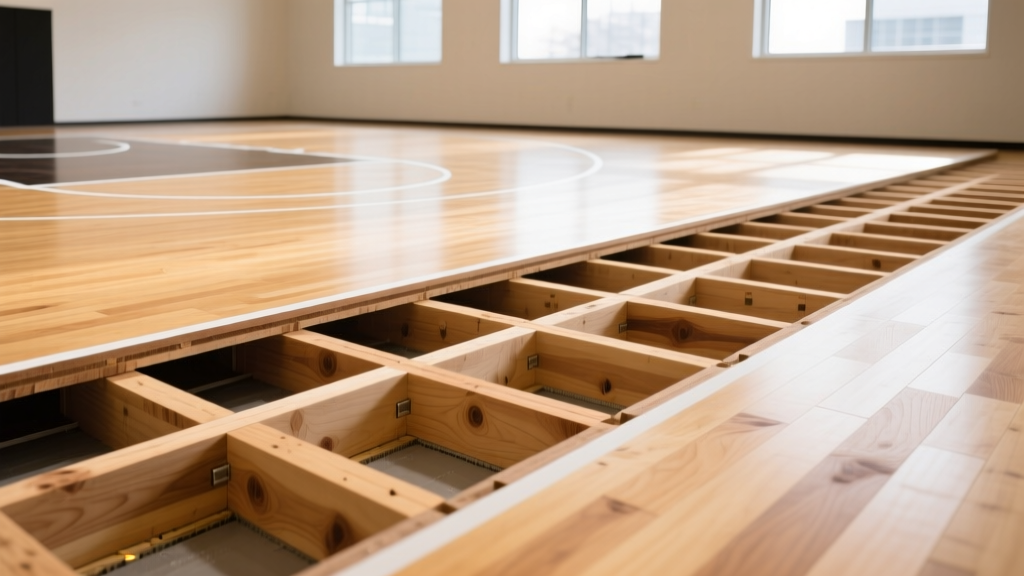
Hardwood maple sport flooring, the standard for competitive basketball, costs $25,000 to $45,000 per full-size court including subfloor sleeper systems, sanding, sealing, and game-line painting. Polyurethane synthetic surfaces offer a lower-cost alternative at $12,000 to $22,000 per court and require less maintenance over a 15-year lifecycle. Facilities hosting multiple sports often choose synthetic surfaces for their versatility.
Site Work and Foundation
Site preparation costs depend heavily on soil conditions, topography, and utility access. Grading, excavation, and foundation work for a 30,000-square-foot gymnasium typically cost $300,000 to $700,000. Poor soil conditions requiring deep foundations or pilings can double this estimate. Parking lot construction, stormwater management, and utility connections add another $200,000 to $500,000 depending on municipal requirements.
Gymnasium Type Comparison Matrix
The following table compares three common gymnasium configurations across key planning dimensions to help stakeholders evaluate scope trade-offs.
| Feature | Basic Single-Court | Standard Two-Court | Competition Arena |
|---|---|---|---|
| Floor Area | 12,000–18,000 sq ft | 25,000–35,000 sq ft | 40,000–60,000+ sq ft |
| Total Cost Range | $1.8M–$5.4M | $4.5M–$10M | $12M–$30M+ |
| Cost per Sq Ft | $150–$300 | $180–$320 | $250–$500+ |
| Spectator Capacity | 200–500 (retractable) | 800–2,000 | 3,000–8,000+ |
| Structural System | Pre-engineered metal | Steel truss or pre-engineered | Conventional steel frame |
| HVAC | Rooftop units | Central air handling | Chiller plant with AHUs |
| Construction Timeline | 10–14 months | 14–18 months | 18–30 months |
Budget Planning Checklist
Use this checklist to ensure your gymnasium project budget accounts for all major cost categories before submitting funding requests or issuing bid documents.
Gymnasium Budget Planning Checklist
- ☐ Land acquisition and site due diligence — survey, geotechnical report, environmental assessment
- ☐ Site preparation — grading, excavation, utility stubs, stormwater detention
- ☐ Foundation and structural shell — footings, slab, steel or pre-engineered frame, roof system
- ☐ Building envelope — exterior walls, insulation, windows, doors, waterproofing
- ☐ Mechanical systems — HVAC equipment, ductwork, controls, ventilation
- ☐ Electrical systems — service entrance, distribution panels, sports lighting, emergency power
- ☐ Plumbing — restrooms, locker rooms, drinking fountains, fire suppression sprinklers
- ☐ Interior finishes — sport flooring, wall protection, ceiling treatments, paint
- ☐ Fixed equipment — bleachers, scoreboards, basketball goals, divider curtains
- ☐ Soft costs — architectural and engineering fees (typically 8%–12% of construction), permits, insurance
- ☐ Contingency reserve — 10%–15% of total hard costs for unforeseen conditions
- ☐ Parking and exterior amenities — lot paving, lighting, landscaping, signage
Frequently Asked Questions
How much does it cost to build a high school basketball gymnasium?
A typical high school basketball gymnasium with one to two courts, seating for 1,000 to 2,500 spectators, adjacent locker rooms, and a concession area costs between $5 million and $12 million in 2026. The wide range reflects differences in geographic labor costs, seismic or wind-load requirements, and finish selections. Urban districts in high-cost labor markets such as New York or San Francisco should budget toward the upper end, while rural districts in the Midwest or Southeast may achieve costs near the lower range.
What is the cost per square foot to build a gymnasium?
Gymnasium construction costs range from $150 to $350 per square foot for most projects completed in 2026. Basic recreational facilities with pre-engineered metal construction and minimal finishes cluster near $150 to $200 per square foot. Institutional-quality gymnasiums with masonry exteriors, central HVAC, hardwood courts, and permanent seating fall in the $220 to $320 range. Premium competition venues with tiered concrete seating, broadcast infrastructure, and high-end finishes exceed $350 per square foot.
What is the cheapest way to build a basketball gym?
The most cost-effective approach combines a pre-engineered metal building shell with a single-court layout, retractable bleachers, rooftop HVAC units, and synthetic sport flooring. This configuration can achieve costs as low as $150 per square foot, resulting in a total project budget near $1.8 million to $2.4 million for a 12,000 to 16,000-square-foot facility. Eliminating locker rooms and limiting spectator capacity further reduces costs.
How long does it take to build a basketball gymnasium?
Construction timelines for basketball gymnasiums range from 10 to 18 months for single- and two-court facilities, measured from groundbreaking to certificate of occupancy. Pre-engineered metal buildings compress the shell erection phase to 4 to 6 months, while conventional steel-frame structures require 6 to 9 months for the same phase. Interior fit-out, mechanical commissioning, and sport flooring installation typically consume the final 3 to 5 months. Add 6 to 12 months of pre-construction time for design development, permitting, and bidding.
Final Planning Guidance
Building a basketball gymnasium represents a significant capital investment that demands accurate early-stage cost estimating to secure appropriate funding and avoid mid-project shortfalls. The total cost to build a gymnasium in 2026 depends primarily on facility size, structural system selection, mechanical complexity, and finish quality — with single-court facilities starting near $2.4 million and competition arenas exceeding $12 million.
Your most impactful next step is to define your program requirements in writing: number of courts, spectator capacity, auxiliary spaces, and performance level. Feed those requirements into a detailed line-item estimate prepared by a licensed cost estimator or use the BuildMat Insight gymnasium cost calculator to generate a preliminary budget range before engaging an architect. Establishing a realistic budget envelope early prevents costly redesign cycles and keeps your project on schedule.
Written by
James ThorntonJames Thornton is a construction industry veteran with 25 years of hands-on experience in wood framing, lumber grading, and residential building codes. He started as a framing carpenter in rural Oregon, earned his ICC Residential Building Inspector certification, and eventually became a senior plan reviewer for the City of Portland Bureau of Development Services. James holds a B.S. in Wood Science & Technology from Oregon State University and is a certified lumber grader through the West Coast Lumber Inspection Bureau (WCLIB). He has inspected over 3,000 residential construction sites and authored the city's internal guide on advanced framing techniques (2x6 at 24" O.C.). James lives in Bend, OR, where he builds custom timber-frame cabins and competes in lumberjack sports.
More from James Thornton
View all
Insulation
Best Home Insulation Materials: Complete 2026 Guide
Compare top home insulation materials for 2026. Find R-values, installed costs per square foot, and best uses for fiberglass, spray foam, and mineral wool.
Aug 4, 2026

Sustainable Building
Certify Your Green Building Material for LEED and WELL
Step-by-step guide to certifying a green building material for LEED v5 and WELL v2. Master EPDs, HPDs, and VOC limits for 2026 project specifications.
Aug 4, 2026

Stone & Masonry
Veneer Stacked Stone Panels: Interior Design & Style Showcase
Discover how veneer stacked stone panels transform interiors. Explore modern design profiles, material pairings, and technical installation specs.
Aug 4, 2026