How Much Does It Cost to Build a Buc-ee's?
How much does it cost to build a Buc-ee's? Regional breakdown of land, material, and MEP expenses for these travel centers in 2026.

The Anatomy of a Mega-Travel Center
Estimating the construction of a standard convenience store is a straightforward exercise in commercial retail costing. Estimating a Buc-ee’s, however, requires throwing out the standard playbook. When commercial real estate analysts and general contractors ask how much does it cost to build a Buc-ee's, the answer is not a simple price-per-square-foot metric. It is a complex synthesis of heavy civil engineering, industrial-grade mechanical systems, and massive steel erection.
As of 2026, the total capitalized cost to deliver a new, ground-up Buc-ee’s travel center ranges from $35 million to $55 million, excluding land acquisition. The footprint typically demands 15 to 30 acres of highly visible, highway-adjacent real estate, with a store shell ranging from 50,000 to 75,000 square feet, supported by 80 to 120+ fuel dispensers.
2026 Quick Cost Snapshot
- Total Hard Costs: $35M – $55M (excluding land)
- Store Shell (50k-75k sq ft): $160 – $220 per sq ft
- Fuel Canopy & Islands: $8M – $12M
- Site Work & Earthmoving (20+ acres): $4M – $8M
- Required Land: 15 – 30 acres with direct interstate visibility
Regional Price Matrix: Where Does It Cost More?
Construction costs for mega-travel centers fluctuate wildly based on regional labor rates, soil conditions, and local building codes. According to regional labor multipliers tracked by Engineering News-Record (ENR), building in the Southeast or Mountain West introduces distinct premiums compared to the brand's home state of Texas.
| Region | Est. Total Hard Cost | Primary Cost Drivers | Site Work Premium |
|---|---|---|---|
| Texas | $35M – $42M | Established supply chains, favorable soil, lower union labor density. | Baseline |
| Florida | $45M – $55M | Hurricane wind-load engineering, high water table dewatering, impact glass. | +25% |
| Colorado | $42M – $50M | Winter construction heating, mountainous terrain grading, high-altitude HVAC tuning. | +15% |
| Tennessee / Southeast | $38M – $46M | Rock excavation (blasting), heavy stormwater management, prevailing wage overlaps. | +10% |
Deep Dive: The Florida Wind-Load Premium
When expanding into Florida, the structural steel requirements for the iconic Buc-ee’s fuel canopy increase drastically. Standard canopy columns in Texas might utilize HSS 8x8 steel tubing. In Florida’s High-Velocity Hurricane Zones (HVHZ), engineers must specify heavier W-flange beams, deeper moment-resisting foundations, and impact-resistant polycarbonate canopy decking. This structural upgrade alone can add $1.2 million to $1.8 million to the canopy package.
Line-Item Construction Costs & Material Specifics
To understand the true cost, estimators must break the project down into its core components. Data from RSMeans commercial construction databases provides baseline retail costs, but a Buc-ee’s requires heavy industrial modifications across the board.
1. Heavy Civil & Earthwork ($4M – $8M)
A 25-acre site requires massive cut-and-fill operations. Because the fuel canopy and store must be perfectly level to ensure accurate fuel dispenser calibration and ADA-compliant grading, contractors often move 100,000+ cubic yards of dirt. Furthermore, the sheer volume of impervious surface (concrete and asphalt) requires massive underground stormwater retention systems, often involving subterranean concrete vaults or deep dry wells.
2. The Fuel Canopy & Pump Islands ($8M – $12M)
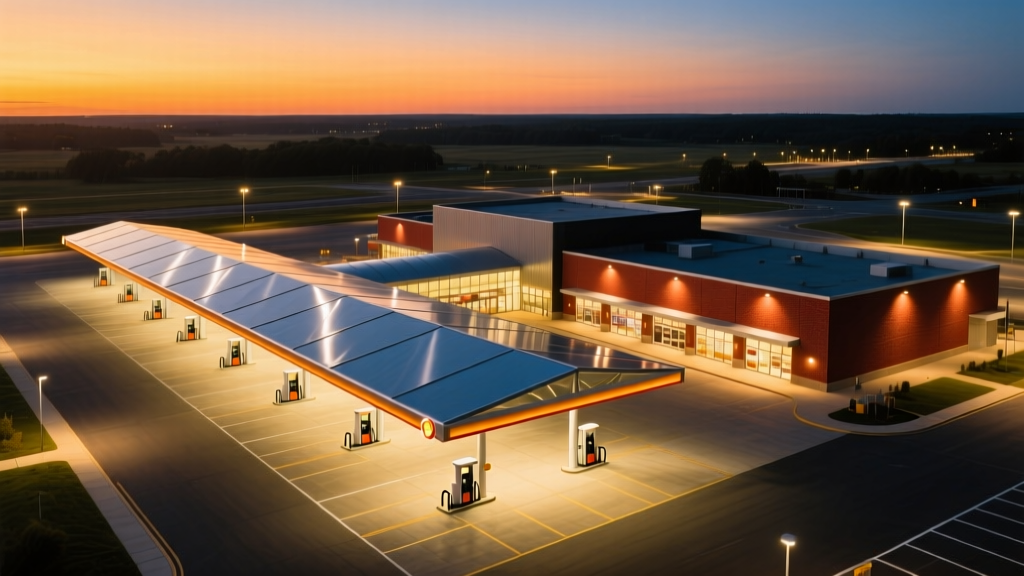
A standard travel center features a 4,000-square-foot canopy. A Buc-ee’s canopy spans 25,000+ square feet. To accommodate large RVs and 18-wheelers, the canopy must feature long-span steel trusses with minimal intermediate columns. The pump islands themselves require 5,000 PSI concrete mixed with synthetic fiber mesh and sealed with fuel-resistant epoxy coatings to prevent hydrocarbon degradation of the slab.
3. The 120-Toilet Plumbing Challenge ($2.5M – $4M MEP Package)
This is where the Buc-ee’s model defies standard commercial estimating. A typical big-box store has 8 to 12 toilets. Buc-ee’s locations routinely feature over 100 toilets, alongside massive Texas Round-Up BBQ kitchens.
- Sanitary Sewer: Standard 4-inch PVC waste lines are insufficient. The main trunk lines require 10-inch to 12-inch cast iron or heavy-wall PVC to handle the simultaneous flush load of a busy holiday weekend.
- Water Heating: The facility requires a manifold of commercial-grade 100-gallon natural gas water heaters, piped in parallel, to ensure continuous hot water supply.
- Grease Traps: The on-site BBQ and bakery facilities require massive 15,000-gallon exterior grease interceptors, requiring heavy excavation and crane setting.
4. Electrical Switchgear & Utility Tie-Ins ($1.5M – $2.5M)
Powering 120 fuel dispensers (each with digital screens and high-flow pumps), a 70,000 sq ft HVAC load, and commercial kitchen equipment requires a 4,000-amp main electrical service. In many rural highway locations, the local utility grid cannot support this. The project budget must often include the construction of a dedicated utility substation or the funding of major off-site transmission line upgrades.
Corporate Standards vs. Value Engineering
One of the most critical insights for commercial estimators is understanding the corporate structure. Unlike competitors that rely on franchisees who aggressively value-engineer (VE) projects to save capital, Buc-ee’s is entirely corporate-owned.
The Estimator's Reality: You cannot value-engineer a Buc-ee's. The corporate mandate requires premium finishes, specific brand-standard masonry, high-end terrazzo or premium porcelain tile flooring, and oversized HVAC systems to maintain positive air pressure (keeping dust and exhaust fumes out when the automatic doors open). Attempting to substitute specified materials with cheaper alternatives will result in rejected submittals and project delays.
This strict adherence to corporate standards means that the contingency budget for a Buc-ee's build should be set at a minimum of 8% to 10%, compared to the standard 5% for generic commercial retail builds.
FAQ: Buc-ee’s Construction Realities
How long does it take to build a Buc-ee's from groundbreaking to opening?
Typically 10 to 14 months. However, the pre-construction phase—including environmental impact studies, TxDOT (or state equivalent) highway interchange approvals, and utility easements—can add 12 to 24 months before a single shovel hits the dirt.
What is the biggest hidden cost in mega-travel center construction?
Off-site infrastructure. State Departments of Transportation frequently require the developer to fund dedicated highway off-ramps, acceleration/deceleration lanes, and traffic signalization for the adjacent interstate interchange. These DOT-mandated improvements can easily add $3M to $7M to the overall project ledger.
Can a standard commercial GC bid on a Buc-ee's?
General Contractors must be pre-approved by the corporate development team. Because of the specialized nature of the fuel farm (requiring API-certified underground tank installers) and the massive scale of the steel canopy, only GCs with dedicated heavy-commercial and petroleum infrastructure divisions are typically awarded the prime contracts.
Written by
Elena RodriguezElena Rodriguez is a civil engineer and technical writer specializing in concrete technology, masonry systems, and ASTM/ACI compliance. She earned her B.S. in Civil Engineering from Texas A&M University and spent a decade at a materials testing laboratory, performing over 2,000 concrete compressive strength tests and masonry prism evaluations. Elena is an ACI-certified Field Testing Technician (Grade I) and a member of ASTM Committee C12 on Natural Building Stone. She currently consults on forensic engineering cases involving concrete failures and moisture intrusion. Based in San Antonio, TX, Elena is a proud member of the Society of Women Engineers (SWE) and coaches her daughter's FIRST Robotics team.
More from Elena Rodriguez
View all
Walls & Panels
Cost Analysis: Light Gauge Steel Framing Advantages and Disadvantages
Evaluate light gauge steel framing advantages and disadvantages through a strict cost analysis lens, comparing material, labor, and lifecycle expenses.
Aug 4, 2026

Walls & Panels
Gypsum Board Types: Exact Specifications, Thickness & Dimensions
Compare standard, Type X, and moisture-resistant gypsum board types. Get exact specifications, thicknesses, dimensions, and ASTM standards for your project.
Aug 4, 2026

Fire Resistance
Best Fire-Resistant Outdoor Decking Materials: 2026 Buyer Guide
Discover the best fire-resistant outdoor decking materials for 2026. Compare Class A PVC, aluminum, and hardwood options for WUI compliance and safety.
Aug 4, 2026