How Much Does It Cost to Build a House in Georgia? Financing Guide
Discover how much it costs to build a house in Georgia. Explore regional pricing, construction loan types, draw schedules, and hidden budget traps.
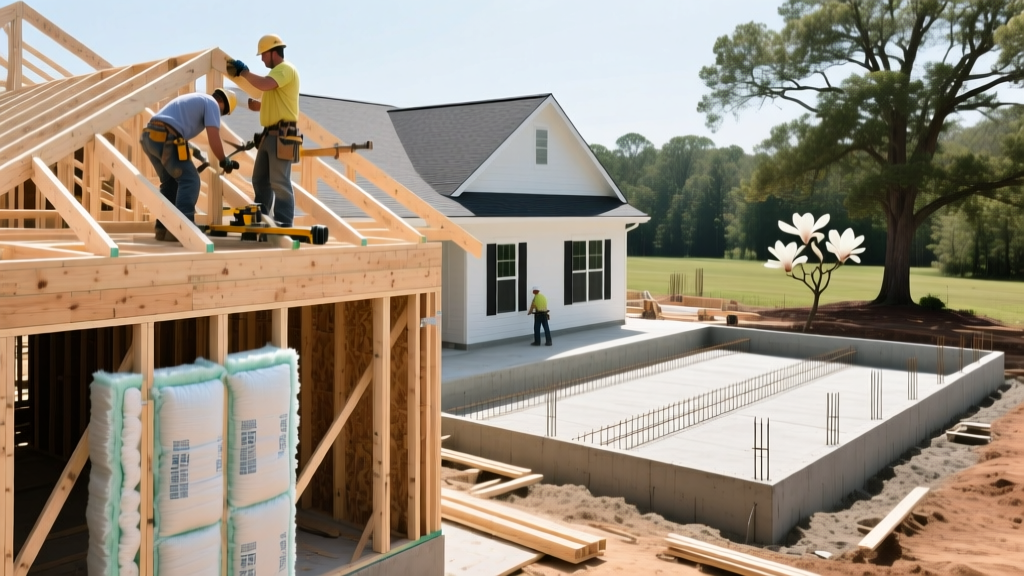
Georgia Construction Costs: Regional Baselines
Determining how much it costs to build a house in Georgia requires moving beyond statewide averages. The state's diverse topography and varying municipal codes create drastic pricing disparities between regions. A 2,500-square-foot custom home will cost significantly more in the North Georgia mountains than in the rural coastal plain due to terrain preparation, foundation engineering, and local labor markets.
According to data tracked by the Home Builders Association of Georgia, regional material and labor variances dictate your baseline budget before land acquisition or financing fees are applied.
| Georgia Region | Cost Per Sq. Ft. (2026) | Primary Cost Drivers | Estimated Total (2,500 Sq. Ft.) |
|---|---|---|---|
| Metro Atlanta (Fulton, Cobb, Gwinnett) | $180 – $280 | High labor demand, impact fees, strict zoning | $450,000 – $700,000 |
| North GA Mountains (Fannin, Union) | $200 – $320 | Rock blasting, steep driveway grading, well/septic | $500,000 – $800,000 |
| Coastal (Chatham, Glynn) | $170 – $260 | Hurricane wind-strapping, elevation pilings, flood insurance | $425,000 – $650,000 |
| Rural / South GA | $140 – $190 | Lower labor costs, fewer municipal impact fees | $350,000 – $475,000 |
Matching Your Budget to Construction Loan Structures
Standard mortgages cannot be used to build a home from the ground up. You must utilize specialized construction financing that converts to a permanent mortgage or requires refinancing upon completion. The Consumer Financial Protection Bureau outlines strict underwriting guidelines for these products, requiring detailed builder contracts and architectural plans before approval.
Construction-to-Permanent (Single-Close) Loans
This is the most common financing vehicle for custom builds in Georgia. You close on the loan once, paying closing costs a single time. During the build phase (typically 9 to 12 months), you make interest-only payments on the funds drawn. Once the certificate of occupancy (CO) is issued, the loan automatically converts to a standard 30-year fixed or adjustable-rate mortgage.
- Down Payment: Typically 20% of the total projected cost (land + construction).
- Best For: Borrowers who want to lock in an interest rate early and avoid double closing costs.
Standalone Construction Loans
These are short-term loans (usually 12 months) that cover only the building phase. Once the home is complete, you must apply for a completely new traditional mortgage to pay off the construction loan.
- Down Payment: Often 25% or higher due to the increased risk for the lender.
- Best For: Borrowers who expect a significant drop in interest rates by the time the build finishes, or those who need to sell their current home to qualify for the permanent mortgage.
FHA One-Time Close Construction Loans
Backed by the federal government, this program allows for a down payment as low as 3.5%. However, the builder must be on the lender's approved FHA roster, and the architectural plans must meet strict HUD guidelines. You cannot act as your own general contractor (owner-builder) with an FHA construction loan.
The Draw Schedule: How Funds Are Actually Released
Lenders do not hand the builder a lump sum. Funds are released in 'draws' tied to specific construction milestones. Before each draw is funded, the bank sends a third-party inspector (such as EFI or Landcor) to verify the work is complete. If your builder requests a draw for framing, but the inspector notes the roof sheathing is incomplete, the bank will withhold the funds.
- Draw 1 (10%): Site clearing, grading, and foundation pouring.
- Draw 2 (20%): Framing, roof trusses, and dry-in (windows/doors installed).
- Draw 3 (20%): MEP rough-ins (Mechanical, Electrical, Plumbing) and municipal inspections.
- Draw 4 (20%): Insulation, drywall installation, and interior trim.
- Draw 5 (20%): Cabinets, flooring, painting, and fixture installation.
- Draw 6 (10%): Final walkthrough, landscaping, and retainage release.
Financing Tip: Always negotiate a 5% to 10% retainage clause in your builder's contract. This ensures the final draw is not released until all punch-list items are resolved and the final municipal CO is in hand.
Hidden Georgia Costs That Derail Budgets
When calculating how much it costs to build a house in Georgia, most borrowers account for lumber, concrete, and labor. However, regional environmental and bureaucratic factors routinely cause budget overruns that can exhaust your loan contingency reserves.
Expansive Red Clay Soil Engineering
Much of the Piedmont region (including Metro Atlanta and Athens) is built on expansive red clay. This soil swells significantly when wet and shrinks when dry, exerting massive lateral pressure on foundation walls. Lenders will often require a geotechnical soil boring report ($1,500 to $2,500) before approving the construction loan. If the soil is deemed highly expansive, your structural engineer may mandate helical piers or a post-tensioned slab, adding $5,000 to $15,000 to your foundation budget.
Metro Atlanta Development Impact Fees
Counties like Cherokee, Forsyth, and Gwinnett levy aggressive development impact fees to fund new schools and road infrastructure. These fees are charged per single-family lot and can range from $4,000 to over $9,000. This fee is usually due when the building permit is pulled and must be paid out-of-pocket or rolled into your initial construction loan draw.
Coastal Wind Mitigation and Elevation
Building east of I-95 toward the coast requires adherence to the International Residential Code (IRC) wind-borne debris provisions. You must budget for impact-resistant windows or engineered shutter systems, reinforced roof-to-wall hurricane straps, and potentially elevated pilings if your lot sits in a FEMA-designated AE or VE flood zone. The Georgia Department of Community Affairs provides specific guidance on state minimum building codes that local coastal municipalities frequently exceed.
Securing Your Loan: A Step-by-Step Action Plan
To secure financing without delaying your build timeline, follow this sequential framework:
- Land Acquisition & Perc Testing: If buying rural land, make your purchase contract contingent on a successful perc test (for septic) and a well-water yield test. Lenders will not finance a construction loan on unbuildable land.
- Finalize Architectural Plans & Specs: Lenders require a comprehensive 'spec sheet' detailing exact materials (e.g., 'Owens Corning Duration architectural shingles', 'HardiePlank fiber cement siding'). Vague allowances will result in loan denial.
- Secure the Builder's Package: Your builder must provide a fixed-price contract, a detailed line-item budget, proof of general liability insurance, and a completed IRS W-9.
- Appraisal (Subject-To): The bank will order an appraisal based on the plans and specs. If the 'subject-to' appraisal comes in lower than your total land + construction cost, you must bring the difference in cash to closing.
- Close and Lock: Sign the single-close construction loan documents and lock your interest rate to protect against market volatility during the 12-month build phase.
Frequently Asked Questions
Can I act as my own general contractor (owner-builder) in Georgia?
Yes, Georgia law allows you to build your own primary residence without a contractor's license. However, securing financing as an owner-builder is exceptionally difficult. Most conventional construction lenders require a licensed, insured general contractor. If you intend to owner-build, you will likely need to self-fund the construction phase and refinance into a traditional mortgage upon completion.
How much contingency reserve should I include in my loan?
Always budget a minimum 10% to 15% contingency reserve on top of the builder's hard costs. In Georgia, weather delays (such as summer thunderstorms halting foundation work) and supply chain fluctuations for custom materials routinely eat into timelines and budgets. If you do not use the contingency funds, they are applied to your principal balance when the loan converts to a permanent mortgage.
Do I have to pay property taxes while the house is being built?
You are responsible for property taxes on the land during construction. Once the foundation is poured and the structure is partially enclosed, the county tax assessor may reassess the property and issue a supplemental tax bill for the 'improvements in progress.' Ensure your construction loan budget includes a reserve for these interim tax liabilities.
Written by
Elena RodriguezElena Rodriguez is a civil engineer and technical writer specializing in concrete technology, masonry systems, and ASTM/ACI compliance. She earned her B.S. in Civil Engineering from Texas A&M University and spent a decade at a materials testing laboratory, performing over 2,000 concrete compressive strength tests and masonry prism evaluations. Elena is an ACI-certified Field Testing Technician (Grade I) and a member of ASTM Committee C12 on Natural Building Stone. She currently consults on forensic engineering cases involving concrete failures and moisture intrusion. Based in San Antonio, TX, Elena is a proud member of the Society of Women Engineers (SWE) and coaches her daughter's FIRST Robotics team.
More from Elena Rodriguez
View all
Walls & Panels
Cost Analysis: Light Gauge Steel Framing Advantages and Disadvantages
Evaluate light gauge steel framing advantages and disadvantages through a strict cost analysis lens, comparing material, labor, and lifecycle expenses.
Aug 4, 2026

Walls & Panels
Gypsum Board Types: Exact Specifications, Thickness & Dimensions
Compare standard, Type X, and moisture-resistant gypsum board types. Get exact specifications, thicknesses, dimensions, and ASTM standards for your project.
Aug 4, 2026

Fire Resistance
Best Fire-Resistant Outdoor Decking Materials: 2026 Buyer Guide
Discover the best fire-resistant outdoor decking materials for 2026. Compare Class A PVC, aluminum, and hardwood options for WUI compliance and safety.
Aug 4, 2026