How Much Does It Cost to Build a House on Land in 2026?
Discover exactly how much it costs to build a house on land. Break down site prep, framing, MEP systems, and hidden land-building expenses.

When evaluating raw acreage, the purchase price of the lot is merely the entry fee. The question of how much does it cost to build house on land requires dissecting a complex matrix of site-specific variables, material choices, and local labor rates. Unlike purchasing a production home in a master-planned community where infrastructure is already subsidized and installed, building on your own land shifts the burden of site development entirely onto your shoulders.
As of 2026, the national average for custom home construction on raw land ranges from $200 to $450+ per square foot for the vertical build, but site preparation can add an unpredictable $25,000 to $120,000 before a single piece of lumber is framed. Below is a comprehensive, data-driven breakdown of the true costs involved in turning a blank parcel into a finished residence.
The 2026 Cost Baseline: Hard Costs vs. Soft Costs
To build an accurate budget, you must separate soft costs (design, permitting, engineering) from hard costs (materials and labor). According to data tracked by the U.S. Census Bureau Construction Surveys, the proportion of soft costs has risen over the last decade due to stricter energy codes and complex zoning requirements.
| Cost Category | Budget Allocation | Estimated Cost (2,500 Sq Ft Home) |
|---|---|---|
| Soft Costs (Architect, Engineer, Permits) | 10% - 15% | $50,000 - $75,000 |
| Site Prep & Land Development | 10% - 20% | $50,000 - $100,000 |
| Foundation & Framing (Shell) | 20% - 25% | $100,000 - $125,000 |
| Exterior Finishes (Roof, Siding, Windows) | 15% - 18% | $75,000 - $90,000 |
| MEP Systems (Mechanical, Electrical, Plumbing) | 15% - 18% | $75,000 - $90,000 |
| Interior Finishes & Cabinetry | 20% - 25% | $100,000 - $125,000 |
Site Preparation: The 'Blank Canvas' Tax
The most volatile variable in land-building is site development. A heavily wooded, sloped lot with poor soil drainage will exponentially increase your foundational and utility costs compared to a flat, cleared parcel with municipal hookups.
Land Clearing and Grading
Clearing trees and stumps costs between $1,500 and $3,500 per acre, but heavy timber or rocky terrain can push this to $6,000+ per acre. Grading to ensure proper water runoff away from the future foundation pad typically requires heavy equipment, billed at $120 to $160 per hour. Expect to spend $5,000 to $15,000 on rough and finish grading for a standard homesite.
Utilities: Municipal vs. Decentralized
If your land lacks municipal water and sewer, you must install decentralized systems. The Environmental Protection Agency (EPA) notes that over 20% of US households rely on septic systems, but soil conditions dictate the cost.
A standard percolation (perc) test costs $300 to $800. If your soil fails to absorb water at the required rate, you will need an engineered alternative system (such as a mound system or aerobic treatment unit). While a conventional gravity septic system costs $4,000 to $8,000, an engineered mound system can cost between $18,000 and $35,000. Always make your land purchase offer contingent on a passing perc test.
Well drilling is priced by the foot, typically $35 to $65 per linear foot for the casing and drilling. A 200-foot well with a submersible pump, pressure tank, and trenching to the house will average $10,000 to $16,000.
Foundation & Shell Matrix: Choosing Your Envelope
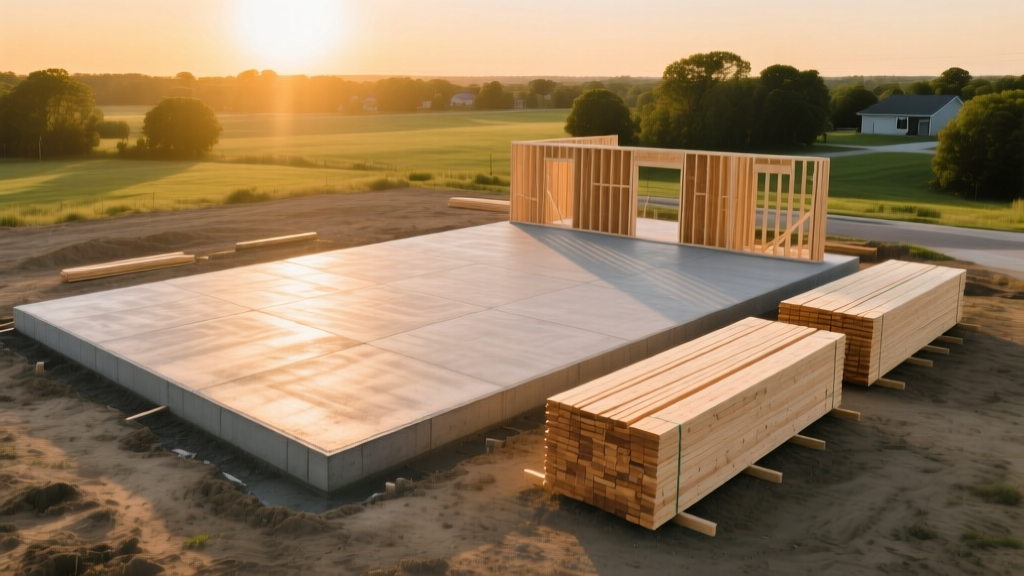
The structural shell accounts for roughly a quarter of your vertical build budget. In 2026, energy codes require tighter building envelopes, making the choice of framing and insulation critical to both upfront costs and long-term HVAC sizing.
| Shell Method | Cost per Sq Ft (Footprint) | Pros & Cons |
|---|---|---|
| Traditional Stick-Built (2x6) | $45 - $65 | Pros: High labor availability, easy to modify. Cons: Prone to thermal bridging, higher air infiltration. |
| Structural Insulated Panels (SIPs) | $60 - $85 | Pros: Extremely airtight, fast assembly, high R-value. Cons: Requires specialized crane, harder to run wiring. |
| Insulated Concrete Forms (ICF) | $75 - $100+ | Pros: Superior soundproofing, disaster-resistant, low HVAC load. Cons: High material cost, limits exterior design changes. |
Expert Insight: According to the U.S. Department of Energy, upgrading from a standard 2x4 wall to a 2x6 wall with closed-cell spray foam or continuous exterior rigid insulation can reduce heating and cooling loads by up to 30%. This allows you to downsize your HVAC equipment, offsetting a portion of the insulation premium.
Foundation Alternatives: The FPSF Advantage
In northern climates (Zones 4 through 8), traditional foundations require digging below the frost line (often 4 to 6 feet deep). A Frost-Protected Shallow Foundation (FPSF) uses rigid foam insulation around the perimeter to trap geothermal heat, preventing frost heave. An FPSF can save $8,000 to $14,000 in excavation and concrete costs compared to a full frost-wall foundation, while providing superior floor insulation.
MEP Rough-Ins: Where Budgets Quietly Bleed
Mechanical, Electrical, and Plumbing (MEP) systems are hidden behind drywall, making them an easy place for contractors to cut corners or for homeowners to accidentally overspecify.
Electrical: The 400-Amp Reality
Standard homes use a 200-amp electrical service. However, the 2026 landscape of home energy includes dual EV chargers, induction cooktops, and cold-climate heat pumps. Upgrading to a 400-amp service (typically achieved via a 400A meter main splitting into two 200A panels) costs an additional $2,500 to $4,500 in panel and utility hookup fees, but future-proofs the home and prevents costly trenching later.
Plumbing: PEX-A vs. Copper
While copper remains the premium standard ($3.50 to $5.50 per linear foot for materials alone), cross-linked polyethylene (PEX) is the industry standard for cost-efficiency and freeze resistance. Specifically, PEX-A (expansion PEX, like the Uponor brand) costs roughly $0.60 to $0.90 per linear foot. PEX-A expands during installation, requiring fewer fittings and virtually eliminating leak points at joints, saving thousands in labor compared to soldered copper.
The Land-Build Budgeting Framework
To avoid the common pitfall of running out of capital before interior finishes, allocate your total project capital using the following sequential framework:
- Land Acquisition (20-25%): Include closing costs and immediate survey/perc testing.
- Site Development (15%): Driveway, well, septic, power trenching, and grading.
- Vertical Shell (25%): Foundation, framing, roof, windows, and exterior doors.
- MEP & Drywall (15%): Rough-ins, insulation, drywall, and HVAC commissioning.
- Finishes & Fixtures (20%): Cabinets, flooring, trim, paint, and appliances.
Never build on raw land without a minimum 15% contingency fund held in liquid cash. Subsurface surprises (hitting bedrock during basement excavation, discovering a high water table) are the primary cause of construction loan defaults. If your total budget is $600,000, your hard construction budget must not exceed $510,000.
Frequently Asked Questions
Is it cheaper to buy land and build, or buy an existing home?
In most markets, buying an existing home is cheaper upfront due to the economies of scale in production building and pre-existing infrastructure. Building on your own land typically costs 15% to 30% more per square foot than buying a comparable resale home, but it yields a custom asset with modern energy efficiency and zero deferred maintenance, which can result in lower total cost of ownership over 15 years.
How long does it take to build a house on raw land?
While the vertical construction of a 2,500 sq ft home takes 6 to 9 months, site development on raw land can add 2 to 4 months. Securing well drillers, septic engineers, and utility companies to trench power to the site often involves significant lead times. Expect a total timeline of 12 to 16 months from closing on the land to moving in.
Do I need a construction loan to build on land I already own?
If you own the land free and clear, the land itself can often be used as the down payment (equity) for a construction-to-permanent loan. Lenders typically require a 20% equity position; if your land is appraised at $100,000 and your build costs $400,000, your land equity covers the 20% down payment requirement, allowing you to finance the entire $400,000 construction cost.
Written by
Priya KapoorPriya Kapoor is a real estate market analyst and construction economics researcher with expertise in housing affordability, development feasibility, and infrastructure investment. She holds a Master of Regional Planning from Cornell University and previously worked as a senior analyst at CBRE's Investment Properties group, where she modeled returns for $4B in mixed-use development pipelines. Priya now runs an independent research practice advising developers, municipalities, and REITs on construction cost forecasting and market timing. She publishes the quarterly "BuildMat Market Pulse" report tracking material price indices across 12 commodity categories. Based in Austin, TX, Priya serves on the board of Habitat for Humanity Austin and is a marathon runner.
More from Priya Kapoor
View all
Construction Cost
Cost to Build a 1600 Sq Ft Home in 2026: Full Breakdown
Accurate 2026 cost to build a 1600 sq ft home—material, labor, and regional pricing breakdowns included. Plan your budget with real-time estimates.
Aug 11, 2026

Wood & Lumber
Name the Types of Wood for Pressure Treatment and Preservation
Learn how to name the types of wood best suited for pressure treatment. Compare species treatability, chemical retention levels, and 2026 preservation costs.
Aug 4, 2026

Stone & Masonry
Stone Veneer Suppliers Lindenhurst: 2026 Cost Analysis
Analyze 2026 stone veneer costs in Lindenhurst, NY. Compare local supplier pricing, delivery fees, and Suffolk County installation labor rates.
Aug 4, 2026