Regional Cost to Move a Storage Building: Price Breakdown
Discover the regional cost to move a storage building. Compare prices by state, size, and foundation type to accurately budget your relocation project.

The True Cost to Move a Storage Building
Relocating a prefabricated or site-built storage building is a complex logistical operation that goes far beyond standard freight hauling. Whether you are moving a 10x12 backyard shed to a new property or transporting a 24x40 commercial pole barn across county lines, the cost to move a storage building fluctuates wildly based on regional infrastructure, local permitting laws, and terrain. In 2026, rising diesel prices and stricter Department of Transportation (DOT) enforcement on oversize loads have fundamentally shifted the pricing landscape for structural movers.
Quick National Averages
- Short-Distance (Under 10 Miles): $350 to $850
- Mid-Distance (10 to 50 Miles): $900 to $2,200
- Long-Distance (50+ Miles): $2,500 to $5,500+
- Crane Mobilization Fee: $800 to $1,500 minimum
According to the International Association of Structural Movers, the most common point of failure in these projects is underestimating the site preparation and route survey costs. A building that can be towed on skids across a flat field will cost a fraction of what it takes to crane-lift that same structure over a two-story house onto a lowboy trailer.
Regional Price Matrix: What You Will Actually Pay
The regional cost to move a storage building is heavily dictated by local topography, population density, and state-level transportation regulations. Below is a breakdown of base mobilization rates and per-mile costs across major U.S. regions.
| Region | Base Mobilization | Per-Mile Rate | Permit Difficulty |
|---|---|---|---|
| Northeast & Mid-Atlantic | $750 - $1,200 | $5.50 - $8.00 | High (Strict urban routing) |
| Midwest & Plains | $400 - $650 | $2.50 - $4.00 | Low (Wide county grids) |
| South & Sunbelt | $500 - $800 | $3.50 - $5.50 | Medium (Terrain dependent) |
| West Coast & Mountain | $850 - $1,400 | $6.00 - $9.50 | Very High (Caltrans/WDOT) |
Northeast & Mid-Atlantic
Moving structures in states like New York, New Jersey, and Massachusetts is the most expensive in the country. The primary culprit is spatial constraint. Navigating a 12-foot-wide storage building through narrow, tree-lined suburban streets or historic districts often requires articulating boom cranes rather than standard rough-terrain cranes. Furthermore, union labor requirements in certain metro areas and high municipal road-use fees can easily add $1,000 to your final invoice.
Midwest & Plains
States like Iowa, Nebraska, and Ohio offer the most favorable economics for structural relocation. The grid-like county road systems, flat terrain, and lenient local permitting offices keep overhead low. Movers here frequently use heavy-duty skid-steer setups and hydraulic dollies without needing to mobilize expensive crane fleets, keeping the cost to move a storage building highly competitive.
South & Sunbelt
The South presents a unique variable: soil composition. In areas with expansive clay soils (like Texas and Georgia), spring rains can turn access roads into mud bogs. Movers often have to deploy temporary timber matting to support crane outriggers and prevent flatbed trucks from sinking, which adds $300 to $600 in equipment rental and labor to the project.
West Coast & Mountain
California, Oregon, and Colorado enforce some of the strictest oversize load regulations in the nation. The Federal Motor Carrier Safety Administration sets the baseline, but state agencies like Caltrans require meticulous route surveys, superload permits for structures exceeding 14 feet in width, and mandatory highway patrol escorts during specific off-peak hours. Mountainous terrain also restricts the use of lowboy trailers, forcing movers to use specialized multi-axle hydraulic platform trailers that command a premium hourly rate.
Variables That Spike Your Relocation Quote
When soliciting bids from structural movers, the base mileage rate is only the beginning. The following variables will dictate the final scope of work:
- Dimensional Thresholds: The federal standard for maximum legal width without a permit is 8 feet 6 inches (102 inches). If your storage building is 10 or 12 feet wide, it automatically triggers a wide-load permit, requiring amber flashing lights, 'Oversize Load' banners, and potentially pilot cars.
- Foundation Detachment: Buildings sitting on gravel pads or concrete blocks are easy to jack up. However, if your structure is anchored to a poured concrete slab or sonotube piers, the mover must bring in a demolition crew to sever the anchor bolts and break away the concrete skirt, adding $400 to $1,200 in site prep.
- Roof Pitch and Height: A standard 8-foot wall height shed will easily clear most traffic lights. A storage building with a steep 12/12 pitch roof or a lofted second story may exceed the 13.5-foot legal height limit, requiring the mover to map a route that avoids low-clearance bridges and railway overpasses.
- Seasonal Road Bans: In northern climates, the spring thaw weakens roadbeds. Many counties enforce 'frost laws' or seasonal weight restrictions from March through May, legally preventing heavy flatbeds from using local roads. Attempting to move during this window may result in massive detours or project delays.
Structural Prep: Skids vs. Rollers vs. Crane Lifts
The method used to physically load the building onto the transport vehicle is the largest driver of labor costs. Your mover will select the method based on distance, obstacles, and the structural integrity of the building.
| Method | Best Use Case | Estimated Cost Add | Risk Level |
|---|---|---|---|
| Skid-Steer Towing | Under 5 miles, clear fields, no public roads | $200 - $400 | Low (if floor joists are reinforced) |
| Hydraulic Dollies | Suburban moves, paved driveways, public roads | $600 - $1,100 | Medium (requires jacking and blocking) |
| Crane Lift & Flatbed | Long-distance, clearing fences/trees, fragile structures | $1,200 - $2,500+ | Low (safest for the structure) |
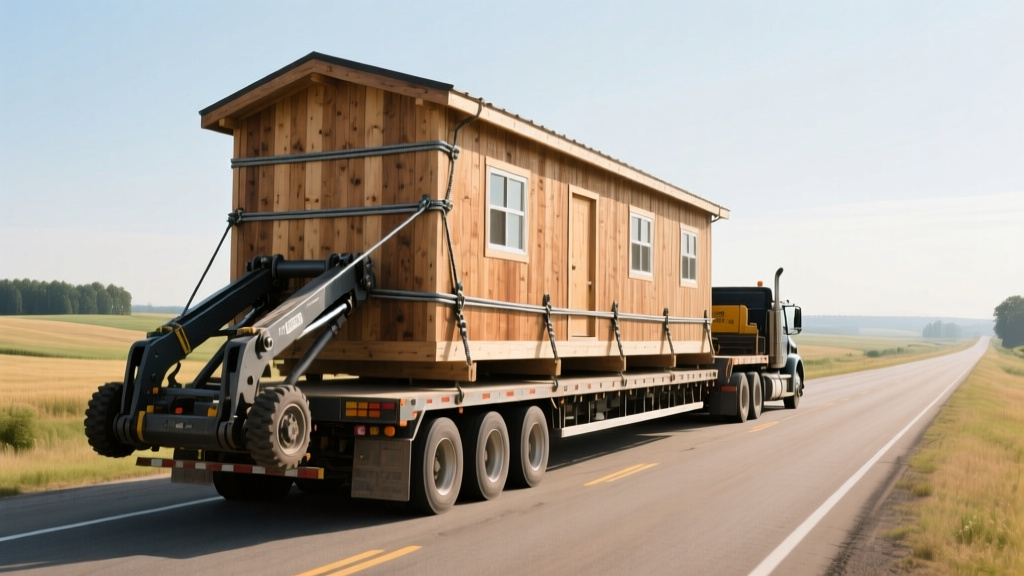
For long-distance highway transport, crane lifting onto a secured flatbed is the industry gold standard. Towing a shed on skids over highway speeds can cause catastrophic floor joist failure due to harmonic vibration and wind shear.
Hidden Fees and Permitting Roadblocks
Budgeting for a structural move requires accounting for the invisible bureaucracy of local infrastructure. One of the most frequently overlooked expenses is the utility wire lift. When an oversize storage building approaches an intersection with low-hanging telecommunications or power lines, the mover cannot simply drive under them. They must coordinate with the local utility provider to send a bucket truck to physically lift the drop wires over the load.
Utility wire lifts typically cost between $150 and $300 per intersection. If your route requires navigating through a dense suburban grid, you could easily face five or six of these lifts, adding over $1,500 in unexpected utility fees to your project.
Additionally, if your building requires a pilot car (escort vehicle), expect to pay between $1.50 and $2.50 per mile for the escort driver. For multi-state moves, you will also need to purchase temporary oversize load permits for every single state and county the truck passes through, which can range from $25 to $150 per jurisdiction.
Decision Framework: Move, Sell, or Rebuild?
Before signing a contract with a structural mover, run your project through this practical decision matrix to ensure financial viability:
- Calculate the Replacement Cost: Get a quote for a brand-new storage building of the exact same dimensions delivered to your new site. In 2026, a standard 12x20 engineered wood shed costs roughly $4,500 to $7,000 installed.
- Get a Binding Route Survey: Do not accept an over-the-phone estimate. Pay the $150-$300 fee for a professional mover to physically drive the route and measure clearances. This will give you the true, burdened cost of the move.
- Assess Structural Integrity: If the building is over 15 years old, has rotted bottom plates, or shows signs of racking (leaning), the cost to reinforce it for transport will likely exceed its residual value. In this case, sell it as-is to the current property owner and buy new.
- Verify Zoning and Setbacks: Ensure your new property's zoning laws allow for a secondary structure of that specific size, and verify that the intended placement location meets local setback requirements from property lines.
By understanding the deep regional variances and logistical hurdles involved, you can accurately forecast the cost to move a storage building and avoid the financial pitfalls that catch unprepared property owners off guard. For more data on material and transport logistics, industry professionals frequently consult resources like Move.org to track seasonal fluctuations in heavy-haul freight rates.
Written by
Elena RodriguezElena Rodriguez is a civil engineer and technical writer specializing in concrete technology, masonry systems, and ASTM/ACI compliance. She earned her B.S. in Civil Engineering from Texas A&M University and spent a decade at a materials testing laboratory, performing over 2,000 concrete compressive strength tests and masonry prism evaluations. Elena is an ACI-certified Field Testing Technician (Grade I) and a member of ASTM Committee C12 on Natural Building Stone. She currently consults on forensic engineering cases involving concrete failures and moisture intrusion. Based in San Antonio, TX, Elena is a proud member of the Society of Women Engineers (SWE) and coaches her daughter's FIRST Robotics team.
More from Elena Rodriguez
View all
Walls & Panels
Cost Analysis: Light Gauge Steel Framing Advantages and Disadvantages
Evaluate light gauge steel framing advantages and disadvantages through a strict cost analysis lens, comparing material, labor, and lifecycle expenses.
Aug 4, 2026

Walls & Panels
Gypsum Board Types: Exact Specifications, Thickness & Dimensions
Compare standard, Type X, and moisture-resistant gypsum board types. Get exact specifications, thicknesses, dimensions, and ASTM standards for your project.
Aug 4, 2026

Fire Resistance
Best Fire-Resistant Outdoor Decking Materials: 2026 Buyer Guide
Discover the best fire-resistant outdoor decking materials for 2026. Compare Class A PVC, aluminum, and hardwood options for WUI compliance and safety.
Aug 4, 2026