How Much Does It Cost to Build a Pond? 2026 Pricing
Discover exactly how much it costs to build a pond in 2026. Complete pricing breakdown for excavation, EPDM vs RPE liners, filtration, and hidden fees.
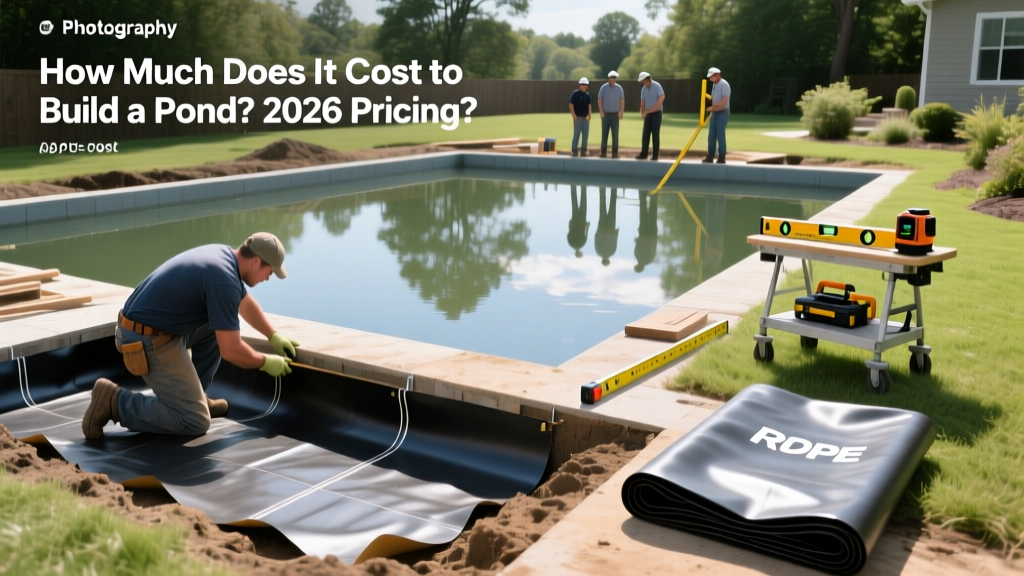
The True Cost of Building a Pond: Beyond the Liner
When homeowners and landowners ask, "how much does it cost to build a pond?", they are often met with vague estimates that fail to account for site-specific variables. The reality is that pond construction costs are dictated by soil composition, hydraulic requirements, and the intended biological load of the water feature. In 2026, a basic backyard water garden (200–400 square feet) typically ranges from $3,500 to $8,000, while a dedicated, heavily filtered koi pond (800–1,500 square feet) easily commands $15,000 to $35,000. For rural landowners, a 1/4-acre farm or irrigation pond built via heavy earthmoving equipment averages $18,000 to $45,000, heavily dependent on topography and clay availability.
Quick Cost Summary by Pond Type
- Backyard Water Garden (200-500 sq ft): $3,500 – $8,500
- Dedicated Koi Pond (800-1,500 sq ft, 4ft deep): $15,000 – $35,000
- Natural Swimming Pond (1,500+ sq ft): $40,000 – $85,000
- Farm/Irrigation Pond (1/4 acre to 1 acre): $18,000 – $65,000+
Cost Breakdown Matrix: Where the Budget Goes
To accurately estimate your project, you must break down the construction into distinct phases. The following matrix outlines the percentage of the total budget each phase typically consumes for a mid-sized residential pond (approx. 1,000 sq ft).
| Construction Phase | Estimated Cost Range | Budget % |
|---|---|---|
| Excavation & Earthwork | $2,500 – $6,000 | 20% - 25% |
| Liner & Underlayment | $2,200 – $4,500 | 15% - 20% |
| Filtration & Plumbing | $3,000 – $8,000 | 25% - 30% |
| Hardscaping & Boulders | $2,000 – $5,000 | 15% - 20% |
| Electrical & Water Fill | $800 – $2,000 | 5% - 10% |
Excavation & Earthwork Realities
Excavation is rarely as simple as digging a hole. Contractors typically charge by the cubic yard, with rates ranging from $8 to $15 per cubic yard for standard soil. However, a 1,000 square foot pond dug to an average depth of 3 feet requires moving roughly 111 cubic yards of dirt. The complication arises with spoil removal. Unless you have a designated area on your property to berm or spread the excavated soil, you will pay to haul it away. Dump truck disposal fees and transport can add $150 to $300 per load, easily adding $2,000 to your final bill.
If your soil test reveals shale, bedrock, or heavy glacial till, standard excavator buckets will fail. Contractors must bring in hydraulic hammers or rock rippers, which carry a surcharge of $500 to $1,200 per day. Always mandate a test pit dig (usually $300-$500) before signing a fixed-price excavation contract.
Pond Liners: EPDM vs. RPE vs. Bentonite
Selecting the right containment membrane is critical. According to guidelines from the USDA NRCS Pond Planning and Design standards, preventing seepage is the primary engineering challenge in pond construction. For residential and koi ponds, flexible membranes are the standard, while large rural ponds rely on compacted clay or bentonite.
45-Mil EPDM (Ethylene Propylene Diene Monomer)
EPDM remains the industry workhorse for backyard ponds. It costs between $1.80 and $2.50 per square foot. It is highly flexible, UV-stable, and can conform to complex shapes and shelving for aquatic plants. However, EPDM is vulnerable to punctures from sharp rocks and aggressive tree roots. You must install a non-woven geotextile underlayment (typically 4oz to 6oz weight, costing $0.40 to $0.60 per sq ft) beneath the liner to protect it.
RPE (Reinforced Polyethylene)
RPE liners cost $2.50 to $4.00 per square foot. They are significantly lighter than EPDM and feature a woven scrim core that provides immense puncture resistance, often eliminating the need for a separate geotextile underlayment. The trade-off is that RPE is stiffer, making it difficult to fold neatly into tight corners, and seams require specialized heat-welding or highly specific seam tapes rather than standard double-sided butyl tape.
Bentonite Clay (For Large Earthen Ponds)
For farm ponds exceeding 1/8th of an acre, synthetic liners are cost-prohibitive. Instead, contractors use Sodium Bentonite clay, which swells when wet to create an impermeable seal. As noted by Penn State Extension's pond building guidelines, bentonite application requires precise soil integration. It costs roughly $1,500 to $3,000 per acre for the material, plus the cost of a sheepsfoot roller to compact the clay into the subgrade.
Filtration, Pumps, and Hydraulics
A pond without adequate filtration will become a stagnant, algae-filled swamp within weeks. The cost of your filtration system scales directly with the biological load (fish) and the total water volume.
Sizing Your Pump (GPH Calculations)
Water gardens generally require a turnover rate of 0.5 to 1 time per hour. Koi ponds, due to heavy waste production, require 1.5 to 2 turnovers per hour. If you have a 3,000-gallon koi pond, you need a pump that delivers 4,500 to 6,000 Gallons Per Hour (GPH) after accounting for head pressure. Every 10 feet of 1.5-inch PVC pipe, plus every 90-degree elbow, adds friction loss (head pressure). High-efficiency external centrifugal pumps (like those from Sequence or Oase) cost between $800 and $2,200, while submersible mag-drive pumps cost $300 to $700 but consume significantly more electricity over their lifespan.
Filtration Systems
- Pressurized Bead Filters: Ideal for space-constrained yards. They combine mechanical and biological filtration in a sealed vessel, allowing for backwashing. Cost: $1,200 – $3,500.
- Bog / Wetland Filters: Water is pushed up through a gravel bed planted with marginal aquatic plants. Extremely low maintenance and highly effective, but requires dedicating 15% to 20% of the total pond surface area to the filter zone. Cost: $500 – $1,500 (mostly labor and gravel).
- UV Clarifiers: Essential for eradicating suspended green water algae. Expect to pay $250 to $600 for a properly sized UV unit, plus $80 for annual bulb replacements.
Hidden Costs That Derail Pond Budgets
First-time builders frequently overlook the peripheral expenses required to make a pond legally compliant and structurally sound.
- Soil Percolation & Perc Tests ($400 – $900): Many local conservation districts and county planning boards require a perc test to ensure your pond won't drain into the water table or destabilize neighboring properties.
- Permitting & Engineering ($300 – $2,500): If your pond holds more than a specific acre-foot volume (often regulated by the Army Corps of Engineers or state DEP), you may need stamped engineering blueprints and environmental impact permits.
- Electrical Trenching ($15 – $25 per linear foot): Pumps, UV lights, and landscape lighting require dedicated GFCI-protected circuits. Trenching conduit from your main panel to the pond site is a major variable cost.
- Dam Core Trenching (Farm Ponds Only): If building a dam, you must excavate a 'keyway' trench down to impermeable bedrock or heavy clay and fill it with compacted clay to prevent water from piping under the dam. This can add 20% to earthmoving costs.
Step-by-Step Budgeting Framework
To finalize your estimate, follow this sequential framework:
Step 1: Calculate Volume & Surface Area. Use the formula: Length x Width x Average Depth x 7.48 = Total Gallons. Multiply surface area by 1.5 to account for liner overlap and shelving.
Step 2: Get Site-Specific Earthwork Quotes. Do not accept per-square-foot excavation quotes. Demand a per-cubic-yard estimate that explicitly includes spoil removal or on-site berming.
Step 3: Price the Liner System. Add the cost of your chosen membrane, underlayment, and seam tape. Add 10% for material waste and cutting errors.
Step 4: Specify Hydraulics. Map your plumbing route. Calculate total dynamic head (TDH) and select a pump that meets your GPH requirement at that specific TDH. Price the corresponding filter and UV unit.
Step 5: Allocate a 15% Contingency. Unforeseen subsurface obstacles (buried debris, high water tables requiring dewatering pumps during construction) are common. Never finalize a budget without a 15% buffer.
Building a pond is a significant landscape investment that blends civil engineering with aquatic biology. By understanding the exact costs of excavation, modern liner materials, and hydraulic turnover requirements, you can avoid the common pitfalls of undercapitalized water features and ensure a thriving, structurally sound ecosystem for decades.
Written by
Elena RodriguezElena Rodriguez is a civil engineer and technical writer specializing in concrete technology, masonry systems, and ASTM/ACI compliance. She earned her B.S. in Civil Engineering from Texas A&M University and spent a decade at a materials testing laboratory, performing over 2,000 concrete compressive strength tests and masonry prism evaluations. Elena is an ACI-certified Field Testing Technician (Grade I) and a member of ASTM Committee C12 on Natural Building Stone. She currently consults on forensic engineering cases involving concrete failures and moisture intrusion. Based in San Antonio, TX, Elena is a proud member of the Society of Women Engineers (SWE) and coaches her daughter's FIRST Robotics team.
More from Elena Rodriguez
View all
Walls & Panels
Cost Analysis: Light Gauge Steel Framing Advantages and Disadvantages
Evaluate light gauge steel framing advantages and disadvantages through a strict cost analysis lens, comparing material, labor, and lifecycle expenses.
Aug 4, 2026

Walls & Panels
Gypsum Board Types: Exact Specifications, Thickness & Dimensions
Compare standard, Type X, and moisture-resistant gypsum board types. Get exact specifications, thicknesses, dimensions, and ASTM standards for your project.
Aug 4, 2026

Fire Resistance
Best Fire-Resistant Outdoor Decking Materials: 2026 Buyer Guide
Discover the best fire-resistant outdoor decking materials for 2026. Compare Class A PVC, aluminum, and hardwood options for WUI compliance and safety.
Aug 4, 2026