How Much Does It Cost to Build a Car Wash? 2026 Breakdown
Discover how much it costs to build a car wash in 2026. Compare expenses for self-serve, in-bay automatic, and tunnel washes with detailed breakdowns.

Determining how much it costs to build a car wash requires moving beyond generic national averages and analyzing the specific mechanics of site work, equipment selection, and utility infrastructure. In 2026, supply chain stabilization has reduced the cost of structural steel and conveyor components by roughly 8% compared to post-pandemic peaks, but skilled concrete finishing labor and municipal water tap fees have surged. A single-bay self-serve wash might require a modest capital outlay, while a modern express tunnel demands a multi-million-dollar investment. This guide breaks down the exact capital expenditure (CapEx) requirements across the three primary car wash models, providing the granular data needed to underwrite a profitable facility.
The 2026 Car Wash Construction Cost Matrix
Before evaluating specific equipment packages, it is critical to understand the baseline capital requirements for the three dominant car wash formats. The ranges below include land acquisition (assuming a 0.5 to 1.5-acre parcel), site preparation, building construction, equipment installation, and initial chemical inventories.
| Car Wash Model | Average Footprint | Estimated Total CapEx (2026) | Cost Per Bay / Linear Foot | Primary Revenue Driver |
|---|---|---|---|---|
| Self-Serve (Coin/RFID) | 3,000 - 5,000 sq ft | $150,000 - $350,000 | $50k - $85k per bay | Low-volume, high-margin detailing |
| In-Bay Automatic (IBA) | 4,000 - 8,000 sq ft | $450,000 - $950,000 | $250k - $400k per bay | Convenience and speed |
| Express Exterior Tunnel | 10,000 - 18,000 sq ft | $2,500,000 - $4,800,000+ | $18k - $25k per linear foot | High-volume monthly subscriptions |
In-Bay Automatic (IBA) vs. Express Tunnel: Where the Money Goes
The divergence in cost between an IBA and an Express Tunnel is not just about scale; it is about fundamental differences in civil engineering and mechanical complexity. According to industry data tracked by the International Carwash Association, express tunnels have captured over 60% of new market share in suburban developments due to the recurring revenue model of unlimited wash clubs.
In-Bay Automatic (IBA) Breakdown
An IBA facility typically features one to three bays where the vehicle remains stationary while the equipment moves around it. You will generally choose between friction (brushes) or touchless (high-pressure water) systems, or a hybrid.
- Equipment Costs: A single touchless system (e.g., PDQ LaserWash 360) costs between $65,000 and $90,000. Friction systems are slightly cheaper, ranging from $50,000 to $75,000.
- Building Shell: IBA buildings are relatively simple masonry or tilt-up concrete structures. Expect to pay $120 to $160 per square foot for the enclosed bay, including the specialized ceiling tracks and utility chases.
- Water Reclamation: While not always legally mandated for smaller IBA setups, installing a basic water reclaim system adds $25,000 to $40,000 per bay but reduces municipal water consumption by up to 70%.
Express Tunnel Breakdown
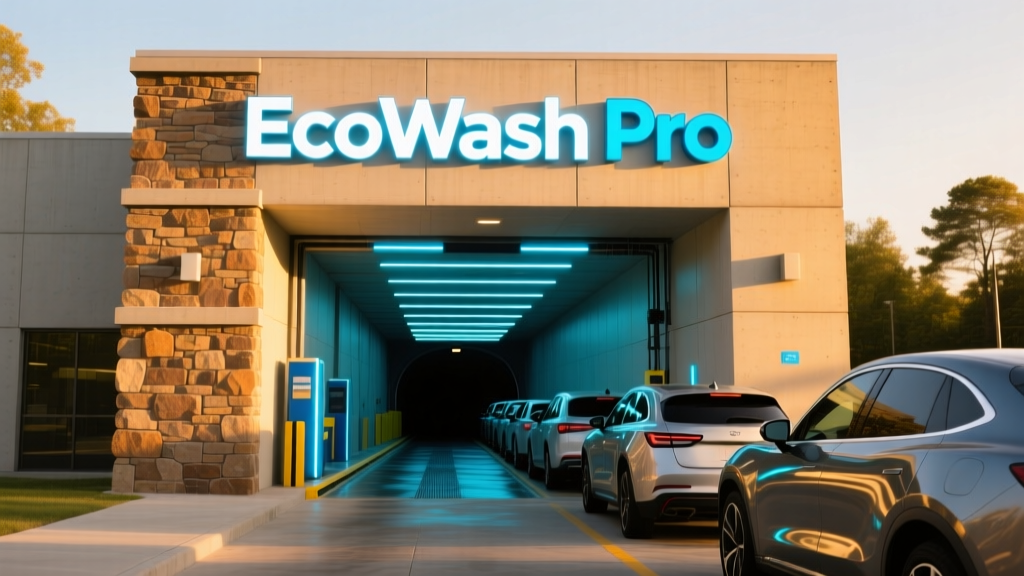
Express tunnels move vehicles through a 100-foot to 150-foot wash corridor using a chain conveyor system. The capital intensity here is driven by the sheer volume of mechanical arches and the massive footprint required for stacking vehicles.
- Conveyor and Mechanicals: A heavy-duty 30-inch or 42-inch chain conveyor system from manufacturers like Sonny's The CarWash Factory costs $150,000 to $250,000. Adding the wash arches (triple-foam applicators, high-pressure rinse manifolds, mitter curtains, and variable-frequency drive dryers) adds another $300,000 to $600,000.
- The Pit and Trenching: Tunnels require a deep, reinforced concrete pit to house the conveyor return loop and drainage. Excavating and pouring a 120-foot tunnel pit with epoxy-coated walls costs $180,000 to $250,000 due to the intense rebar requirements and waterproofing membranes.
- Advanced Water Treatment: Express tunnels use 30 to 45 gallons of fresh water per car. To comply with EPA Water Reclamation Guidelines and local sewer mandates, facilities must install reverse-osmosis (RO) and ozone-injection water treatment systems, costing $120,000 to $180,000.
Many first-time developers severely underestimate civil engineering costs. Municipal water tap fees for a high-volume tunnel can range from $80,000 to $250,000 depending on the jurisdiction. Furthermore, installing an API 450-compliant oil-water separator (OWS) and engineering a stormwater retention pond to handle the impervious surface runoff can easily add $150,000 to your site work budget. Always demand a comprehensive utility capacity letter from the local public works department before purchasing land.
Concrete, Plumbing, and Electrical Specifications
Cutting corners on the base infrastructure of a car wash leads to catastrophic maintenance costs within the first three years of operation. The environment is highly corrosive, constantly wet, and subjected to heavy vehicular loads.
Concrete and Flooring
Standard 4-inch residential concrete will spall and crack under the weight of commercial vehicles and the constant exposure to alkaline wheel cleaners. For car wash bays and tunnel pits, specify a minimum 4,000 PSI concrete mix with a 6-inch thickness. Use #4 rebar on 18-inch centers, supplemented by synthetic fiber-mesh reinforcement to prevent micro-cracking. The floor must be sloped at a minimum of 1/4 inch per foot toward stainless steel trench drains. In the chemical mixing and storage rooms, apply a 100% solids epoxy coating to prevent chemical degradation of the concrete substrate.
Plumbing and Chemical Delivery
Never use standard Schedule 40 PVC for chemical delivery lines. The high pH of tire cleaners and the acidic nature of wheel brighteners will degrade standard PVC over time. Specify Schedule 80 PVC or CPVC for all chemical lines, utilizing color-coded piping to prevent cross-contamination during maintenance. Fresh water lines should be Type L copper or commercial-grade PEX with brass fittings to withstand pressure spikes from the high-volume booster pumps.
Electrical Infrastructure
Car washes are incredibly power-hungry, primarily due to the massive centrifugal blowers used for drying. A standard express tunnel requires a 3-phase, 480V electrical service with a minimum of 800 to 1,200 amps. Upgrading a commercial parcel to support this load, including the installation of pad-mounted transformers and main distribution panels, typically costs between $45,000 and $90,000. Ensure all bay lighting and control panels are rated NEMA 4X for watertight and corrosion-resistant performance.
ROI Framework and Payback Periods
Understanding how much it costs to build a car wash is only half the equation; the capital must be deployed where it generates the highest yield. In 2026, the express tunnel model dominates valuations, often trading at EBITDA multiples of 8x to 12x once stabilized, according to commercial real estate brokers specializing in automotive properties.
To evaluate a potential project, use this baseline decision framework:
- Low Traffic Count (Under 15,000 VPD): Avoid express tunnels. The volume will not support the $35,000+ monthly debt service. Opt for a 2-bay IBA or a self-serve facility with high-margin detailing bays.
- Medium Traffic Count (15,000 - 25,000 VPD): An In-Bay Automatic with a fleet-wash contract strategy or a short (75-foot) tunnel with a limited equipment package can achieve a 3- to 4-year payback period.
- High Traffic Count (25,000+ VPD) with Easy Ingress/Egress: This is the ideal environment for a 120-foot express tunnel. Focus capital on speed-of-pit conveyors and dual-entrance stacking lanes to process 100+ cars per hour. Payback periods for well-located express tunnels typically range from 24 to 36 months.
Ultimately, the profitability of a car wash is dictated by the intersection of local demographics, traffic patterns, and the precision of your initial construction budget. By allocating capital toward robust concrete infrastructure, high-capacity electrical services, and advanced water reclamation systems, you insulate the business from premature equipment failure and ensure long-term operational viability.
Written by
Marcus ChenMarcus Chen is a licensed structural engineer (PE) and building materials analyst with over 12 years of experience across residential, commercial, and industrial construction. He holds a Master of Science in Civil Engineering from UC Berkeley and spent six years at Thornton Tomasetti before transitioning to independent consulting and technical writing. Marcus specializes in material selection for seismic-prone regions, concrete reinforcement strategies, and lifecycle cost analysis. His work has been cited by the American Concrete Institute (ACI) and the Structural Engineers Association of California (SEAOC). When he is not on a job site or at his desk, you will find him hiking the Sierra Nevada or restoring a 1920s craftsman bungalow in Oakland, CA.
More from Marcus Chen
View all
Construction Cost
How Much Did the Eiffel Tower Cost to Build?
How much did the Eiffel Tower cost to build in 1889? We adjust for inflation and compare its budget to modern skyscraper construction.
Aug 4, 2026

Fire Resistance
What Is a Fire Resistant Material? Testing & Certification Guide
Discover what is a fire resistant material through ASTM and UL testing. Learn how fire ratings, certifications, and assemblies work in construction.
Aug 4, 2026

Construction Cost
How Much Did the Burj Khalifa Cost to Build?
How much did the Burj Khalifa cost to build? We break down the $1.5B project and extract 5 money-saving strategies for your next build.
Jul 30, 2026