How Much Does a Nuclear Plant Cost to Build? Regional Breakdown
Discover how much a nuclear plant costs to build across global regions. We analyze OCC, financing, and reactor models like the AP1000 and SMRs.

The True Baseline: Overnight Capital Costs vs. All-In Costs
When energy developers, policymakers, and investors ask how much does a nuclear plant cost to build, the answer requires splitting the total price tag into two distinct metrics: Overnight Capital Costs (OCC) and Total Capital Costs (often called All-In Costs). Failing to distinguish between these two figures is the primary reason public cost estimates for nuclear energy vary so wildly in mainstream financial reporting.
Overnight Capital Cost (OCC): The direct cost of engineering, procurement, and construction (EPC) assuming the plant is built instantly overnight. This includes materials, labor, and site preparation.
Interest During Construction (IDC): The financing costs accrued over the 7-to-12-year build timeline of a large-scale reactor. In high-interest-rate environments, IDC can equal or exceed the OCC.
A standard 1,100-megawatt (MW) Generation III+ pressurized water reactor (PWR) requires massive upfront capital. While the physical materials and labor (OCC) might cost $4 billion, the decade-long financing (IDC) at commercial interest rates can push the final all-in cost past $10 billion. Understanding this divergence is critical for evaluating regional price disparities, as state-backed financing in Asia dramatically suppresses the IDC penalty that plagues Western developers.
Global Regional Cost Matrix: Price Per Kilowatt
The cost to build a nuclear facility is not a universal constant; it is heavily dictated by regional supply chain maturity, regulatory frameworks, and labor availability. The table below outlines the estimated 2026 capital costs per kilowatt (kW) of installed capacity across major global markets, based on recent Gen III+ deployments and standardized fleet data.
| Region | Dominant Reactor Model | Est. OCC (Per kW) | Est. All-In Cost (Per kW) | Primary Cost Driver |
|---|---|---|---|---|
| North America (US) | Westinghouse AP1000 | $7,500 - $9,500 | $13,000 - $16,000+ | FOAK penalties, supply chain atrophy, high WACC |
| Western Europe (UK/FR) | EDF EPR | $7,000 - $9,000 | $11,000 - $15,000 | Regulatory complexity, labor shortages, design changes |
| South Korea | KEPCO APR1400 | $3,500 - $4,500 | $5,000 - $6,500 | Standardized fleet building, mature domestic supply chain |
| China | CNNC Hualong One / CAP1000 | $2,500 - $3,500 | $3,200 - $4,500 | State financing (low WACC), continuous construction cadence |
According to comprehensive modeling by the MIT Energy Initiative, the stark contrast between Western and Asian costs is rarely about the physical price of steel or concrete. Instead, it is driven by the loss of continuous construction experience in the West, leading to severe First-of-a-Kind (FOAK) engineering penalties and schedule overruns that compound financing costs.
The Western Premium: Why the US and Europe Struggle
In the United States, the recent completion of the Vogtle Units 3 and 4 in Georgia—featuring the Westinghouse AP1000 design—established a new baseline for American nuclear construction. The final all-in cost for the two-unit, 2,200 MW expansion exceeded $36 billion, translating to roughly $16,000 per kW. Similarly, in Europe, EDF’s Flamanville 3 EPR in France and the Hinkley Point C project in the UK have experienced massive budget escalations, with Hinkley Point C's projected costs surpassing £46 billion ($58 billion USD).
Supply Chain Atrophy and Heavy Forging Bottlenecks
A major contributor to the Western premium is the atrophy of the heavy nuclear supply chain. The reactor pressure vessel (RPV) requires massive, ultra-pure steel forgings. For decades, Japan Steel Works (JSW) held a near-global monopoly on the capacity to forge these components. When Western nations halted nuclear builds in the 1990s and 2000s, domestic heavy forging capabilities vanished. Restarting this supply chain requires billions in capital expenditure and years of NRC (Nuclear Regulatory Commission) or ASN (Autorité de sûreté nucléaire) certification, resulting in severe bottlenecks and premium pricing for Western developers.
The FOAK Engineering Penalty
Gen III+ designs like the AP1000 and EPR were theoretically designed to be simpler and cheaper than Gen II plants. However, because they were First-of-a-Kind (FOAK) deployments, builders encountered thousands of undocumented engineering clashes. At Vogtle, construction began before the NRC had fully finalized the design certification, leading to costly mid-build rework. The World Nuclear Association notes that FOAK plants typically cost 30% to 50% more than Nth-of-a-Kind (NOAK) plants due to the learning curve effect, a penalty Western developers are currently absorbing.
The Asian Advantage: Fleet Standardization
Conversely, China and South Korea approach nuclear construction as an industrial manufacturing process rather than a bespoke mega-project. China currently builds between six and eight large-scale reactors annually. This continuous cadence maintains a highly skilled workforce of nuclear-certified welders, pipefitters, and heavy crane operators. Because the supply chain never went dormant, Chinese developers procure RPVs, steam generators, and coolant pumps domestically at mass-production scales.
South Korea’s KEPCO utilizes the APR1400 design, building standardized units sequentially. By freezing the design and repeating it, KEPCO achieves a predictable 56-to-60-month construction timeline. This predictability is the ultimate cost-control mechanism in mega-projects; finishing a plant on schedule prevents the compounding interest of construction loans from destroying the project's internal rate of return (IRR).
Small Modular Reactors (SMRs): A 2026 Cost Reality Check
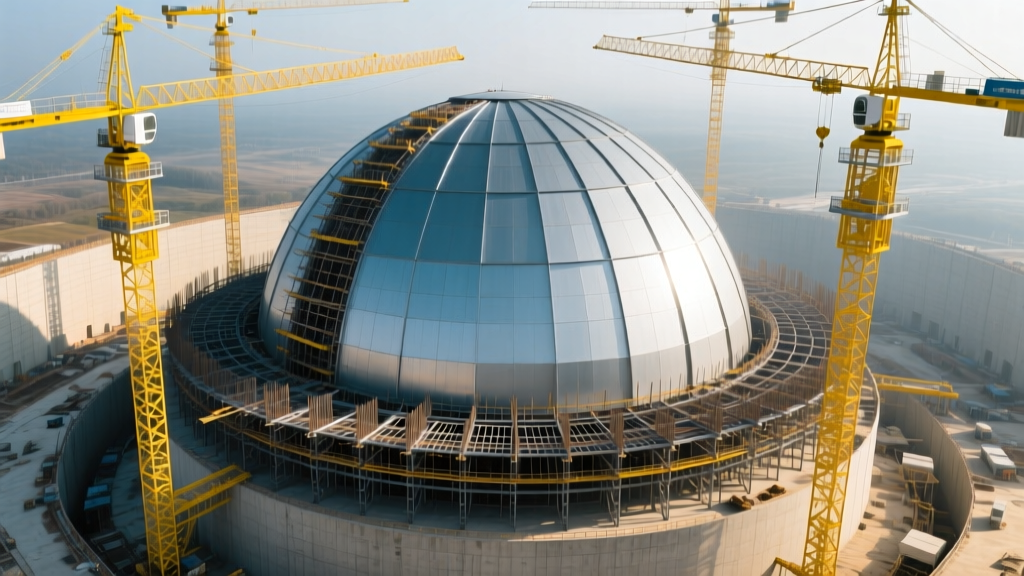
The nuclear industry has heavily promoted Small Modular Reactors (SMRs) as the solution to the capital cost barrier. The premise is that factory-fabricated modules (ranging from 50 MW to 300 MW) can be shipped to sites and assembled rapidly, shifting costs from the construction site to the factory floor. Early projections suggested SMRs could achieve all-in costs of $4,000 to $6,000 per kW.
However, the 2026 reality for SMRs reflects the same FOAK hurdles as large reactors. Following the cancellation of the NuScale UAMPS project in late 2023 due to rising subscription costs and inflation, the industry has recalibrated. Current SMR developers are now targeting initial capital costs closer to $8,000 - $12,000 per kW for first deployments.
To survive the FOAK premium, SMR developers in 2026 are pivoting away from municipal utility grids and instead targeting direct behind-the-meter partnerships with hyperscale data centers, heavy desalination plants, and green hydrogen production facilities. These off-takers are willing to pay a premium for 24/7 firm, zero-carbon baseload power, effectively subsidizing the initial SMR learning curve.
The Hidden Multiplier: How WACC Dictates Viability
When analyzing how much does a nuclear plant cost to build, the Weighted Average Cost of Capital (WACC) is the single most volatile variable. Nuclear plants are highly capital-intensive but feature very low marginal operating costs and 60-to-80-year lifespans. Therefore, the cost of debt and equity during the build phase dictates the final Levelized Cost of Energy (LCOE).
- State-Backed Financing (WACC 3% - 5%): In China, state-owned enterprises borrow at sovereign rates. A 1,000 MW plant costing $3.5 billion in OCC might only add $500 million in financing costs over a 6-year build.
- Regulated Utility Model (WACC 6% - 8%): In the US, regulated utilities can pass costs to ratepayers or use Construction Work in Progress (CWIP) financing, keeping rates moderate but still burdensome.
- Merchant/Private Financing (WACC 9% - 12%): For private developers in deregulated markets (like the UK or parts of the US), the risk premium is massive. A 10% WACC can double the all-in cost of the plant compared to a 3% WACC, rendering the project economically unviable without government loan guarantees or Regulated Asset Base (RAB) funding models.
Data from the U.S. Energy Information Administration (EIA) consistently highlights that capital costs for nuclear are heavily front-loaded, making the technology uniquely sensitive to interest rate fluctuations compared to natural gas or solar, which have lower upfront capital requirements.
Strategic Framework for Energy Developers
For developers and investors evaluating nuclear construction in Western markets, mitigating the historical cost overruns requires a strict, disciplined framework:
- Secure Sovereign or RAB Financing: Never attempt to finance a large-scale nuclear plant on a private merchant basis. Utilize government loan guarantee programs (like the US DOE Title 17) or Regulated Asset Base models to push the WACC below 6%.
- Mandate Design Freeze: Do not break ground until the regulatory body has issued final design certification. Constructing while simultaneously engineering is the primary cause of the multi-billion-dollar overruns seen in early AP1000 and EPR builds.
- Target Nth-of-a-Kind (NOAK) Sites: If possible, build subsequent units on the same site or use identical site layouts to reuse engineered templates, heavy-lift crane infrastructure, and licensed labor pools.
- Co-locate with Thermal Off-takers: Maximize revenue streams by designing the plant for cogeneration—supplying industrial process heat to adjacent chemical, refining, or district heating facilities, which improves overall thermal efficiency and project IRR.
Ultimately, the cost to build a nuclear plant is not a fixed technological limit, but a reflection of regional industrial policy, supply chain continuity, and financial engineering. Regions that treat nuclear construction as a continuous manufacturing pipeline achieve costs less than half of those that treat it as a bespoke, once-in-a-generation mega-project.
Written by
Elena RodriguezElena Rodriguez is a civil engineer and technical writer specializing in concrete technology, masonry systems, and ASTM/ACI compliance. She earned her B.S. in Civil Engineering from Texas A&M University and spent a decade at a materials testing laboratory, performing over 2,000 concrete compressive strength tests and masonry prism evaluations. Elena is an ACI-certified Field Testing Technician (Grade I) and a member of ASTM Committee C12 on Natural Building Stone. She currently consults on forensic engineering cases involving concrete failures and moisture intrusion. Based in San Antonio, TX, Elena is a proud member of the Society of Women Engineers (SWE) and coaches her daughter's FIRST Robotics team.
More from Elena Rodriguez
View all
Walls & Panels
Cost Analysis: Light Gauge Steel Framing Advantages and Disadvantages
Evaluate light gauge steel framing advantages and disadvantages through a strict cost analysis lens, comparing material, labor, and lifecycle expenses.
Aug 4, 2026

Walls & Panels
Gypsum Board Types: Exact Specifications, Thickness & Dimensions
Compare standard, Type X, and moisture-resistant gypsum board types. Get exact specifications, thicknesses, dimensions, and ASTM standards for your project.
Aug 4, 2026

Fire Resistance
Best Fire-Resistant Outdoor Decking Materials: 2026 Buyer Guide
Discover the best fire-resistant outdoor decking materials for 2026. Compare Class A PVC, aluminum, and hardwood options for WUI compliance and safety.
Aug 4, 2026