Cost to Build Cold Storage Per Tonne in India: 2026 Savings Guide
Discover the exact cost to build cold storage per tonne in India for 2026. Learn material hacks, refrigerant tipping points, and OPEX-saving strategies.

The 2026 Baseline: Cold Storage Cost Per Tonne in India
Calculating the exact cost to build cold storage per tonne in India requires moving beyond generic square-foot estimates. In 2026, the Indian cold chain sector is heavily influenced by fluctuating steel prices, updated energy efficiency norms (ECBC), and the shift toward low-GWP (Global Warming Potential) refrigerants. According to data aligned with the National Centre for Cold-chain Development (NCCD), capital expenditure (CAPEX) is no longer a flat rate; it scales non-linearly based on temperature zones, structural methodology, and automation levels.
For developers and agri-business owners, understanding the cost per Metric Tonne (MT) is the most accurate way to forecast ROI. Below is the current baseline matrix for 2026, excluding land acquisition and localized grid-connection fees.
| Temperature Zone | Primary Application | Insulation Standard | 2026 CAPEX per MT (INR) |
|---|---|---|---|
| Chiller (0°C to 4°C) | Fruits, Vegetables, Dairy | 100mm EPS / 80mm PUF | ₹65,000 - ₹85,000 |
| Freezer (-18°C to -25°C) | Meat, Seafood, Frozen Veg | 150mm PUF (42 kg/m³) | ₹95,000 - ₹1,30,000 |
| Blast Freezer (-35°C to -40°C) | IQF Processing, Pharma | 200mm PUF + Vapor Seal | ₹1,50,000 - ₹2,10,000 |
Material Hacks: Slashing Panel and Insulation CAPEX
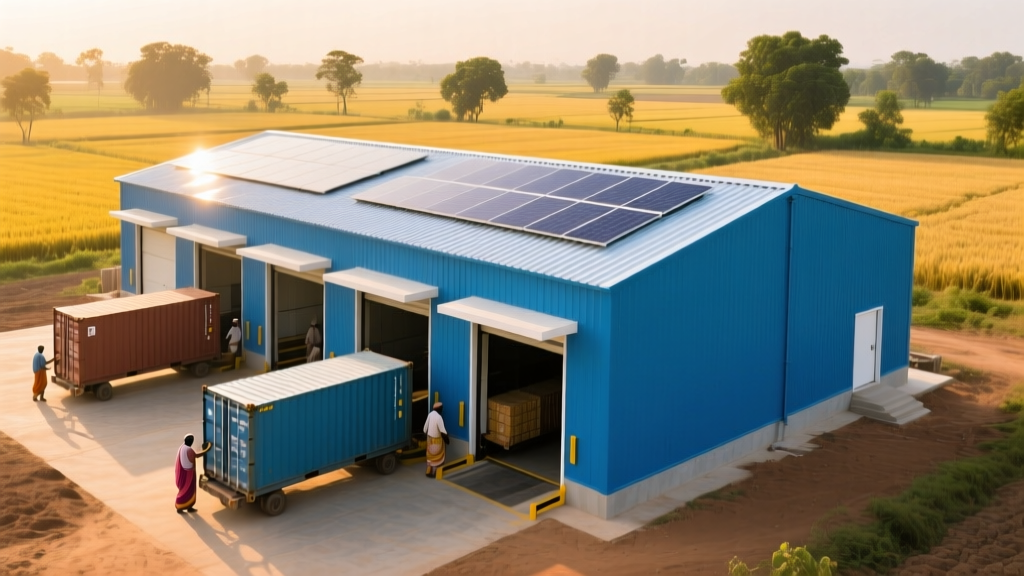
The building envelope accounts for 25% to 35% of the total project cost. The default assumption in the Indian market is to use Polyurethane Foam (PUF) sandwich panels for everything. While PUF offers superior thermal resistance (R-value of ~6.0 per inch), it is a premium material. You can significantly reduce your cost to build cold storage per tonne in India by deploying a hybrid insulation strategy based on the specific thermal load of the chamber.
The EPS vs. PUF Decision Matrix
- For Chillers (0°C to 4°C): Use 100mm Expanded Polystyrene (EPS) panels with a density of 18-20 kg/m³. EPS costs roughly 30% less than PUF. Because the temperature differential (Delta T) between the Indian ambient summer (up to 45°C) and the chamber (4°C) is moderate, EPS provides adequate thermal resistance when paired with a high-quality 0.2mm polyethylene vapor barrier.
- For Freezers (-18°C and below): Strictly use 150mm PUF panels with a density of 40-42 kg/m³. At sub-zero temperatures, EPS becomes brittle and is prone to moisture ingress if the vapor barrier is compromised, leading to structural degradation and massive compressor overwork.
- Ceiling vs. Wall Optimization: In large-span facilities (>2000 MT), the ceiling absorbs the highest solar radiation. Use 120mm PUF for the roof deck, but drop down to 100mm PUF or high-density EPS for the vertical walls if they are shaded or internal, saving up to 12% on total envelope costs.
Furthermore, opt for Pre-Engineered Building (PEB) steel structures over traditional reinforced concrete (RCC). PEB reduces the dead load on the foundation, allowing for isolated footings rather than expensive raft foundations, cutting civil works costs by 15% to 20% while accelerating the construction timeline by 40%.
The Refrigerant Tipping Point: Ammonia vs. HFO Blends
Refrigeration plant sizing dictates the mechanical CAPEX. The choice of refrigerant is the single largest variable in this equation. While global trends push toward natural refrigerants, the Indian regulatory landscape (governed by PESO for hazardous gases) requires a strict cost-benefit analysis.
When to Cross Over to Ammonia (R717)
Ammonia systems offer the lowest cost per Ton of Refrigeration (TR) at scale, but the safety infrastructure (gas detection, emergency scrubbers, blast-proof electrical fittings) adds a fixed CAPEX overhead.
- Under 500 MT Capacity: Stick to HFC/HFO blends (like R448A or R513A). The safety compliance cost for Ammonia will artificially inflate your per-tonne cost, destroying your ROI.
- 500 MT to 2000 MT: Consider CO2 (R744) transcritical booster systems. As highlighted by Danfoss India Cold Chain Solutions, CO2 systems are becoming highly competitive in India's climate, offering excellent heat recovery potential for facility hot water needs without the severe regulatory hurdles of Ammonia.
- Above 2000 MT: Ammonia (R717) is the undisputed king. The economies of scale absorb the safety CAPEX, and the high latent heat of vaporization means smaller pipe diameters and lower compressor power consumption, reducing long-term OPEX by up to 25% compared to synthetic refrigerants.
OPEX Offsets: Designing for the Indian Power Grid
The true cost of a cold storage facility is realized in its operational expenditure (OPEX). In India, industrial power tariffs can exceed ₹8 to ₹10 per kWh, and grid instability necessitates expensive diesel generator (DG) backups. Integrating passive and active energy-saving designs from day one is critical.
Do not attempt to run compressors directly on solar PV without battery storage or grid-tie net metering. Compressors require high starting torque and stable voltage. Instead, design a Solar-Thermal Integration or use solar PV strictly for the facility's auxiliary loads (lighting, vestibule cooling, control panels, and evaporator fans), which account for 15-20% of the total electrical load but are much safer to offset with intermittent solar power.
Thermal Energy Storage (TES): Utilize Phase Change Materials (PCM) or ice-thermal storage tanks. By generating and storing 'coolth' during off-peak night hours (when ambient temperatures are lower and grid tariffs are cheaper), you can shut down the primary compressors during the peak afternoon tariff window (usually 14:00 to 18:00). This load-shifting strategy can reduce monthly electricity bills by 18% to 22%, drastically altering the lifecycle cost of the facility.
4 Hidden Cost Traps That Destroy Margins
Even with optimized material selection, poor detailing during the design phase leads to massive cost overruns. Avoid these common pitfalls documented by the International Association of Refrigerated Warehouses (IARW) and local engineering audits:
- Skipping Underfloor Heating in Freezers: In sub-zero chambers, the cold penetrates the floor slab and freezes the soil moisture beneath, causing 'frost heave' that will crack and lift the concrete slab within 3 to 5 years. Installing a glycol-loop or electric mat underfloor heating system costs roughly ₹450 per sq.m. Retrofitting it after a slab failure costs upwards of ₹3,500 per sq.m. and requires facility downtime.
- Undersized Loading Vestibules: A vestibule acts as an airlock. If it is too small (e.g., 5x5 meters), forklifts cannot maneuver with pallets, forcing operators to leave the main chamber doors open longer. Specify a minimum 8x6 meter vestibule equipped with high-speed rapid roll doors (operating at 1.5m/s) to minimize thermal exchange and reduce compressor load.
- Vapor Barrier Punctures: The vapor barrier must be on the 'warm side' of the insulation. In India, this means the exterior face of the cold room panels. If civil contractors run electrical conduits or plumbing through the panels without properly sealing them with specialized mastic and mechanical glands, moisture will infiltrate the PUF/EPS, destroying its R-value and causing ice buildup on the evaporator coils.
- Incorrect Defrost Sizing: Relying solely on electric defrost for large freezers wastes massive amounts of energy. Specify hot-gas defrost systems for ammonia and large freon plants. While hot-gas piping adds about 8% to the initial mechanical CAPEX, it utilizes waste heat from the compressor to melt ice on the coils, paying for itself in energy savings within 14 months.
'The most expensive cold storage facility is not the one with the highest initial CAPEX, but the one built with generic specifications that ignore the local micro-climate and grid realities. Precision in envelope detailing and refrigerant selection is where the actual margin is protected.'
— Senior Cold Chain Infrastructure Auditor, 2026 Industry Report
By treating the cost to build cold storage per tonne in India as a dynamic equation rather than a fixed metric, developers can engineer facilities that are not only cheaper to build but fundamentally more resilient to the operational realities of the Indian supply chain.
Written by
Marcus ChenMarcus Chen is a licensed structural engineer (PE) and building materials analyst with over 12 years of experience across residential, commercial, and industrial construction. He holds a Master of Science in Civil Engineering from UC Berkeley and spent six years at Thornton Tomasetti before transitioning to independent consulting and technical writing. Marcus specializes in material selection for seismic-prone regions, concrete reinforcement strategies, and lifecycle cost analysis. His work has been cited by the American Concrete Institute (ACI) and the Structural Engineers Association of California (SEAOC). When he is not on a job site or at his desk, you will find him hiking the Sierra Nevada or restoring a 1920s craftsman bungalow in Oakland, CA.
More from Marcus Chen
View all
Construction Cost
How Much Did the Eiffel Tower Cost to Build?
How much did the Eiffel Tower cost to build in 1889? We adjust for inflation and compare its budget to modern skyscraper construction.
Aug 4, 2026

Fire Resistance
What Is a Fire Resistant Material? Testing & Certification Guide
Discover what is a fire resistant material through ASTM and UL testing. Learn how fire ratings, certifications, and assemblies work in construction.
Aug 4, 2026

Construction Cost
How Much Did the Burj Khalifa Cost to Build?
How much did the Burj Khalifa cost to build? We break down the $1.5B project and extract 5 money-saving strategies for your next build.
Jul 30, 2026