How Much Does It Cost to Build a Screened Porch in 2026?
Discover exactly how much it costs to build a screened porch in 2026. Breakdowns for materials, labor, roof tie-ins, and hidden expenses.

The Baseline: How Much Cost to Build a Screened Porch?
When homeowners ask how much cost to build a screened porch, the answer depends entirely on structural integration and material grade. In 2026, the national average for a fully enclosed, roofed screened porch ranges from $28 to $45 per square foot for a basic build on an existing slab, and $65 to $115 per square foot for a premium build requiring a new foundation, composite decking, and a complex gable roof tie-in. For a standard 200-square-foot (10x20) porch, expect total project costs to land between $5,600 and $23,000.
• Budget Build (Wood frame, asphalt roof, existing slab): $5,600 - $9,000
• Mid-Range Build (Cedar frame, architectural shingles, new footings): $9,500 - $14,000
• Premium Build (Extruded aluminum, standing seam metal, composite floor): $15,000 - $23,000+
According to industry data tracked by Angi's 2026 outdoor construction index, material costs for extruded aluminum and composite decking have stabilized after the supply chain volatility of previous years, but skilled carpentry labor rates have increased by roughly 8% nationwide.
Material Breakdown: Framing and Screen Systems
The skeleton of your porch dictates both the upfront cost and the long-term maintenance. While pressure-treated wood remains the cheapest option, the industry is rapidly shifting toward specialized aluminum systems.
| Framing Material | Cost per Sq. Ft. (Materials) | Lifespan & Maintenance | Best Use Case |
|---|---|---|---|
| Pressure-Treated Pine (PT) | $6 - $10 | 15-20 years; requires annual sealing/painting | Budget builds, painted finishes |
| Western Red Cedar | $12 - $18 | 25+ years; naturally rot-resistant, weathers to gray | Aesthetic focus, natural wood look |
| Extruded Aluminum (e.g., ScreenEze) | $16 - $24 | 50+ years; zero maintenance, no warping | Premium builds, large unsupported spans |
Screen Mesh Selection: Don't Compromise Here
The mesh itself is a relatively small percentage of the total budget but dictates daily usability. Standard charcoal fiberglass mesh (like Phifer Glass) costs about $0.25 per square foot and offers excellent visibility. However, if you have pets or high-traffic areas, upgrade to a polyester pet screen (e.g., Phifer PetScreen), which costs roughly $0.60 per square foot but is up to seven times thicker and resists claw tears. For coastal areas or regions with high corrosion risk, stainless steel mesh is mandatory, running $2.50 to $4.00 per square foot.
The Roof Tie-In: The Biggest Budget Variable
If you are attaching a screened porch to an existing home, the roof connection is where budgets frequently balloon. You cannot simply bolt a ledger board to existing siding and hope for the best; the International Residential Code (IRC) requires structural load transfer and proper water management.
- Shed Roof (Single Slope): The most economical option ($18 - $25 per sq. ft. for roofing). Requires a continuous ledger board attached directly to the house's rim joist or wall studs. Best for homes with high second-story eaves.
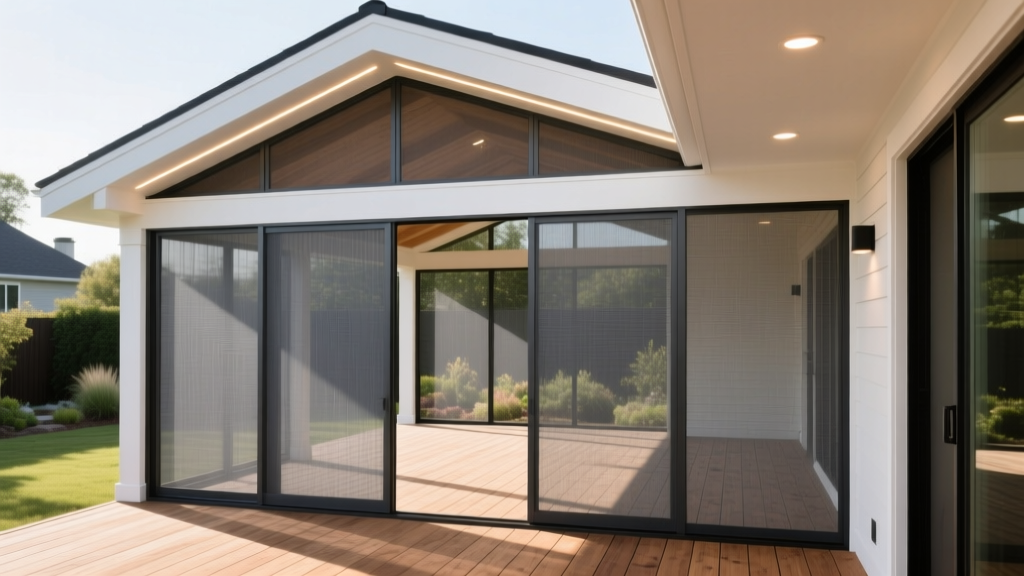
- Gable Roof (Peaked): Costs 30% to 50% more than a shed roof due to the need for a structural ridge beam, additional trusses, and complex flashing. Provides a vaulted ceiling feel and better air circulation but requires cutting into the existing roofline in many cases.
- Flat Roof (EPDM/TPO Membrane): Rare for residential porches due to drainage issues, but sometimes necessary for second-story bump-outs or homes with very low eaves.
Labor Costs and Contractor Markups
Labor typically accounts for 40% to 55% of the total project cost. According to HomeAdvisor's contractor pricing data, general contractors charge a 15% to 20% project management fee on top of subcontractor rates. For a $15,000 porch, that is $2,250 to $3,000 just for coordination.
If you are managing the project yourself (acting as the owner-builder), you can save this markup, but you must coordinate specialized trades:
- Excavation & Concrete: Pouring sonotube footings below the local frost line (typically 36 to 48 inches deep in northern climates).
- Framing & Carpentry: Building the deck substructure, posts, and roof rafters.
- Roofing: Shingling or metal panel installation and flashing.
- Electrical: Running dedicated 20-amp GFCI circuits for outdoor receptacles and installing ceiling fan-rated junction boxes.
Hidden Costs That Blow Up Screened Porch Budgets
Homeowners frequently underestimate the peripheral requirements of a code-compliant porch. Factor these into your initial estimate to avoid mid-project financial shocks:
| Hidden Cost Factor | Estimated Added Cost | Why It's Required |
|---|---|---|
| Helical Piers / Deep Footings | $1,500 - $3,500 | Required if soil is expansive or frost line is deep; prevents roof sagging. |
| HVAC Extension / Mini-Split | $2,000 - $4,500 | Needed if you plan to enclose the porch with windows later (four-season room). |
| Electrical Panel Upgrade | $1,200 - $2,500 | Necessary if your current panel lacks 2 open slots for the new outdoor circuits. |
| Permitting & Engineering | $400 - $900 | Required for structural roof tie-ins; may need stamped engineer drawings. |
Regional Pricing Matrix
Construction costs vary wildly based on local labor rates, permit strictness, and material shipping distances. The National Association of Home Builders (NAHB) regularly tracks regional cost indices, which reflect the following localized averages for a mid-range 200 sq. ft. screened porch in 2026:
- Northeast (e.g., Boston, NY Suburbs): $16,000 - $22,000. High labor rates, strict frost-depth footing requirements, and expensive permit fees drive costs up.
- Southeast (e.g., Atlanta, Charlotte): $11,000 - $15,000. Lower labor costs, shallower frost lines (reducing concrete work), and high market competition keep prices moderate.
- Midwest (e.g., Chicago, Minneapolis): $13,000 - $18,000. Moderate labor, but extreme weather requirements (heavy snow load roof engineering, deep footings) add structural costs.
- West Coast (e.g., Seattle, Bay Area): $18,000 - $26,000+. Highest labor and material costs in the country, compounded by stringent seismic and environmental building codes.
ROI and Resale Value: Is It Worth the Investment?
A screened porch is consistently ranked among the top outdoor living additions for return on investment. While a basic wood deck might recoup 50% to 60% of its cost at resale, a well-integrated screened porch with a proper roof tie-in and durable materials typically recoups 70% to 80% of the project cost. In regions with high mosquito populations or intense summer sun (like the Southeast and Gulf Coast), a screened porch is often considered a mandatory feature by buyers, effectively increasing the home's marketability and reducing days on market, even if the direct dollar-for-dollar ROI caps out around 75%.
To maximize ROI, avoid overly personalized design choices. Stick to neutral composite decking colors (like Trex Transcend in Spiced Rum), matte black or bronze aluminum framing, and architectural shingles that perfectly match the primary home's roof. This creates the illusion that the porch was part of the original architectural footprint, which appraisers and buyers heavily favor.
Written by
Marcus ChenMarcus Chen is a licensed structural engineer (PE) and building materials analyst with over 12 years of experience across residential, commercial, and industrial construction. He holds a Master of Science in Civil Engineering from UC Berkeley and spent six years at Thornton Tomasetti before transitioning to independent consulting and technical writing. Marcus specializes in material selection for seismic-prone regions, concrete reinforcement strategies, and lifecycle cost analysis. His work has been cited by the American Concrete Institute (ACI) and the Structural Engineers Association of California (SEAOC). When he is not on a job site or at his desk, you will find him hiking the Sierra Nevada or restoring a 1920s craftsman bungalow in Oakland, CA.
More from Marcus Chen
View all
Construction Cost
How Much Did the Eiffel Tower Cost to Build?
How much did the Eiffel Tower cost to build in 1889? We adjust for inflation and compare its budget to modern skyscraper construction.
Aug 4, 2026

Fire Resistance
What Is a Fire Resistant Material? Testing & Certification Guide
Discover what is a fire resistant material through ASTM and UL testing. Learn how fire ratings, certifications, and assemblies work in construction.
Aug 4, 2026

Construction Cost
How Much Did the Burj Khalifa Cost to Build?
How much did the Burj Khalifa cost to build? We break down the $1.5B project and extract 5 money-saving strategies for your next build.
Jul 30, 2026