How Much Did It Cost to Build Twin Towers? A Financing Case Study
Discover how much it cost to build the original Twin Towers, the municipal bond financing used, and what a modern equivalent mega-project costs today.

The Original Price Tag: How Much Did It Cost to Build Twin Towers?
When analyzing mega-project economics, developers and financial analysts frequently ask: how much did it cost to build the original Twin Towers? The direct construction cost for One and Two World Trade Center was approximately $400 million upon completion in 1973. The broader 16-acre World Trade Center complex, which included the Marriott hotel, the low-rise buildings, and the subterranean mall, brought the total project cost to roughly $900 million.
However, looking at raw historical numbers without adjusting for inflation and construction-specific economic shifts provides a distorted view of project feasibility. According to data tracked by the Bureau of Labor Statistics Producer Price Index for Construction, standard consumer inflation drastically underrepresents the true cost escalation in commercial high-rise development.
| Cost Metric | 1973 Nominal Cost | 2026 CPI Adjusted | 2026 Construction Cost Index (CCI) Adjusted |
|---|---|---|---|
| Twin Towers (Direct Construction) | $400 Million | $2.85 Billion | $4.60 Billion |
| Full 16-Acre Complex | $900 Million | $6.41 Billion | $10.35 Billion |
| Land Acquisition & Site Prep | $60 Million | $427 Million | $850 Million+ |
The disparity between the Consumer Price Index (CPI) adjustment and the Construction Cost Index (CCI) adjustment highlights a critical reality in modern cost estimating: specialized materials (like high-strength structural steel), unionized skilled labor, and complex engineering scale at a much higher rate than general consumer goods.
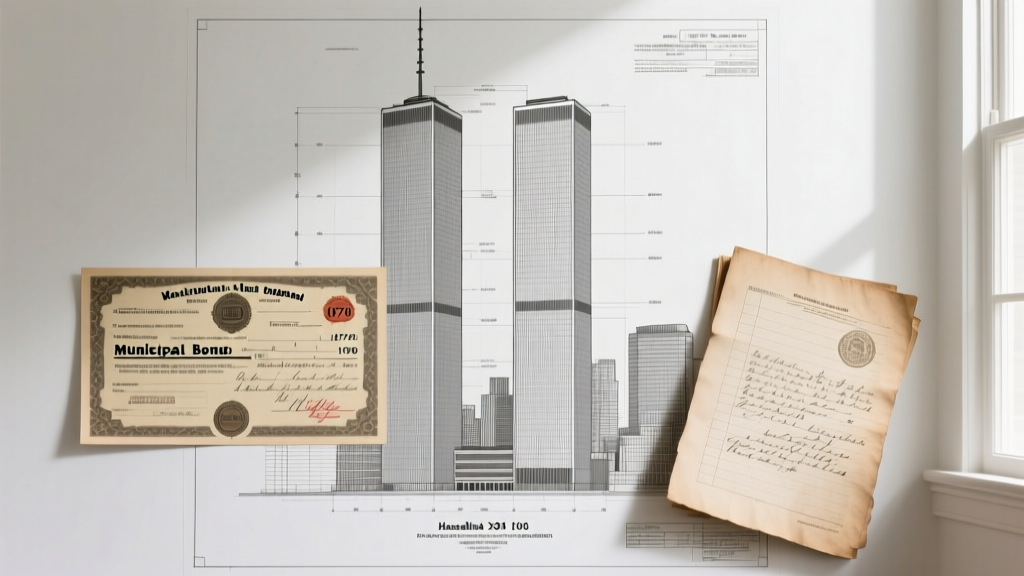
The Financing Blueprint: Funding a 1970s Mega-Project
Understanding how much it cost to build the Twin Towers is only half the equation; understanding how it was paid for provides the real masterclass in mega-project finance. The Port Authority of New York and New Jersey (PANYNJ) did not rely on direct taxpayer appropriations. Instead, they utilized a sophisticated municipal revenue bond structure.
Key Financing Mechanism: Tax-Exempt Revenue Bonds
The Port Authority issued tax-exempt bonds to raise the initial capital. Because the WTC was classified as a public-purpose infrastructure project (facilitating interstate commerce and transit), the interest paid to bondholders was exempt from federal income tax. This allowed the Port Authority to offer lower interest rates than conventional corporate debt, saving hundreds of millions in debt service over the life of the bonds.
To secure these bonds, the Port Authority relied on a "leaseback" and guaranteed occupancy model. The State of New York and various federal agencies signed long-term, ironclad leases for millions of square feet of office space before the towers were even completed. These guaranteed lease revenues served as the collateral that made the bonds highly attractive to institutional investors like pension funds and insurance companies.
The Role of the Hudson River Landfill
A hidden financial masterstroke was the site preparation itself. The 16-acre site was largely underwater, requiring the construction of a massive slurry wall (the "bathtub") to hold back the Hudson River. The excavated dirt and rock—over 1 million cubic yards—was not hauled away at a premium. Instead, it was used to create 23 acres of new landfill in Battery Park City, generating new real estate assets that further subsidized the project's capital stack.
Modern Equivalents: What Would It Cost to Build the Twin Towers Today?
If a developer proposed building the exact Twin Towers today, the cost would be astronomical, driven by post-9/11 structural codes, LEED sustainability mandates, and advanced life-safety systems. We can look to the Council on Tall Buildings and Urban Habitat (CTBUH) data on One World Trade Center (Freedom Tower) for a modern baseline.
One WTC, a single 104-story tower, cost approximately $3.9 billion to complete in 2014. Adjusting for 2026 construction inflation, a single modern supertall tower of that magnitude now costs between $4.5 billion and $5.2 billion. Therefore, a modern twin-tower equivalent would require a capital stack of $9 billion to $11 billion.
| Cost Category | 1973 WTC Allocation | 2026 Supertall Allocation | Primary Driver of Increase |
|---|---|---|---|
| Structural Steel & Concrete | 35% | 22% | High-strength alloys, outrigger systems |
| MEP (Mechanical, Electrical, Plumbing) | 15% | 28% | Smart building tech, redundant HVAC, LEED |
| Life Safety & Fireproofing | 5% | 15% | Post-9/11 codes, pressurized stairwells |
| Soft Costs (Design, Legal, Insurance) | 10% | 20% | Environmental reviews, complex zoning |
| Substructure & Foundation | 15% | 15% | Deep bedrock anchoring, seismic retrofitting |
4 Mega-Project Financing Strategies for Modern Developers
While the Port Authority's tax-exempt bond model worked for a bi-state government entity in the 1960s, private developers and modern public-private partnerships (P3) must utilize different vehicles to finance $5B+ commercial projects today.
- Commercial Mortgage-Backed Securities (CMBS): For stabilized, income-producing towers, developers bundle the mortgage into a CMBS trust. This provides access to deep institutional capital pools, though it requires rigid prepayment lockouts and strict debt-service coverage ratios (DSCR) of 1.25x or higher.
- Tax Increment Financing (TIF): For projects in designated development zones, municipalities issue bonds backed by the future increase in property tax revenues generated by the new towers. This is heavily used in Chicago and Atlanta to subsidize the infrastructure costs of mega-developments.
- Opportunity Zone Equity Stacks: Developers leverage federal Opportunity Zone tax benefits to attract high-net-worth equity. By holding the asset for 10 years, investors can eliminate capital gains taxes on the project's appreciation, making the risk profile of a $2 billion high-rise much more palatable.
- Ground Lease Structures: To reduce the initial capital outlay, developers separate the land from the improvements. An institutional landlord (like a university or pension fund) retains fee simple ownership of the land and issues a 99-year ground lease to the developer, who finances only the vertical construction. This dramatically lowers the developer's equity requirement.
Structuring the Capital Stack for a $5 Billion High-Rise
Financing a modern equivalent of the Twin Towers requires a highly structured capital stack to balance risk, cost of capital, and cash flow waterfall priorities. A typical 2026 capital stack for a $5 billion supertall commercial project looks like this:
- Senior Debt (55% - $2.75B): Syndicated bank loans or construction-to-permanent loans. Lowest risk, first lien position, typically priced at SOFR + 250-350 bps.
- Mezzanine Debt (15% - $750M): Subordinated debt secured by a pledge of equity interests. Bridges the gap between senior debt and equity. Carries higher interest (10-13%) and often includes equity kickers or warrants.
- Preferred Equity (15% - $750M): Institutional capital that demands a preferred return (e.g., 12-15% IRR) before the common equity sponsor sees any cash flow. Does not have a maturity date like debt, providing breathing room during lease-up phases.
- Common Equity / Sponsor Cash (15% - $750M): The developer's "skin in the game." Highest risk, but captures the vast majority of the upside once the project stabilizes and is refinanced or sold.
Risk Mitigation Warning: The Lease-Up Valley of Death
The greatest financial risk in a mega-project is the "lease-up valley of death"—the 24 to 48 months post-completion where debt service begins but the building is not yet at stabilized occupancy (typically 85-90%). Modern developers must secure interest rate caps and establish robust debt service reserve accounts (DSRA) funded at closing to survive this period without triggering technical defaults on their senior debt.
Conclusion: The Evolution of Skyscraper Economics
Answering the question of how much it cost to build the Twin Towers reveals a stark evolution in construction economics. What was achieved for $400 million in 1973 through government-backed municipal bonds and simplified structural codes would require upwards of $10 billion and a highly complex, multi-tiered private capital stack today. For modern estimators and developers, the lesson is clear: while hard costs for steel and concrete remain foundational, the true complexity of mega-projects lies in navigating soft costs, life-safety mandates, and the intricate financial engineering required to bring a supertall vision to life.
Written by
David NakamuraDavid Nakamura is a licensed architect (AIA) and construction technology writer focused on sustainable building methods, mass timber engineering, and high-performance building envelopes. He holds a Master of Architecture from the University of Washington and is a certified Passive House Consultant (CPHC). David spent eight years at the Seattle firm Mithun, where he led the design of three LEED Platinum projects, before founding his own practice specializing in net-zero residential design. He serves on the editorial advisory board of GreenBuilder Magazine and has authored peer-reviewed papers on cross-laminated timber (CLT) connections for the Journal of Structural Engineering. In his spare time, David teaches woodworking at Pratt Fine Arts Center and kayaks the Puget Sound.
More from David Nakamura
View all
Construction Cost
Labor Cost to Build a Deck Per Sq Ft: 2026 Installation Guide
Discover the exact labor cost to build a deck per sq ft in 2026. This installation guide breaks down contractor rates, complexity factors, and hidden fees.
Aug 4, 2026

Construction Cost
How Much Does It Cost to Build a 3 Bedroom House? Financing Guide
Learn exactly how much it costs to build a 3 bedroom house and explore 2026 financing options, construction loan types, and budget frameworks for your build.
Aug 4, 2026

Construction Cost
Cost to Build a Tennis Court: 2026 Guide
How much does it cost to build a tennis court in 2026? Breakdowns for asphalt, concrete, and synthetic surfaces plus fencing and lighting.
Jul 30, 2026