Regional Cost to Build Steps: 2026 Price Analysis
Analyze the regional cost to build steps in 2026. Compare concrete, wood, and stone stair pricing, labor rates, and frost-line footing requirements.
National Baseline vs. Regional Cost Multipliers
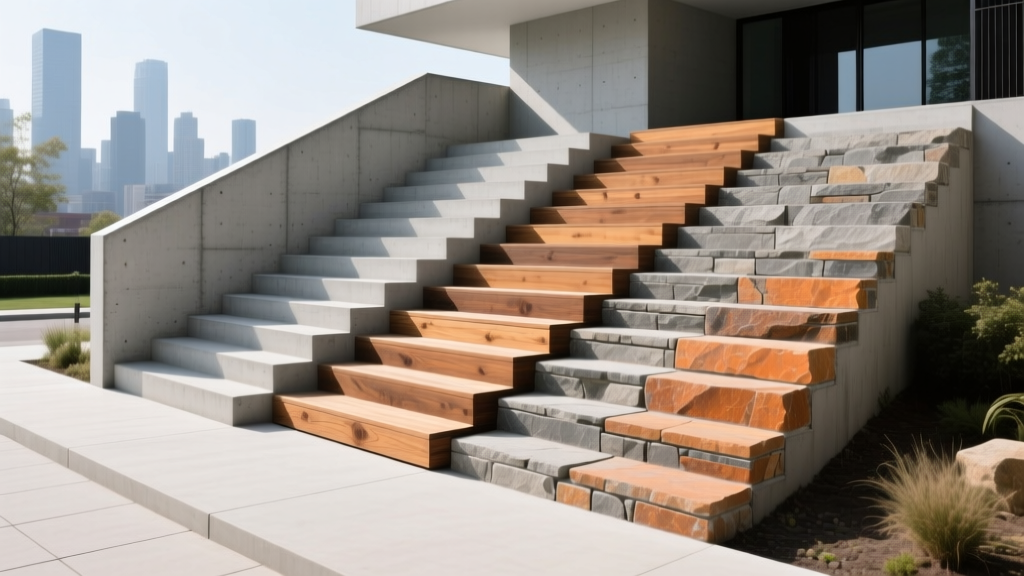
The cost to build steps fluctuates significantly depending on your geographic location, driven primarily by regional labor rates, local building codes, and material availability. While a basic 4-foot wide, three-tread poured concrete staircase averages $1,800 to $2,500 nationally, regional variables can push this figure below $1,200 in the South or above $3,400 in the Northeast. According to the U.S. Department of Housing and Urban Development (HUD) Construction Cost Data, location factors drastically alter baseline material and labor estimates. A project bid at $2,000 in a baseline market like Dallas, Texas, will carry a 1.35x multiplier in San Francisco, California, and a 1.22x multiplier in Boston, Massachusetts.
| U.S. Region | Labor Index | Material Index | Avg Cost per Tread (Concrete) |
|---|---|---|---|
| Northeast | 1.28 | 1.12 | $750 - $950 |
| Midwest | 1.05 | 0.98 | $550 - $650 |
| South | 0.88 | 0.95 | $400 - $520 |
| West | 1.35 | 1.15 | $800 - $1,100 |
Material Breakdown: How Region Dictates Pricing
Material selection for exterior stairs is heavily influenced by regional climate and local supply chains. The cost to build steps using premium materials varies not just by the raw material cost, but by the freight surcharges required to move heavy masonry products across the country.
Precast Concrete vs. Poured-in-Place
Precast concrete steps (such as those manufactured by Century Group) offer rapid installation. A standard 48-inch wide, 4-tread precast unit costs $850 to $1,150 at the plant. However, regional logistics alter the final price. In dense urban areas in the Northeast or West Coast, delivery and crane-setting fees can add $600 to $900 due to equipment staging constraints. In rural Southern or Midwestern sites, a flat-bed drop fee might only incur a $150 to $250 surcharge, making precast highly economical in those regions.
Natural Stone and Bluestone Treads
Full-depth thermal bluestone treads (2-inch thick) cost $55 to $75 per linear foot. Because high-quality bluestone is primarily quarried in Pennsylvania and New York, builders in the Northeast benefit from minimal transport costs. Conversely, specifying bluestone for a project in California or the Pacific Northwest introduces heavy freight surcharges, often increasing the material cost by 30% to 40%. In Western states, locally sourced basalt or granite is a more cost-effective alternative, typically running $45 to $60 per linear foot.
Composite Framing and Treads
For wood-framed exterior stairs, pressure-treated Southern Yellow Pine remains the standard structural base nationwide. However, the cost to build steps using composite cladding (like Trex Transcend or TimberTech) varies by regional dealer networks. Composite stair treads average $45 to $60 per linear foot. In regions with high humidity and termite pressure (the Deep South and Gulf Coast), the premium for composite over pressure-treated wood is easily justified by the elimination of annual sealing and rot-replacement costs.
The Hidden Cost Driver: Frost Line Footing Requirements
The most frequently overlooked variable in regional stair estimating is the frost line. Exterior stair landings and independent step footings must extend below the local frost line to prevent frost heave, which can crack stair stringers or pull the landing away from the main foundation.
In the Upper Midwest and Northeast, frost lines range from 48 to 72 inches deep. Excavating a 6-foot deep trench for a simple 4-foot wide stair landing requires a mini-excavator (averaging $450-$800 per day) and roughly 1.5 cubic yards of additional concrete. In the Deep South (frost line 6-12 inches), hand-digging is standard, saving $1,200 to $1,800 in site prep and material costs alone.
When estimating the cost to build steps in cold climates, contractors must factor in the engineering required to pin the top landing to the existing house foundation. This typically involves drilling into the existing concrete footing and installing 1/2-inch epoxy-set anchor bolts to prevent the new stairs from settling independently of the main structure.
Regional Labor Rate Discrepancies
Labor accounts for 50% to 65% of the total cost to build steps. According to the U.S. Bureau of Labor Statistics (BLS) Occupational Employment and Wage Statistics, the mean hourly wage for structural masons and finish carpenters varies wildly by metropolitan statistical area (MSA).
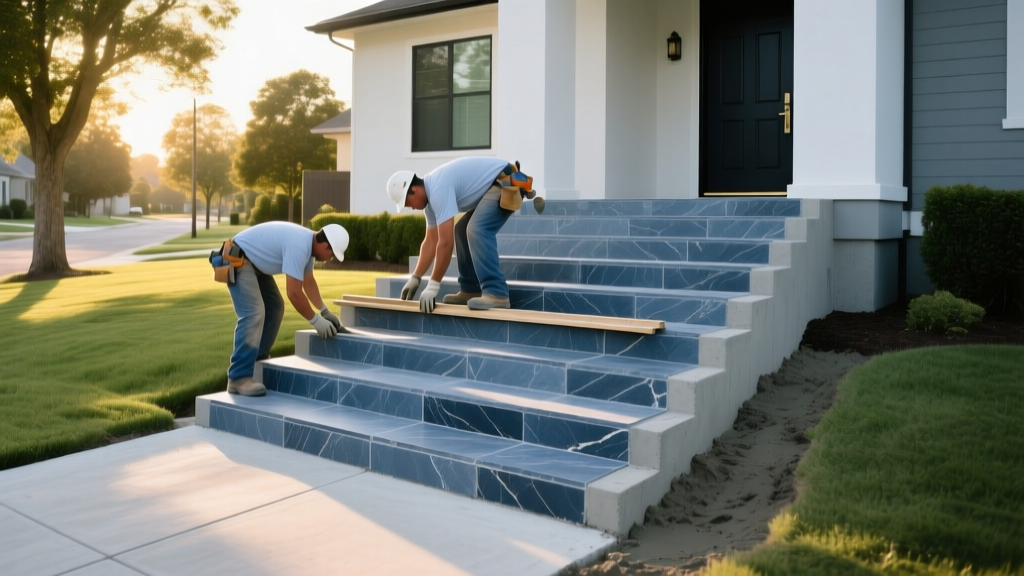
- High-Cost MSAs (San Francisco, New York, Boston): Union and prevailing wage requirements often push masonry and carpentry labor rates to $85 to $125 per hour. A three-person crew will burn through $2,000 to $3,000 in labor costs for a two-day stair build.
- Mid-Tier MSAs (Chicago, Denver, Atlanta): Labor rates stabilize between $55 and $75 per hour, reflecting a mix of union and open-shop contractors.
- Low-Cost MSAs (Rural South, Rural Midwest): Open-shop labor rates range from $35 to $50 per hour. Furthermore, smaller crew sizes and lower overhead allow local contractors to reduce their margin requirements.
Code Compliance and Permitting Variances
Stair geometry is strictly regulated, and failing to account for local amendments to the national code will result in failed inspections and expensive tear-outs. The International Residential Code (IRC) Section R311.7 mandates a maximum riser height of 7-3/4 inches and a minimum tread depth of 10 inches. The greatest variation between any two risers in a flight cannot exceed 3/8 inch.
Seismic and Wind Uplift Amendments
In California, Title 24 seismic requirements dictate enhanced anchoring for exterior masonry steps. Stairs cannot simply rest on a concrete pad; they must be laterally braced and anchored to the main foundation using specialized hardware, such as Simpson Strong-Tie SET-3G epoxy anchors. This adds $300 to $500 in specialized labor and materials.
Similarly, in High-Velocity Hurricane Zones (HVHZ) in coastal Florida and the Carolinas, exterior stair landings attached to elevated wood-frame homes must be engineered to withstand specific wind-uplift pressures. This requires heavy-duty galvanized tension ties (like the Simpson DTT2Z) connecting the landing joists directly to the main house rim joist, adding $150 to $250 in hardware and framing labor to the overall estimate.
Strategic Estimating Framework
To accurately budget for stair construction, estimators must abandon national averages and apply a localized framework:
- Identify the Frost Line: Call the local building department to confirm the exact frost depth. Multiply the depth by the width of the stairs to calculate the cubic yardage of the required footing.
- Apply the HUD Location Factor: Take your baseline national material cost and multiply it by the HUD county-specific location factor to adjust for regional supply chain inflation.
- Verify Local IRC Amendments: Check if your municipality enforces stricter tread depth requirements (some localities mandate an 11-inch minimum tread) or requires specific seismic/hurricane tie-downs.
By isolating these regional variables, builders and homeowners can achieve precision in their budgets, avoiding the severe cost overruns that occur when national averages are applied to highly localized construction environments.
Written by
Marcus ChenMarcus Chen is a licensed structural engineer (PE) and building materials analyst with over 12 years of experience across residential, commercial, and industrial construction. He holds a Master of Science in Civil Engineering from UC Berkeley and spent six years at Thornton Tomasetti before transitioning to independent consulting and technical writing. Marcus specializes in material selection for seismic-prone regions, concrete reinforcement strategies, and lifecycle cost analysis. His work has been cited by the American Concrete Institute (ACI) and the Structural Engineers Association of California (SEAOC). When he is not on a job site or at his desk, you will find him hiking the Sierra Nevada or restoring a 1920s craftsman bungalow in Oakland, CA.
More from Marcus Chen
View all
Construction Cost
How Much Did the Eiffel Tower Cost to Build?
How much did the Eiffel Tower cost to build in 1889? We adjust for inflation and compare its budget to modern skyscraper construction.
Aug 4, 2026

Fire Resistance
What Is a Fire Resistant Material? Testing & Certification Guide
Discover what is a fire resistant material through ASTM and UL testing. Learn how fire ratings, certifications, and assemblies work in construction.
Aug 4, 2026

Construction Cost
How Much Did the Burj Khalifa Cost to Build?
How much did the Burj Khalifa cost to build? We break down the $1.5B project and extract 5 money-saving strategies for your next build.
Jul 30, 2026