How Much Does It Cost to Build a Bowling Center? 2026 Guide
Discover exactly how much it costs to build a bowling center in 2026. Detailed breakdown of lane equipment, site work, and entertainment buildouts.

The Core Metric: Cost Per Lane vs. Total Facility Cost
Estimating the cost to build a bowling center requires separating the specialized bowling equipment from the general commercial construction. In 2026, the industry standard metric for a fully built-out, modern entertainment center ranges from $125,000 to $165,000 per lane. This figure encompasses everything from the concrete slab to the pinsetters, scoring systems, and bar buildout.
Quick Cost Snapshot (16-Lane Facility)
- Total Estimated Cost: $2,000,000 – $2,640,000
- Equipment Only (Lanes, Pinsetters, Scoring): $720,000 – $960,000
- Shell & Architectural Buildout: $800,000 – $1,100,000
- F&B and Entertainment Add-ons: $480,000 – $580,000
According to industry data tracked by the Bowling Proprietors' Association of America (BPAA), the shift toward 'boutique' and family entertainment center (FEC) models has driven up the average cost per square foot, as modern centers allocate significantly more space to high-margin food and beverage operations, arcades, and private event rooms than traditional 1990s-era alleys.
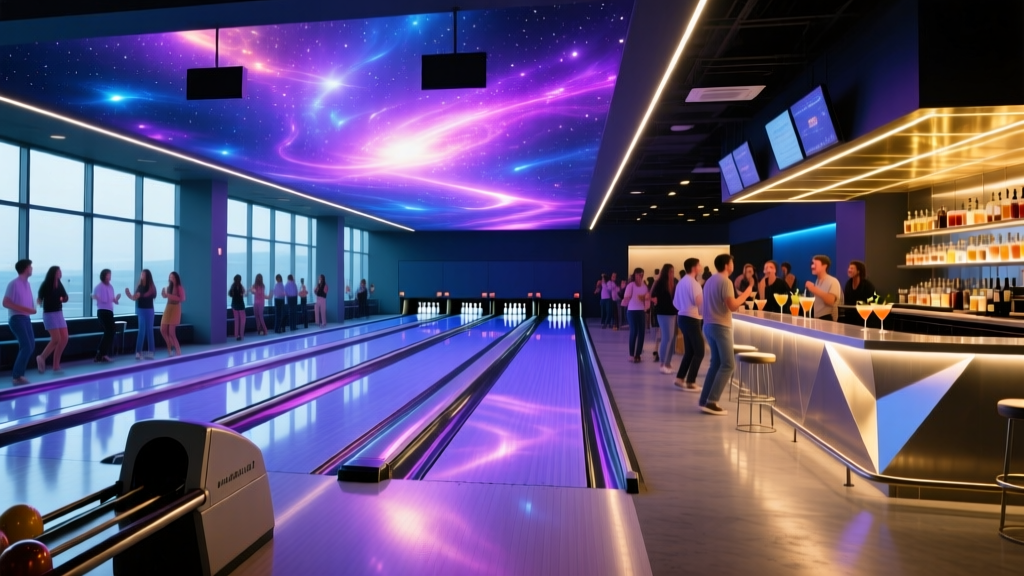
Phase 1: Shell, Site Work, and Architectural Buildout
Bowling centers have highly specific architectural requirements that dictate site selection and construction costs. The most critical factor is the building's dimensions. A standard bowling lane requires a clear, column-free span of approximately 100 feet in length (15 feet for the approach, 60 feet for the lane, and 25 feet for the pinsetter and maintenance area).
| Construction Phase | Cost Range (16-Lane) | Key Specifications |
|---|---|---|
| Land & Site Prep | $150,000 - $400,000 | Requires 1.5 to 2.5 acres for building + parking (approx. 15,000 - 20,000 sq ft footprint). |
| Foundation & Slab | $120,000 - $180,000 | Concrete subfloor must meet strict FF/FL (Flatness/Levelness) tolerances for synthetic lane installation. |
| Steel & Roofing | $250,000 - $400,000 | Clear-span steel trusses required over the lane area; minimum 14-foot ceiling clearance. |
| MEP (Mechanical, Electrical, Plumbing) | $200,000 - $350,000 | High-capacity HVAC, heavy electrical loads for pinsetters and kitchen, grease traps. |
Phase 2: Bowling-Specific Equipment and Installation
The equipment package is where specialized vendors come into play. You cannot use general contractors for the installation of the lanes and pinsetters; this must be handled by certified technicians from manufacturers like Brunswick Bowling or QubicaAMF.
Pinsetters: Free-Fall vs. String
The most significant equipment decision in 2026 is choosing between traditional free-fall pinsetters and string pinsetters. The United States Bowling Congress (USBC) officially certified string pinsetters for professional and league play, fundamentally altering the ROI model for new centers.
- Free-Fall Pinsetters: Cost between $22,000 and $28,000 per lane. They offer the traditional acoustic 'crash' and visual appeal but require extensive maintenance, specialized mechanics, and higher energy consumption.
- String Pinsetters: Cost between $14,000 and $18,000 per lane. They reduce maintenance labor costs by up to 40%, consume less electricity, and eliminate the need for heavy overhead maintenance walkways. However, some purist leagues still prefer free-fall.
Lanes and Scoring Systems
Wood lanes (maple and pine) are virtually extinct in new construction due to high maintenance and humidity sensitivity. Modern centers use synthetic lanes, which cost between $12,000 and $16,000 per lane installed. These panels are highly durable and require only routine cleaning and oiling.
For scoring and management systems, expect to pay $5,000 to $8,000 per lane. Modern systems integrate directly with point-of-sale (POS) systems, allowing for dynamic pricing, remote lane reservations, and in-lane food and beverage ordering via touchscreens.
Phase 3: The Entertainment and F&B Buildouts
Modern bowling centers generate 40% to 60% of their gross revenue from food, beverage, and ancillary entertainment. The days of a simple snack bar with a fryer are over.
A full-service commercial kitchen with hoods, grease traps, and walk-in coolers will add $150,000 to $300,000 to your project. Many new boutique centers opt for a 'limited prep' kitchen model (conveyor ovens, panini presses, no open flames) to bypass expensive Type-1 exhaust hoods and reduce initial capital expenditure by up to $100,000.
Beyond the bar and kitchen, successful centers integrate additional revenue streams:
- Arcade & VR Zones: $50,000 – $150,000 (requires specialized card-reader integration and high-speed localized Wi-Fi).
- Escape Rooms / Laser Tag: $80,000 – $200,000 (highly dependent on square footage and thematic buildouts).
- Cosmic Bowling Lighting: $1,500 – $2,500 per lane for programmable LED under-lane lighting, blacklights, and laser projections.
Hidden Costs and Edge Cases
When underwriting a bowling center construction loan, developers frequently overlook three critical expenses that can derail a budget:
1. Strict HVAC and Humidity Control
Synthetic bowling lanes are installed over a steel or wood substructure that is highly sensitive to environmental changes. The HVAC system must maintain a strict temperature range of 68°F to 72°F and a relative humidity level between 40% and 50% year-round. If humidity spikes, the substructure expands, causing the lanes to crown or cup, which ruins the playability and voids the manufacturer warranty. Budget an extra $40,000 to $60,000 for dedicated, precision-climate RTUs (Roof Top Units) specifically for the bowling space.
2. Acoustic Treatments
A 24-lane center with free-fall pinsetters generates massive decibel levels. Without proper acoustic baffling, the noise from the pin deck will bleed into the bar, restaurant, and party rooms, ruining the guest experience. Budget $25,000 to $45,000 for acoustic wall panels, ceiling clouds, and sound-isolating drywall partitions between the lane area and the F&B zones.
3. Lane Oiling Machines and Conditioners
While synthetic lanes don't need resurfacing, they do require precise oil patterns to protect the surface and dictate ball hook potential. A new programmable lane machine (such as those engineered by Kegel) costs between $12,000 and $18,000. You will need at least two machines for a 16-lane center to ensure efficient daily maintenance.
Step-by-Step Pre-Construction Checklist
- Market Demographics Study: Verify a population of at least 100,000 within a 20-minute drive time. Bowling is a hyper-local convenience entertainment model.
- Zoning and Noise Ordinances: Confirm the parcel is zoned for entertainment/commercial use and check municipal decibel limits at the property line.
- Equipment Vendor Selection: Secure quotes from Brunswick or QubicaAMF early. Equipment lead times can stretch 6 to 9 months, which will dictate your construction timeline.
- Architectural Clear-Span Verification: Ensure your architect designs a 100-foot clear-span truss system over the lanes. Interior support columns will render the space unusable for bowling.
- MEP Coordination: Have the equipment vendor provide exact electrical drop schedules and data line requirements to the general contractor before the slab is poured.
Frequently Asked Questions
How long does it take to build a bowling center?
From groundbreaking to opening day, expect a timeline of 9 to 14 months. The general construction of the shell takes 4 to 6 months, while the specialized installation of the lanes, pinsetters, and scoring systems requires an additional 8 to 12 weeks of precise calibration.
Is a boutique bowling alley profitable?
Yes, but the profit margins are driven by F&B and private events, not just open-play bowling. According to analyses featured in Bowlers Journal International, modern boutique centers that successfully integrate high-margin craft beverages, corporate event spaces, and gourmet food options see EBITDA margins between 15% and 22%, compared to the 8% to 12% margins of legacy, bowling-only centers.
Can I build a bowling alley in an existing retail building?
It is possible but challenging. The primary hurdle is the 100-foot clear-span length requirement and the ceiling height. If the existing building has interior load-bearing columns or a ceiling height under 14 feet, retrofitting it for bowling will likely be cost-prohibitive due to the need for structural steel reinforcement and roof raising.
Written by
Marcus ChenMarcus Chen is a licensed structural engineer (PE) and building materials analyst with over 12 years of experience across residential, commercial, and industrial construction. He holds a Master of Science in Civil Engineering from UC Berkeley and spent six years at Thornton Tomasetti before transitioning to independent consulting and technical writing. Marcus specializes in material selection for seismic-prone regions, concrete reinforcement strategies, and lifecycle cost analysis. His work has been cited by the American Concrete Institute (ACI) and the Structural Engineers Association of California (SEAOC). When he is not on a job site or at his desk, you will find him hiking the Sierra Nevada or restoring a 1920s craftsman bungalow in Oakland, CA.
More from Marcus Chen
View all
Construction Cost
How Much Did the Eiffel Tower Cost to Build?
How much did the Eiffel Tower cost to build in 1889? We adjust for inflation and compare its budget to modern skyscraper construction.
Aug 4, 2026

Fire Resistance
What Is a Fire Resistant Material? Testing & Certification Guide
Discover what is a fire resistant material through ASTM and UL testing. Learn how fire ratings, certifications, and assemblies work in construction.
Aug 4, 2026

Construction Cost
How Much Did the Burj Khalifa Cost to Build?
How much did the Burj Khalifa cost to build? We break down the $1.5B project and extract 5 money-saving strategies for your next build.
Jul 30, 2026