Cost to Build a House in Iowa: 2026 Budget Planning
Discover the true cost to build a house in Iowa in 2026. Break down regional pricing, frost-line foundation expenses, and mandatory radon mitigation budgets.

The Baseline: Average Cost to Build a House in Iowa
Calculating the accurate cost to build a house in Iowa requires looking past national averages and addressing the specific geotechnical, climatic, and regulatory realities of the Midwest. As of 2026, the baseline construction cost in Iowa ranges from $145 to $215 per square foot for a custom, stick-built single-family home. This translates to $290,000 to $430,000 for a standard 2,000-square-foot floor plan, excluding land acquisition and site development.
According to data tracked by the U.S. Census Bureau Building Permits Survey, Iowa consistently ranks among the more affordable states for residential construction, primarily due to lower regional labor rates and proximity to Midwestern lumber and concrete supply chains. However, budget planning must account for severe weather structural reinforcements and deep frost-line foundation requirements that do not exist in southern states.
2026 Iowa Construction Cost Snapshot
- Entry-Level / Builder Grade: $145 - $165 per sq. ft.
- Mid-Range Custom: $166 - $195 per sq. ft.
- High-End / Luxury Custom: $196 - $250+ per sq. ft.
- Average Land Cost (Developed Lot): $45,000 - $85,000
Regional Cost Variations Across the Hawkeye State
Iowa is not a monolith; construction costs fluctuate significantly based on local labor availability, municipal permit fees, and proximity to major material distributors. Building in the Des Moines metro area commands a premium compared to rural counties in the southwest or northwest.
| Region / Metro Area | Avg Cost per Sq. Ft. | 2,000 Sq. Ft. Estimate | Primary Budget Driver |
|---|---|---|---|
| Des Moines Metro (Polk/Dallas) | $175 - $225 | $350,000 - $450,000 | High land costs, strict municipal zoning, union-adjacent labor rates |
| Cedar Rapids / Iowa City Corridor | $160 - $200 | $320,000 - $400,000 | University-driven demand, specialized subcontractor availability |
| Quad Cities (Scott County) | $155 - $190 | $310,000 - $380,000 | Cross-state labor competition, river-adjacent soil mitigation |
| Rural / Western Iowa (Loess Hills) | $145 - $175 | $290,000 - $350,000 | Lower labor rates, but higher site prep and well/septic costs |
Subsurface Budget Killers: Frost Lines and Expansive Soils
The most frequent budget overruns for out-of-state builders or first-time custom home clients in Iowa occur below grade. Iowa's climate and geology demand robust foundation engineering.
The 42-Inch Frost Line Reality
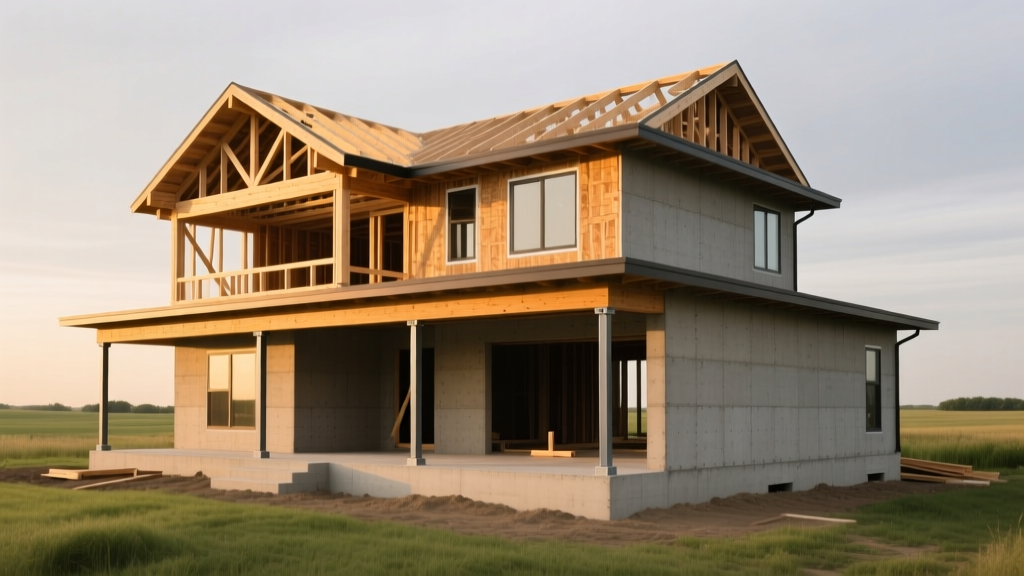
In central and northern Iowa, the building code mandates a minimum footing depth of 42 inches below finished grade to prevent frost heave. For a standard 2,000-square-foot home with a 60-linear-foot exterior wall footprint, digging 42 inches deep rather than the 12 inches required in southern states exponentially increases excavation time, concrete volume, and rebar requirements. Budget an additional $8,500 to $12,000 specifically for frost-wall concrete and labor compared to southern U.S. builds.
Loess Soils and Expansive Clay
Western Iowa, particularly the Council Bluffs and Loess Hills region, features highly erosive and expansive silt soils. If your soil test reveals high plasticity clay or unstable loess, standard spread footings will fail. You must budget for over-excavation and backfilling with engineered aggregate, or the installation of helical piers driven to bedrock. Helical pier foundation systems can add $15,000 to $25,000 to your baseline budget but are non-negotiable for structural longevity in these specific zip codes.
Mandatory Environmental and Code Upgrades
Iowa's adoption of the 2021 International Energy Conservation Code (IECC) and strict environmental health mandates require specific line items in your 2026 budget plan.
"Ignoring radon mitigation in an Iowa budget is a critical failure. The entire state is classified as a high-risk zone, and retrofitting a system after the slab is poured costs three times as much as roughing it in during construction."
Radon Mitigation (EPA Zone 1)
The EPA Radon Zone Map classifies nearly all of Iowa as Zone 1, meaning predicted average indoor radon screening levels are greater than 4 pCi/L. Building codes strongly mandate (and buyers expect) an active soil depressurization system. Budget $1,200 to $1,800 for a sub-slab gravel layer, vapor barrier, 4-inch PVC riser pipe, and an attic-mounted radon fan.
Thermal Envelope and Wind Resistance
To meet the 2021 IECC standards enforced by most Iowa municipalities, your insulation budget must increase. You are required to install a minimum of R-49 in the attic and R-20+ in exterior walls (often achieved via 2x6 framing with closed-cell spray foam or dense-pack cellulose). Additionally, Iowa's basic wind speed maps require 90 to 115 mph wind resistance. This necessitates H-clips on roof sheathing, continuous load path hurricane ties, and closer nail spacing on sheathing edges, adding roughly $3,500 in framing hardware and labor.
Material and Labor Allocation Matrix
Understanding where your capital is deployed helps in value-engineering your plans. Based on National Association of Home Builders (NAHB) Housing Economics data adjusted for 2026 Midwestern markets, here is how a typical $350,000 Iowa construction budget breaks down:
- Site Work & Foundation (14% | $49,000): Excavation, 42-inch frost walls, flatwork, radon prep.
- Framing & Exterior Shell (21% | $73,500): Lumber package, engineered trusses, OSB sheathing, architectural asphalt shingles, and vinyl or fiber-cement siding.
- Major Systems (15% | $52,500): High-efficiency gas furnace (96% AFUE), central AC, PEX plumbing, and 200-amp electrical service.
- Interior Finishes (26% | $91,000): Drywall, quartz/granite countertops, LVP or hardwood flooring, custom cabinetry, and interior doors.
- Labor & General Conditions (16% | $56,000): General contractor overhead, project management, portable toilets, dumpster rentals, and builder's risk insurance.
- Permits, Fees, & Contingency (8% | $28,000): Municipal tap fees, impact fees, soil testing, and a standard 5% contingency reserve.
Step-by-Step Budget Planning Framework for Iowa Builders
To prevent budget blowouts, follow this sequential planning framework before breaking ground:
- Procure a Geotechnical Report ($1,500 - $2,500): Never finalize foundation costs without a soil boring test. This dictates whether you need standard footings or engineered piers.
- Secure Utility Tap Letters: In rural Iowa, running a new electrical drop or water main from the county road can cost $15,000+. Get exact quotes from the local REC (Rural Electric Cooperative) and water district before purchasing the land.
- Value-Engineer the Roofline: Complex rooflines with multiple valleys and dormers increase both framing labor and ice-and-water shield requirements (mandatory in Iowa for ice dam prevention). Simplify to a gable or hip roof to save 8-12% on the shell.
- Lock in Early-Stage Material Pricing: Midwestern lumber yards experience price volatility in early spring. Lock in your framing package and concrete quotes in Q4 of the previous year to hedge against spring surges.
Accurately estimating the cost to build a house in Iowa requires respecting the subsurface conditions and strict thermal codes of the region. By front-loading your budget planning with geotechnical data and code-specific allowances, you ensure your 2026 build remains financially predictable from the first excavation to the final certificate of occupancy.
Written by
Marcus ChenMarcus Chen is a licensed structural engineer (PE) and building materials analyst with over 12 years of experience across residential, commercial, and industrial construction. He holds a Master of Science in Civil Engineering from UC Berkeley and spent six years at Thornton Tomasetti before transitioning to independent consulting and technical writing. Marcus specializes in material selection for seismic-prone regions, concrete reinforcement strategies, and lifecycle cost analysis. His work has been cited by the American Concrete Institute (ACI) and the Structural Engineers Association of California (SEAOC). When he is not on a job site or at his desk, you will find him hiking the Sierra Nevada or restoring a 1920s craftsman bungalow in Oakland, CA.
More from Marcus Chen
View all
Construction Cost
How Much Did the Eiffel Tower Cost to Build?
How much did the Eiffel Tower cost to build in 1889? We adjust for inflation and compare its budget to modern skyscraper construction.
Aug 4, 2026

Fire Resistance
What Is a Fire Resistant Material? Testing & Certification Guide
Discover what is a fire resistant material through ASTM and UL testing. Learn how fire ratings, certifications, and assemblies work in construction.
Aug 4, 2026

Construction Cost
How Much Did the Burj Khalifa Cost to Build?
How much did the Burj Khalifa cost to build? We break down the $1.5B project and extract 5 money-saving strategies for your next build.
Jul 30, 2026