Cost to Build a House in Maryland: Size & Scope Calculator
Calculate the cost to build a house in Maryland using our size and scope framework. Break down regional pricing, impact fees, and non-linear sq ft math.
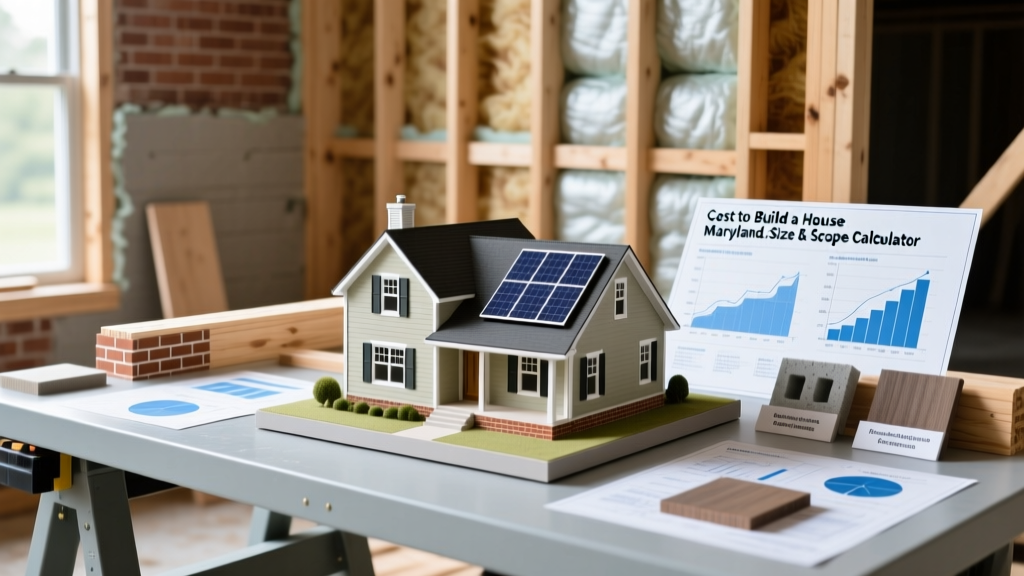
Maryland Construction Cost Matrix: Region and Finish Level
Estimating the cost to build a house in Maryland requires discarding national averages. The state's construction economics are heavily fractured by county lines, local labor markets, and strict municipal zoning. As of 2026, the baseline cost per square foot fluctuates wildly depending on whether you are building in the DC metro suburbs, the Baltimore corridor, or the rural western counties.
| Region | Builder-Grade ($/sq ft) | Semi-Custom ($/sq ft) | High-End Custom ($/sq ft) |
|---|---|---|---|
| DC Suburbs (Montgomery, PG, Howard) | $185 - $225 | $260 - $340 | $380 - $550+ |
| Central MD (Baltimore, Harford, Carroll) | $160 - $195 | $220 - $290 | $310 - $440 |
| Western MD (Frederick, Washington, Allegany) | $145 - $175 | $190 - $250 | $270 - $360 |
| Eastern Shore / Southern MD | $155 - $185 | $210 - $270 | $290 - $400 |
The premium in the DC suburbs is not merely a product of higher land values. It reflects stringent stormwater management requirements, prevailing wage overlaps for specialized trades, and severe logistical constraints for material delivery in high-density zones. According to data tracked by the U.S. Census Bureau Construction Statistics, regional labor shortages in the Mid-Atlantic continue to keep framing and MEP (mechanical, electrical, plumbing) costs 12% to 18% above the national median.
The Size & Scope Calculator: Non-Linear Square Footage Math
A critical error in residential cost estimating is multiplying total square footage by a flat rate. Construction costs do not scale linearly. A 4,000-square-foot house does not cost exactly twice as much as a 2,000-square-foot house. To accurately calculate your scope, you must divide your floor plan into 'wet' and 'dry' zones.
- Wet Zones (Kitchens, Bathrooms, Laundry): These areas require intensive MEP rough-ins, waterproofing, cabinetry, and high-end finishes. Expect wet zones to cost between $600 and $1,200+ per square foot.
- Dry Zones (Bedrooms, Living Areas, Hallways): These spaces primarily require framing, drywall, flooring, and basic electrical. Dry zones typically cost between $130 and $180 per square foot.
Scope Variables: Footprint, Stories, and Subsurface Conditions
The physical geometry of your home and the geological reality of your lot dictate the 'invisible' costs of your build.
One-Story vs. Two-Story Economics
Building a 2,500-square-foot ranch (one-story) requires a foundation and a roof system that covers 2,500 square feet. Building a 2,500-square-foot colonial (two-story) requires a foundation and roof covering only 1,250 square feet. While a two-story home incurs the cost of a structural staircase ($4,500 to $9,000) and engineered floor joists for the second level, the savings on concrete, excavation, and roofing materials typically make a two-story footprint 8% to 12% cheaper per square foot than a sprawling ranch.
Maryland Subsurface Geology
Site work is the most volatile variable in your budget. Maryland's geology is split into distinct regions that dictate foundation costs:
- The Piedmont Plateau (Central/Western MD): Characterized by dense clay and shallow bedrock. If your lot requires rock blasting or heavy mechanical excavation to reach the frost line (30 inches minimum), expect to add $8,000 to $18,000 to your site-work budget. Standard perc tests for septic systems also take longer and may require engineered sand mounds.
- The Coastal Plain (Eastern Shore/Southern MD): Characterized by sandy soils and high water tables. While excavation is cheap, you will likely need deep foundation pilings, specialized French drain networks, and vapor barriers to prevent hydrostatic pressure issues. Budget an additional $6,000 to $14,000 for water management and structural reinforcement.
Hidden Maryland Fees: Impact Taxes and Utility Hookups
When calculating the cost to build a house in Maryland, soft costs and municipal impact fees can silently add $20,000 to $50,000 to your final ledger. The Maryland Department of Housing and Community Development notes that local jurisdictions levy these fees to offset the strain new construction places on public infrastructure.
- WSSC Capital Facility Charge (CFC): If building in Montgomery or Prince George's counties, the Washington Suburban Sanitary Commission charges a CFC for water and sewer hookups. For a standard 3-bedroom, 2.5-bath single-family home, this fee currently ranges from $11,000 to $14,500, payable before the building permit is issued.
- School Impact Taxes: Montgomery County is notorious for its School Impact Tax, which varies by geographic zone. Depending on the specific high school district your lot falls within, this tax can range from $8,000 to over $24,000 per new single-family dwelling. The Montgomery County Department of Permitting Services provides a zone-by-zone fee calculator on their portal.
- Forest Conservation Act Mitigation: Maryland enforces strict tree canopy retention laws. If your site plan requires clearing protected trees, you must either replant at a 2:1 or 3:1 ratio on-site, or pay a steep mitigation fee into a county fund, often calculated at $300 to $600 per inch of caliper removed.
Step-by-Step Scope Calculation Framework
To generate a highly accurate budget for your Maryland build, follow this sequential calculation framework rather than relying on top-line square-footage multipliers.
- Calculate Base Shell Costs: Multiply your total exterior footprint square footage by the regional foundation/roof rate (approx. $45-$65/sq ft). Add the regional framing rate for your total interior volume.
- Calculate MEP Rough-Ins: Price your HVAC (typically $12-$18 per sq ft for high-efficiency heat pumps), plumbing ($3,500 per full bath + $5,000 for kitchen), and electrical ($6-$9 per sq ft) based on fixture counts, not just square footage.
- Apply Finish Multipliers: Assign your wet zones the $600+ rate and dry zones the $150 rate. Adjust based on specific material selections (e.g., upgrading from LVP flooring to site-finished white oak adds $8-$12 per sq ft).
- Add Site Work & Soft Costs: Allocate 15% to 22% of your hard construction costs for excavation, utility trenching, permitting, architectural fees, and the specific impact taxes outlined above.
- Apply the Contingency Buffer: Add a strict 10% contingency for subsurface surprises (rock, water, or unsuitable soil) and 2026 material supply chain fluctuations.
By breaking down the cost to build a house in Maryland through this granular size and scope lens, you insulate your project from the sticker shock that plagues owners who rely on overly simplified online estimators. Precision in the planning phase is the most cost-effective investment you can make in your build.
Written by
Sarah WhitfieldSarah Whitfield is a chartered quantity surveyor (MRICS) and construction cost analyst with 15 years of experience in material pricing, procurement strategy, and project budgeting. She earned her degree in Construction Management from the University of Reading (UK) and has worked on projects ranging from $2M custom homes to $180M mixed-use developments across North America and Europe. Sarah currently leads cost estimating for BuildMat Insight, maintaining a proprietary database of 4,000+ material price points updated quarterly. She is a frequent contributor to RSMeans cost data panels and has presented at the International Cost Engineering Council (ICEC) congress. Based in Denver, CO, Sarah is an avid trail runner and volunteer mentor for Women in Construction.
More from Sarah Whitfield
View all
Wood & Lumber
What Are the Different Types of Wood? A Builder's Guide
Compare structural softwoods, finish hardwoods, and engineered lumber. Analyze Janka ratings, MOE values, and 2026 pricing for construction.
Aug 4, 2026

Walls & Panels
Steel Framing vs Wood Framing: Corrosion and Moisture Defense
Compare steel framing vs wood framing for moisture resistance. Learn about galvanized coatings, condensation risks, and corrosion protection strategies.
Jul 21, 2026

Stone & Masonry
How to Cut Stone Veneer: Wet Saw vs Grinder Comparison
Compare the best tools for cutting stone veneer. We review wet saws, angle grinders, and chop saws to help you achieve clean, chip-free cuts.
Jul 21, 2026