Cost to Build an Underground Pool: 2026 Budget Guide
Discover the true cost to build an underground pool in 2026. Explore material pricing, excavation fees, hidden expenses, and budget planning frameworks.

The Real Cost to Build an Underground Pool: Beyond the Brochure
Planning a backyard aquatic retreat requires moving past glossy marketing brochures and confronting the hard data of modern construction. In 2026, the baseline cost to build an underground pool ranges from $75,000 for a modest vinyl-lined setup to over $150,000 for a fully customized, equipment-heavy gunite installation. This variance is not arbitrary; it is dictated by soil mechanics, hydraulic engineering, material longevity, and local permitting hurdles. According to the Pool & Hot Tub Alliance (PHTA), the industry standard for inground construction has shifted heavily toward energy-efficient hydraulics and automated sanitation, both of which increase upfront capital expenditure but drastically reduce long-term operational overhead.
Budgeting accurately means anticipating the hidden variables that derail projects. A $90,000 estimate can easily balloon to $115,000 if the contract lacks clarity on spoil removal, utility rerouting, or bedrock excavation. This guide dissects the exact financial architecture of underground pool construction, providing the technical benchmarks necessary to audit contractor bids and allocate capital efficiently.
Material Showdown: Concrete, Fiberglass, and Vinyl Liner
The shell material dictates roughly 30% of your total budget and locks you into a specific maintenance trajectory for the next three decades. Below is a 2026 comparative matrix of the three primary structural options.
| Material Type | 2026 Base Cost Range | Structural Lifespan | Customization Limit | Maintenance Intensity |
|---|---|---|---|---|
| Gunite / Shotcrete | $95,000 - $160,000+ | 50+ years (shell) | Infinite (any shape/depth) | High (acid washing, replastering every 12-15 yrs) |
| Fiberglass | $80,000 - $120,000 | 25-30 years | Restricted to factory molds | Low (non-porous gelcoat resists algae) |
| Vinyl Liner | $65,000 - $95,000 | Shell: 50+ yrs / Liner: 7-10 yrs | Moderate (custom panel shaping) | Moderate (vulnerable to tearing, UV fading) |
For high-end budget planning, gunite remains the gold standard. A proper gunite mix must achieve a minimum compressive strength of 4,000 PSI, applied pneumatically over a #3 and #4 steel rebar grid spaced at 10-inch centers. Fiberglass, while limited in shape, offers superior hydraulic smoothness, reducing pump head loss and chemical consumption.
The 5-Phase Budget Allocation Framework
To evaluate whether a contractor's bid is front-loaded or balanced, map their line items against this standard industry allocation model:
- Phase 1: Site Prep, Engineering & Excavation (12-18%) - Includes soil boring, layout, digging, and mucking.
- Phase 2: Structural Shell & Rough Plumbing (25-35%) - Steel, gunite/fiberglass shell, and Schedule 40 PVC trenching.
- Phase 3: Equipment, Electrical & Automation (15-22%) - Pumps, heaters, salt cells, and sub-panel installation.
- Phase 4: Coping, Tile, Waterline & Decking (20-28%) - The aesthetic finishes and hardscape integration.
- Phase 5: Permitting, Overhead & Contingency (10%) - Municipal fees, engineering stamps, and buffer capital.
Phase 1 Deep Dive: The Excavation Wildcard
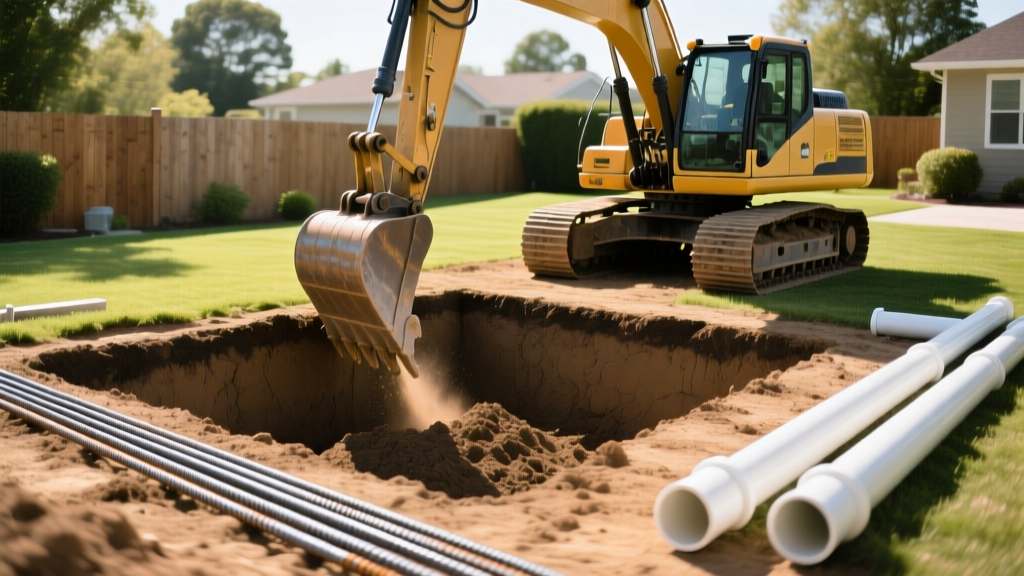
Excavation is the highest-risk phase for budget overruns. Before signing a contract, demand a geotechnical soil report. If your site contains expansive clay or organic topsoil, the contractor must "muck" (over-excavate and backfill with clean gravel), adding $3,000 to $8,000. Furthermore, clarify the "spoil removal" clause. An average 16x32 foot pool generates roughly 70 cubic yards of dirt. At 2026 hauling rates of $20 to $35 per cubic yard, removing that dirt costs up to $2,450. If the contract states "dirt left on site," you will be forced to pay for grading or removal later.
Phase 2 Deep Dive: Hydraulics and Plumbing Integrity
Cheap plumbing is a catastrophic failure point. Mandate the use of rigid 2-inch or 2.5-inch Schedule 40 PVC for all main drains and skimmer lines. Flexible PVC is prone to crushing under soil settlement and is highly vulnerable to rodent damage. For high-flow systems exceeding 60 gallons per minute (GPM), 2.5-inch main drain lines are required to prevent pump cavitation and suction entrapment hazards.
Equipment Selection: Where to Spend and Where to Save
The equipment pad is where modern technology justifies its premium. The U.S. Department of Energy notes that variable-speed pumps can reduce pool energy consumption by up to 90% compared to legacy single-speed models.
Where to Spend (High ROI)
- Variable Speed Pumps (VSP): Models like the Pentair IntelliFlo3 VSF or Hayward TriStar VS cost $1,500 to $2,200 installed but pay for themselves in 18 to 24 months via utility rebates and energy savings.
- Salt Chlorine Generators: Systems like the Hayward AquaRite (approx. $1,800 installed) eliminate the need for manual chlorine dosing and provide a softer water feel, though the titanium cell requires replacement every 3-5 years ($600).
- Automation Hubs: Smart panels allow remote monitoring of pH, ORP (Oxidation-Reduction Potential), and pump scheduling, preventing catastrophic equipment failure from dry-running.
Where to Save (Low ROI)
- Water Features: Laminar jets and sheer descents look impressive but require dedicated booster pumps, massively increasing electrical loads and evaporation rates.
- Exotic Coping: Imported travertine or custom glass tile waterlines can double the Phase 4 budget. Standard pre-cast concrete coping or locally sourced flagstone offers 90% of the aesthetic at a fraction of the cost.
Permitting, HOAs, and Insurance Realities
Budgeting extends beyond the physical build. Municipal permits for underground pools typically range from $400 to $1,200, but this triggers secondary inspections for electrical bonding and gas lines. If your property is governed by a Homeowners Association (HOA), anticipate a 30-to-60-day architectural review period. Delays here can push your project into the off-season, potentially incurring winterization fees if the shell is left exposed to freeze-thaw cycles.
Additionally, contact your home insurance provider before breaking ground. Adding an underground pool increases your liability profile. Most insurers will mandate an umbrella liability policy (typically $1M to $2M in coverage) and require specific safety barriers, such as a 4-foot fence with self-latching gates or an ASTM F1346-compliant automatic safety cover, which adds $5,000 to $8,000 to your final budget.
Auditing Your Contractor's Proposal
When comparing bids, do not look at the bottom line first. Look at the exclusions. A suspiciously low bid often excludes essential items like gas trenching for the heater, electrical sub-panel upgrades (a 200-amp home service may need an upgrade to handle a pool heater and VSP), and final landscaping restoration. According to data from Latham Pool Products, a reputable builder will provide a comprehensive scope of work that includes start-up chemical balancing and a multi-week post-installation service route. Protect your capital by tying payment milestones to verified physical progress—never release more than 10% of the total contract value before the pool is filled, plumbed, and operational.
Written by
Sarah WhitfieldSarah Whitfield is a chartered quantity surveyor (MRICS) and construction cost analyst with 15 years of experience in material pricing, procurement strategy, and project budgeting. She earned her degree in Construction Management from the University of Reading (UK) and has worked on projects ranging from $2M custom homes to $180M mixed-use developments across North America and Europe. Sarah currently leads cost estimating for BuildMat Insight, maintaining a proprietary database of 4,000+ material price points updated quarterly. She is a frequent contributor to RSMeans cost data panels and has presented at the International Cost Engineering Council (ICEC) congress. Based in Denver, CO, Sarah is an avid trail runner and volunteer mentor for Women in Construction.
More from Sarah Whitfield
View all
Wood & Lumber
What Are the Different Types of Wood? A Builder's Guide
Compare structural softwoods, finish hardwoods, and engineered lumber. Analyze Janka ratings, MOE values, and 2026 pricing for construction.
Aug 4, 2026

Walls & Panels
Steel Framing vs Wood Framing: Corrosion and Moisture Defense
Compare steel framing vs wood framing for moisture resistance. Learn about galvanized coatings, condensation risks, and corrosion protection strategies.
Jul 21, 2026

Stone & Masonry
How to Cut Stone Veneer: Wet Saw vs Grinder Comparison
Compare the best tools for cutting stone veneer. We review wet saws, angle grinders, and chop saws to help you achieve clean, chip-free cuts.
Jul 21, 2026