Cost to Build a Data Center: 2026 Tier & Scale Comparison
Analyze the cost to build a data center in 2026. Compare Tier I-IV pricing per megawatt, edge vs. hyperscale models, and AI liquid cooling premiums.

The True Metric: Cost Per Megawatt vs. Square Footage
Evaluating the cost to build a data center using traditional commercial real estate metrics like price per square foot is fundamentally flawed. A 100,000-square-foot facility designed for low-density storage (50 watts per square foot) costs a fraction of a 10,000-square-foot high-performance computing (HPC) facility pulling 500 watts per square foot. In 2026, the industry standard for capital expenditure (CapEx) estimation is cost per megawatt (MW) of critical IT load.
For a fully commissioned, IT-ready facility—excluding the actual servers, storage arrays, and networking hardware—the cost to build a data center ranges from $7 million to over $22 million per MW. This massive variance is dictated by Tier classification, physical scale, and the mechanical cooling architecture required to support modern silicon.
Data Center Tier Classification Cost Matrix
The Uptime Institute Tier classification system remains the definitive framework for data center redundancy and availability. Each step up in Tier classification requires exponential increases in mechanical and electrical (MEP) infrastructure to support concurrent maintainability and fault tolerance.
| Tier Level | Redundancy Topology | Concurrent Maintainability | 2026 Est. Cost per MW | Expected Annual Downtime |
|---|---|---|---|---|
| Tier I | N (No Redundancy) | No | $7.0M - $9.0M | ~28.8 hours |
| Tier II | N+1 | No | $9.0M - $11.5M | ~22.0 hours |
| Tier III | N+1 or 2N | Yes | $12.0M - $15.5M | ~1.6 hours |
| Tier IV | 2N+1 | Yes (Fault Tolerant) | $18.0M - $22.5M+ | ~0.4 hours |
Tier III is the current baseline for enterprise and colocation deployments. The jump from Tier III to Tier IV nearly doubles the cost to build a data center because it requires fully independent, physically separated redundant distribution paths (A and B feeds) for both power and cooling, alongside 2N+1 backup generation.
Scale Economics: Edge vs. Enterprise vs. Hyperscale
The physical footprint and total IT load drastically alter the unit economics. According to recent market analysis by CBRE, supply chain constraints and specialized labor shortages have compressed the cost advantages of massive builds, but economies of scale still apply.
1. Edge Data Centers (500 kW to 2 MW)
- Cost per MW: $14.0M - $18.0M
- Profile: Deployed close to end-users to support 5G, IoT, and localized AI inference.
- Cost Reality: Highest cost per MW. You must purchase minimum viable MEP infrastructure (e.g., a single medium-voltage utility feed, minimum switchgear, and baseline N+1 UPS) regardless of how small the IT load is. Site acquisition and permitting costs also disproportionately inflate the budget.
2. Enterprise Data Centers (5 MW to 20 MW)
- Cost per MW: $11.0M - $14.5M
- Profile: Corporate-owned facilities supporting internal ERP, private clouds, and proprietary workloads.
- Cost Reality: The sweet spot for balancing redundancy and unit cost. Standardized modular builds (e.g., prefabricated power skids) help keep costs in the lower end of this bracket.
3. Hyperscale Data Centers (50 MW to 300 MW+)
- Cost per MW: $8.5M - $11.0M
- Profile: Massive campuses built for cloud providers (AWS, Azure, GCP) and AI training clusters.
- Cost Reality: Lowest cost per MW due to bulk purchasing of chillers, generators, and switchgear. However, the absolute CapEx is massive, often requiring $500M to $2B+ for a single campus phase, plus the cost of building dedicated utility substations.
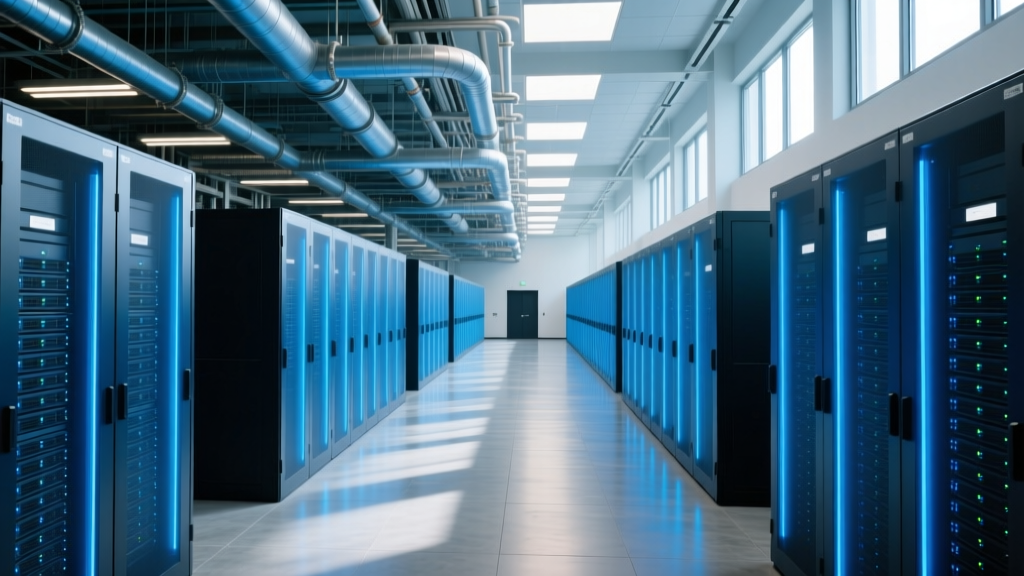
2026 Cost Drivers: AI Density and Liquid Cooling
The most significant variable altering the cost to build a data center today is the thermal output of AI accelerators. Traditional air-cooled racks operate between 8 kW and 15 kW. Modern AI training racks, such as those housing NVIDIA GB200 NVL72 systems, pull 120 kW to 140 kW per rack. Traditional Computer Room Air Handlers (CRAH) and raised-floor plenums physically cannot move enough air to cool these densities.
Engineering Mandate: For rack densities exceeding 40 kW, direct-to-chip (D2C) liquid cooling or rear-door heat exchangers (RDHx) are no longer optional; they are structural requirements.
Integrating liquid cooling infrastructure adds a 15% to 22% premium to the mechanical construction budget. This includes:
- Coolant Distribution Units (CDUs): Primary and secondary pumping loops to isolate facility water from IT hardware.
- Piping Materials: Upgrading from standard carbon steel to 316L stainless steel or specialized PEX to prevent micro-corrosion and biological growth in the coolant loops.
- Structural Reinforcement: Liquid-cooled racks and overhead manifold piping add significant dead load to the data hall slab, requiring thicker concrete pours and tighter rebar spacing (often pushing floor loading requirements from 150 lbs/sq ft to 250+ lbs/sq ft).
MEP Breakdown and Hidden Site Work Edge Cases
When estimating the cost to build a data center, project sponsors frequently underestimate site work and utility integration. A standard 10 MW Tier III facility budget breaks down approximately as follows:
- Electrical Infrastructure (45%): Medium-voltage switchgear, backup generators (e.g., Caterpillar C175-16 sets), automatic transfer switches (ATS), and Lithium-ion UPS systems. Lithium-ion UPS footprints are 50% smaller than legacy VRLA batteries, saving valuable data hall space.
- Mechanical/Cooling (25%): Chillers, cooling towers, CRAH/CRAC units, and liquid cooling manifolds.
- Architectural & Civil (20%): Concrete shell, insulated metal panels (IMPs), raised floors, and security vestibules.
- Site Work & Utility Integration (10%): Grading, fuel storage, and fiber trenching.
Hidden Cost Traps to Anticipate
Utility Substation Buildouts: If the local grid cannot deliver the required medium-voltage (e.g., 12kV or 34kV) power directly to the site boundary, you must fund a dedicated utility substation. This can add $3 million to $8 million and 12 to 18 months to the critical path.
Seismic Bracing: In regions like California or the Pacific Northwest, data centers must meet stringent seismic codes (e.g., OSHPD/DSA standards). Bracing overhead cable trays, heavy busways, and chilled water piping can add $40 to $75 per square foot to the structural budget.
Fuel Storage for Tier III/IV: Maintaining 48 to 72 hours of generator runtime at full load requires massive underground or above-ground UL-142 diesel storage tanks, complete with automated fuel polishing systems to prevent microbial degradation over time.
Decision Framework: Matching Workload to Tier
Do not default to Tier III or Tier IV without a rigorous financial justification. Use this framework to right-size your investment:
- Archive & Backup Storage (Tier I/II): If the workload is batch-processing, cold storage, or non-critical dev/test environments, the cost of downtime is lower than the CapEx premium of higher tiers. Build Tier II and rely on software-level replication to a secondary site.
- Enterprise ERP & Colocation (Tier III): If concurrent maintainability is required—meaning you must be able to replace a failed UPS module or chiller without dropping the IT load—Tier III is mandatory. This covers 85% of modern enterprise builds.
- Financial Trading & Life Safety (Tier IV): Only build Tier IV if a single fault in the electrical or mechanical chain would result in catastrophic financial loss, regulatory fines, or life-safety risks (e.g., hospital infrastructure cores). The 2N+1 topology is rarely justified for standard commercial workloads.
For deeper guidance on optimizing thermal management and reducing operational energy waste post-construction, refer to the U.S. Department of Energy's Data Center infrastructure guidelines. Accurately forecasting the cost to build a data center requires aligning your physical MEP topology directly with your software's tolerance for latency and downtime.
Written by
David NakamuraDavid Nakamura is a licensed architect (AIA) and construction technology writer focused on sustainable building methods, mass timber engineering, and high-performance building envelopes. He holds a Master of Architecture from the University of Washington and is a certified Passive House Consultant (CPHC). David spent eight years at the Seattle firm Mithun, where he led the design of three LEED Platinum projects, before founding his own practice specializing in net-zero residential design. He serves on the editorial advisory board of GreenBuilder Magazine and has authored peer-reviewed papers on cross-laminated timber (CLT) connections for the Journal of Structural Engineering. In his spare time, David teaches woodworking at Pratt Fine Arts Center and kayaks the Puget Sound.
More from David Nakamura
View all
Construction Cost
Labor Cost to Build a Deck Per Sq Ft: 2026 Installation Guide
Discover the exact labor cost to build a deck per sq ft in 2026. This installation guide breaks down contractor rates, complexity factors, and hidden fees.
Aug 4, 2026

Construction Cost
How Much Does It Cost to Build a 3 Bedroom House? Financing Guide
Learn exactly how much it costs to build a 3 bedroom house and explore 2026 financing options, construction loan types, and budget frameworks for your build.
Aug 4, 2026

Construction Cost
Cost to Build a Tennis Court: 2026 Guide
How much does it cost to build a tennis court in 2026? Breakdowns for asphalt, concrete, and synthetic surfaces plus fencing and lighting.
Jul 30, 2026