How Much Does It Cost to Build a Skateboard Deck From Scratch?
Discover exactly how much it costs to build a skateboard deck from scratch. We break down maple veneer, epoxy, and vacuum press expenses for 2026.

The True Economics: How Much Does It Cost to Build a Skateboard?
When woodworkers and skaters ask how much does it cost to build a skateboard, the answer requires splitting the calculation into two distinct phases: initial tooling and per-deck material costs. In 2026, the raw materials for a single professional-grade, 7-ply Canadian maple deck cost between $48 and $65. However, achieving the necessary 14.7 PSI of atmospheric pressure to laminate the veneers without delamination requires a vacuum press system, which demands an upfront investment of $220 to $400.
Building a skateboard is not merely bending wood; it is a precise exercise in composite lamination. The deck must withstand repeated impact forces exceeding 1,500 lbs on the kicktails while maintaining a specific concave geometry. Below is the exhaustive, no-fluff breakdown of every material, tool, and chemical required to press a street-ready deck.
Raw Material Breakdown: The Anatomy of a 7-Ply Deck
The industry standard for skateboard manufacturing relies exclusively on Acer saccharum (Hardrock Sugar Maple), primarily harvested from the Great Lakes region and eastern Canada. According to The Wood Database, Hardrock Maple possesses a Janka hardness rating of 1,450 lbf and an exceptional modulus of rupture (15,800 psi), making it uniquely suited for impact resistance and flex memory.
Veneer Sourcing and Dimensions
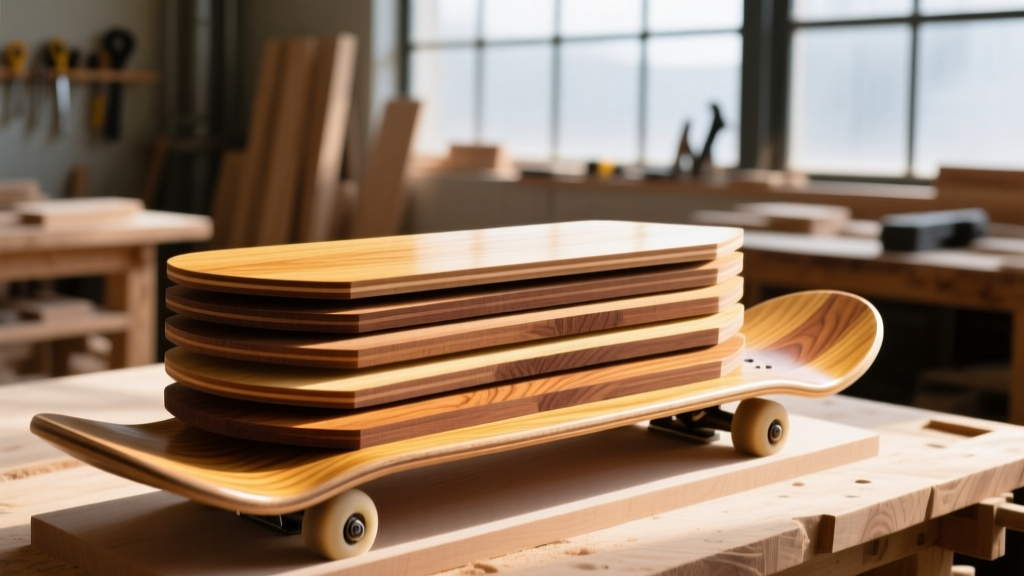
You cannot use standard lumberyard plywood. Skateboards require rotary-cut, unbacked veneer sheets. A standard street deck requires seven plies cut to roughly 10 inches by 34 inches.
- 2 Face Sheets (Top and Bottom): Cut to 1/14" (0.071") thickness for durability and graphic printing.
- 3 Longitudinal Core Sheets: Cut to 1/16" (0.062") thickness, grain running nose-to-tail.
- 2 Cross-Grain Sheets: Cut to 1/16" thickness, rotated 90 degrees to prevent the deck from splitting longitudinally under torsional stress.
The Adhesive Debate: PVA vs. Laminating Epoxy
The choice of adhesive dictates your pressing method and the deck's lifespan. Water-based Polyvinyl Acetate (PVA) glues, like Titebond III, are cheap but introduce moisture into the wood matrix, which can cause the deck to warp or 'spring back' after removal from the mold. Laminating epoxy (such as Entropy Resins or System Three) contains zero VOCs and no water, curing into a rigid structural bond that locks the concave shape permanently.
- Titebond III (16 oz): ~$11 (Yields 4-5 decks)
- Marine-Grade Laminating Epoxy (Half-Gallon Kit): ~$65 (Yields 8-10 decks)
The Tooling Investment: Molds and Vacuum Presses
You cannot clamp a skateboard with standard C-clamps or bar clamps. The 3D compound curve of a modern deck (featuring both longitudinal rocker and lateral concave) requires uniform, omnidirectional pressure. A vacuum press utilizes atmospheric pressure (up to 14.7 PSI at sea level) to crush the veneers into the mold.
1. The Mold ($40 - $150)
Professional factories use CNC-milled high-density urethane (HDU) foam molds. For DIY builders, stacking and routing 3/4" MDF (Medium-Density Fiberboard) is the most cost-effective route. You will need to cut the side profile (the rocker and kicktail angles) and then use a router sled to carve the concave trough. Factoring in MDF sheets, wood glue, and router bits, a custom DIY mold costs roughly $60.
2. The Vacuum Press System ($180 - $350)
A complete vacuum setup requires a vinyl press bag, breather cloth (to allow air evacuation without clogging the vacuum line), sealing tape, and a vacuum pump.
- Electric Vacuum Pump (e.g., Robinair 15115): $110 - $140
- Vinyl Press Bag (12" x 36"): $65
- Brass Fittings, Tubing, and Sealant Tape: $35
Alternative: Manual venturi pumps or hand-pump systems (like the Thin Air Press) can reduce this initial tooling cost to around $130, though they require manual re-pumping as microscopic leaks slowly degrade the vacuum over the 8-hour cure time.
Comprehensive Cost Matrix: Deck vs. Full Setup
Building the wooden deck is only half the battle. To ride it, you must factor in the hardware. The table below outlines the exact capital required for a first-time build versus subsequent production runs.
| Item Category | First Build (Includes Tooling) | Subsequent Builds (Materials Only) |
|---|---|---|
| 7-Ply Maple Veneer | $22.00 | $22.00 |
| Laminating Epoxy / Glue | $8.50 | $8.50 |
| Mold Release & Finishing Oil | $5.00 | $5.00 |
| Grip Tape (9" x 33" Sheet) | $7.00 | $7.00 |
| Vacuum Press & Mold (Amortized) | $310.00 | $0.00 |
| Total Deck Cost | $352.50 | $42.50 |
| Hardware (Trucks, Wheels, Bearings) | $115.00 | $115.00 |
| Grand Total (Ready to Skate) | $467.50 | $157.50 |
Shaping, Routing, and Finishing
Once the epoxy cures (typically 8 to 12 hours at 70°F), the raw 'blank' must be shaped. This stage requires specific woodworking tooling.
The Flush-Trim Routing Process
The veneers will shift slightly during the vacuum press. To achieve a perfectly symmetrical outline, builders use a flush-trim router bit with a top-bearing guide. By tracing a master template (made from 1/4" acrylic or Baltic birch plywood) clamped to the blank, the router shaves the excess maple down to the exact millimeter. Warning: Maple is exceptionally hard and will burn if routed too slowly. Use a carbide spiral bit and maintain a steady feed rate.
Sealing the Edge Grain
Skateboard edges are highly susceptible to moisture intrusion, which causes ply separation (delamination) over time. Before applying grip tape, the exposed edge grain must be sealed. While some use standard polyurethane, the optimal 2026 standard is rubbing in a 50/50 mix of beeswax and boiled linseed oil, or applying a specialized edge sealer like Skate Seal. This prevents water from wicking into the cross-grain sheets during wet-weather sessions.
Common DIY Pressing Failures and How to Avoid Them
Understanding failure modes is critical to protecting your material investment. According to research published by the USDA Forest Products Laboratory regarding wood adhesion and moisture dynamics, improper clamping pressure and moisture content are the leading causes of lamination failure.
The extreme bends of the nose and kicktail require the highest clamping pressure. If your vacuum bag bridges over the sharp angles instead of pushing deep into the mold crevices, you will experience 'glue starvation'—a condition where the epoxy is squeezed out entirely, leaving a dry, unbonded pocket. Always use a soft breather cloth (like felt) over the veneers to ensure the bag conforms to the sharp 30-degree kicktail angles without tearing.
Veneer Cracking on the Cross-Grain
Cross-grain sheets (the 4th and 6th plies) are bent against their natural grain direction to create the lateral concave. If the veneer moisture content drops below 6%, these sheets will snap audibly inside the press. Always store your maple veneer in a climate-controlled room (40-50% relative humidity) and avoid baking it in direct sunlight before pressing.
Final Verdict: Is the ROI Worth It?
If your goal is simply to acquire a single skateboard to ride, buying a factory-pressed deck from a reputable skate shop ($65-$80) is vastly more economical. Factories utilize massive hydraulic presses and bulk-purchased maple to drive costs down.
However, if your objective is to manufacture custom shapes, experiment with alternative core materials (like carbon fiber reinforcement or bamboo/carbon hybrid layups), or produce small batches of branded decks for a local crew, the economics shift dramatically. Once the $310 tooling threshold is crossed, your marginal cost per deck drops to $42.50. At this margin, building your own skateboards transitions from an expensive hobby into a highly viable micro-manufacturing operation, granting you total control over the concave depth, wheelbase, and kicktail angles that mass-market brands simply cannot offer.
Written by
David NakamuraDavid Nakamura is a licensed architect (AIA) and construction technology writer focused on sustainable building methods, mass timber engineering, and high-performance building envelopes. He holds a Master of Architecture from the University of Washington and is a certified Passive House Consultant (CPHC). David spent eight years at the Seattle firm Mithun, where he led the design of three LEED Platinum projects, before founding his own practice specializing in net-zero residential design. He serves on the editorial advisory board of GreenBuilder Magazine and has authored peer-reviewed papers on cross-laminated timber (CLT) connections for the Journal of Structural Engineering. In his spare time, David teaches woodworking at Pratt Fine Arts Center and kayaks the Puget Sound.
More from David Nakamura
View all
Construction Cost
Labor Cost to Build a Deck Per Sq Ft: 2026 Installation Guide
Discover the exact labor cost to build a deck per sq ft in 2026. This installation guide breaks down contractor rates, complexity factors, and hidden fees.
Aug 4, 2026

Construction Cost
How Much Does It Cost to Build a 3 Bedroom House? Financing Guide
Learn exactly how much it costs to build a 3 bedroom house and explore 2026 financing options, construction loan types, and budget frameworks for your build.
Aug 4, 2026

Construction Cost
Cost to Build a Tennis Court: 2026 Guide
How much does it cost to build a tennis court in 2026? Breakdowns for asphalt, concrete, and synthetic surfaces plus fencing and lighting.
Jul 30, 2026