How Much Does It Cost to Build a Greenhouse on a Budget?
Discover how much it costs to build a greenhouse using budget-friendly strategies, from 6-mil poly hoop houses to passive solar thermal mass designs.

When researching how much does it cost to build a greenhouse, you will encounter estimates ranging from $2,500 to $25,000 for a standard backyard structure. The massive variance stems from material choices, structural geometry, and site preparation. For budget-conscious growers, the national average for a functional, durable greenhouse sits between $3 and $7 per square foot. However, by leveraging agricultural-grade materials and passive solar principles, you can drive costs down to $1.50 to $3.00 per square foot without sacrificing environmental control.
The True Cost Breakdown: Where Your Money Actually Goes
Before cutting corners, you must understand the financial anatomy of a greenhouse. Commercial kits often mark up individual components by 300% to 500% for the convenience of pre-cut parts. Sourcing raw materials from agricultural suppliers fundamentally shifts your budget.
| Component | Budget Approach (Cost per Sq Ft) | Premium Approach (Cost per Sq Ft) | Primary Cost Driver |
|---|---|---|---|
| Framing | $0.60 - $1.20 (Galvanized steel hoop) | $4.00 - $8.00 (Extruded aluminum) | Material gauge and corrosion resistance |
| Glazing | $0.12 - $0.25 (6-mil UV poly film) | $2.50 - $5.00 (8mm twin-wall polycarbonate) | R-value (insulation) and light diffusion |
| Foundation | $0.30 - $0.60 (Driven ground posts) | $2.00 - $4.50 (Concrete piers/perimeter) | Excavation, concrete, and labor |
| Ventilation | $0.10 (Manual roll-up sides) | $1.50+ (Motorized roof vents with thermostats) | Automation and electrical integration |
5 Proven Money-Saving Strategies for Greenhouse Construction
1. Adopt Hoop House Geometry Over Rigid Frames
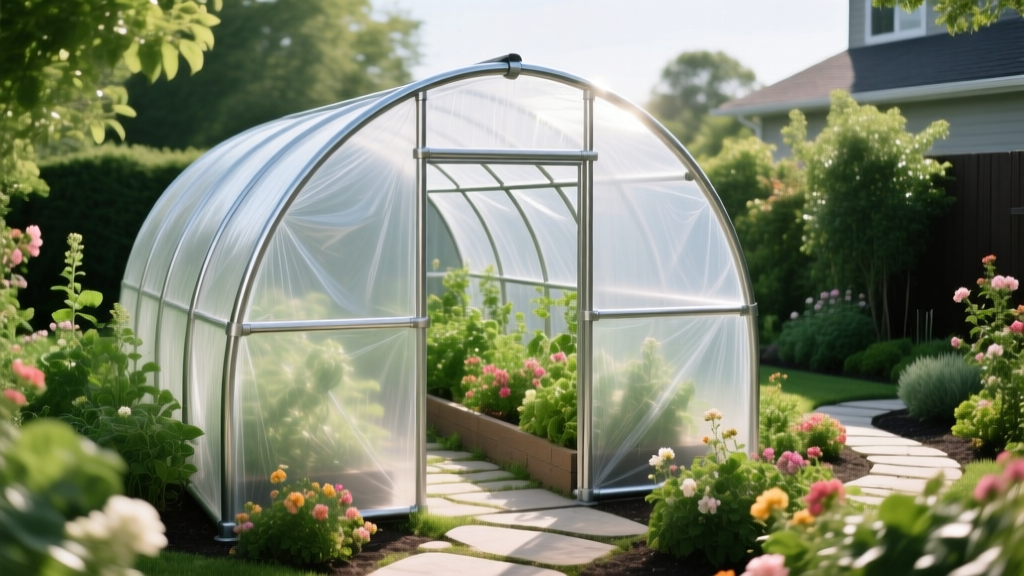
The structural shape dictates your material list. A traditional gable or A-frame greenhouse requires complex truss engineering, numerous connectors, and rigid glazing panels (glass or polycarbonate) that cannot bend. A Quonset or hoop house design utilizes the natural tensile strength of bent tubing. By using 1-3/8 inch galvanized steel chain-link top rail (often available at fencing suppliers for under $15 per 21-foot length) bent with a manual hoop bender, you eliminate the need for expensive truss brackets and reduce framing costs by up to 65% compared to aluminum extrusions.
2. Specify Agricultural-Grade 6-Mil Poly Film
Never use construction-grade painter's plastic from a big-box hardware store; it lacks UV inhibitors and will shatter into microplastics within three months. Instead, purchase 6-mil greenhouse-grade polyethylene film infused with UV stabilizers and anti-drip (condensate control) additives. According to UMass Amherst Extension, modern 6-mil poly offers an R-value of roughly 0.87 and lasts 4 to 5 years. To maximize insulation on a budget, install a double layer of poly and use a small blower fan to inflate the gap with air, creating a dead-air space that boosts the R-value to 1.5 and reduces winter heating costs by up to 40%.
3. Secure Glazing with Wiggle Wire, Not Staples
A common budget-builder mistake is using staples or battens to attach poly film directly to wood frames. This creates puncture points that tear under wind load. Invest in aluminum base channels and wiggle wire (lockwire). While the initial channel installation costs about $1.50 per linear foot, it allows you to stretch the film drum-tight, preventing wind-flap fatigue and allowing you to easily remove and reuse the film if repairs are needed.
4. Implement Passive Solar Thermal Mass
Heating a greenhouse in winter is the highest ongoing operational cost. Instead of buying a 5,000-watt electric heater, build thermal mass into the structure. Line the north wall of the greenhouse with 55-gallon HDPE food-grade barrels filled with water and painted flat black. Water holds heat 3,500 times better than air by volume. During the day, the barrels absorb solar radiation; at night, they slowly release it, buffering temperature drops by 10°F to 15°F and drastically reducing the need for auxiliary heating.
5. Utilize Driven Ground Posts Instead of Concrete
Pouring a concrete perimeter or individual footers requires forming, mixing, and curing, easily adding $1,500 to a 12x20 footprint. For hoop houses, use 2-foot to 3-foot driven ground posts. By sinking 1-5/8 inch galvanized steel posts 24 inches into undisturbed soil using a manual post driver, you achieve sufficient wind-load resistance for most USDA zones without a single bag of concrete. The USDA NRCS Seasonal High Tunnel Initiative frequently approves driven ground posts for agricultural cost-share programs, validating their structural integrity for seasonal and year-round growing.
DIY vs. Kit vs. Custom: A Cost-Per-Square-Foot Matrix
Choosing your procurement method is the second largest financial decision after material selection. The matrix below compares a standard 12' x 20' (240 sq ft) footprint across different build methodologies.
| Build Method | Estimated Total Cost | Cost per Sq Ft | Time Investment | Best For |
|---|---|---|---|---|
| 100% DIY (Raw Ag Materials) | $600 - $900 | $2.50 - $3.75 | 40 - 60 hours | Handy builders with basic metalworking/carpentry tools |
| Pre-Fabricated Hobby Kit | $2,000 - $4,500 | $8.30 - $18.75 | 15 - 25 hours | Beginners wanting polycarbonate panels and pre-drilled aluminum |
| Custom Contractor Build | $7,500 - $15,000+ | $31.00 - $62.00+ | 0 hours (Managed) | High-end glass/cedar structures requiring permits and utility trenching |
Smart Sourcing: Where to Buy Materials
Big-box home improvement stores are generally the most expensive place to source greenhouse components. They stock consumer-grade plastics and lack specialized agricultural hardware. To protect your budget, source from dedicated commercial growers' suppliers:
- Glazing & Films: Suppliers like FarmTek or Greenhouse Megastore sell 6-mil poly in 50x100 foot rolls for roughly $0.12 per square foot, a fraction of the cost of pre-cut retail sheets.
- Framing: Local chain-link fencing contractors often sell surplus galvanized top rail and line posts at a discount compared to retail hardware stores.
- Ventilation Hardware: Purchase wax-cylinder automatic vent openers (approx. $45 each) directly from agricultural importers. These require zero electricity, expanding and contracting with temperature changes to open roof vents automatically.
Frequently Asked Questions
What is the cheapest glazing material for a greenhouse?
6-mil UV-treated polyethylene film is the cheapest viable glazing, costing between $0.10 and $0.20 per square foot. While it requires replacement every 4 to 5 years, its initial cost is 90% lower than twin-wall polycarbonate or tempered glass.
Do I need a permit to build a DIY greenhouse?
Permit requirements depend on local zoning laws and the structure's permanence. Temporary hoop houses secured with driven ground posts and covered in poly film are often classified as agricultural equipment or temporary structures, bypassing standard building permits. However, rigid-frame structures anchored in concrete usually require a permit if they exceed 120 to 200 square feet.
How can I heat a budget greenhouse in the winter?
Before buying electric or propane heaters, maximize passive heat. Seal all glazing gaps with foam tape, utilize water-filled thermal mass barrels, and add a layer of bubble wrap insulation to the interior north wall. For active heating, a small, thermostatically controlled ceramic poultry water heater or a specialized seedling heat mat targeting root zones uses a fraction of the electricity required to heat the entire ambient air volume.
Written by
David NakamuraDavid Nakamura is a licensed architect (AIA) and construction technology writer focused on sustainable building methods, mass timber engineering, and high-performance building envelopes. He holds a Master of Architecture from the University of Washington and is a certified Passive House Consultant (CPHC). David spent eight years at the Seattle firm Mithun, where he led the design of three LEED Platinum projects, before founding his own practice specializing in net-zero residential design. He serves on the editorial advisory board of GreenBuilder Magazine and has authored peer-reviewed papers on cross-laminated timber (CLT) connections for the Journal of Structural Engineering. In his spare time, David teaches woodworking at Pratt Fine Arts Center and kayaks the Puget Sound.
More from David Nakamura
View all
Construction Cost
Labor Cost to Build a Deck Per Sq Ft: 2026 Installation Guide
Discover the exact labor cost to build a deck per sq ft in 2026. This installation guide breaks down contractor rates, complexity factors, and hidden fees.
Aug 4, 2026

Construction Cost
How Much Does It Cost to Build a 3 Bedroom House? Financing Guide
Learn exactly how much it costs to build a 3 bedroom house and explore 2026 financing options, construction loan types, and budget frameworks for your build.
Aug 4, 2026

Construction Cost
Cost to Build a Tennis Court: 2026 Guide
How much does it cost to build a tennis court in 2026? Breakdowns for asphalt, concrete, and synthetic surfaces plus fencing and lighting.
Jul 30, 2026