How Much Does It Cost to Build a Data Center in 2026?
Discover how much it costs to build a data center in 2026, including per-megawatt pricing, AI cooling upgrades, and electrical infrastructure breakdowns.
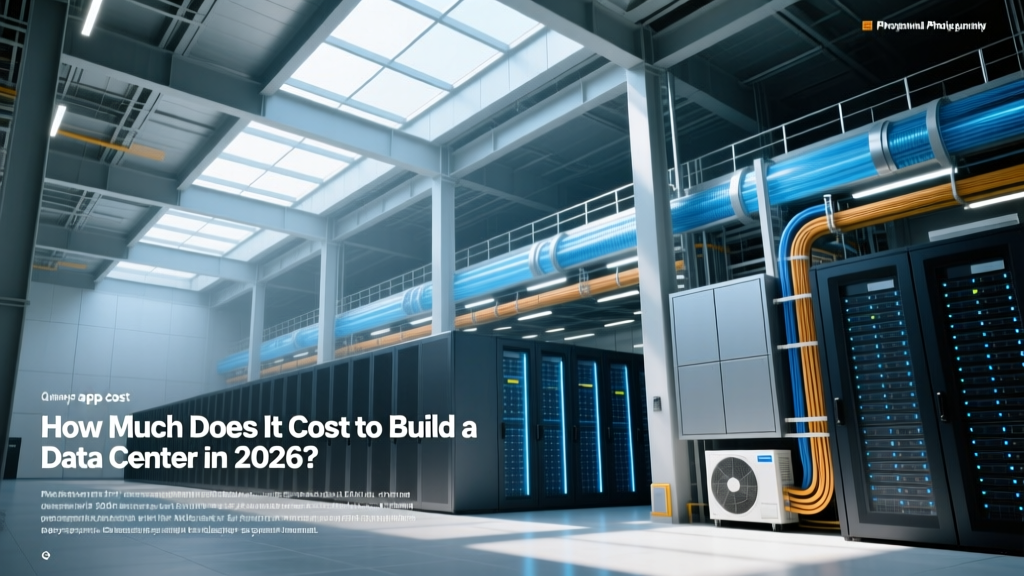
When evaluating how much does it cost to build a data center, developers must shift away from traditional commercial real estate metrics like price-per-square-foot. In 2026, the industry standard for capital expenditure (CapEx) estimation is the cost-per-megawatt (MW) of IT load. Driven by the explosive demand for high-density AI computing, supply chain constraints on medium-voltage electrical gear, and evolving thermal management requirements, baseline costs have fundamentally shifted. Currently, building a Tier III or Tier IV hyperscale data center costs between $9.5 million and $14.5 million per MW of critical IT load, excluding land acquisition and IT servers.
The Megawatt Metric: Baseline Construction Costs by Tier
The Uptime Institute classifies data centers into four tiers based on redundancy and uptime guarantees. The financial jump between tiers is non-linear, primarily due to the duplication of mechanical, electrical, and plumbing (MEP) systems required for concurrent maintainability and fault tolerance.
| Classification | Redundancy Topology | Est. Cost per MW (2026) | Est. Cost per Sq. Ft. | Target Use Case |
|---|---|---|---|---|
| Tier I | N (No redundancy) | $6.5M - $7.5M | $600 - $750 | Internal enterprise, non-critical backups |
| Tier II | N+1 (Partial redundancy) | $7.5M - $9.0M | $750 - $900 | Small managed service providers |
| Tier III | N+1 / 2N (Concurrent maintainability) | $9.5M - $12.5M | $950 - $1,200 | Colocation, standard cloud regions |
| Tier IV | 2N+1 (Fault tolerant) | $12.5M - $14.5M+ | $1,250 - $1,500+ | Hyperscale AI, financial trading, government |
AI and High-Density Computing: The 2026 Cost Multiplier
The most significant variable altering construction budgets today is rack density. Traditional cloud workloads operate at 5kW to 15kW per rack. Modern AI training clusters utilizing NVIDIA Blackwell or equivalent next-generation GPUs demand 50kW to 120kW+ per rack. This density renders traditional raised-floor air cooling obsolete, forcing a shift in structural and mechanical design.
Cooling Infrastructure Showdown: Air vs. Liquid
According to guidelines from the American Society of Heating, Refrigerating and Air-Conditioning Engineers (ASHRAE), liquid cooling is no longer optional for high-density AI deployments. Here is how the capital costs compare for a 10MW IT load facility:
- Precision Air (CRAC/CRAH): $1.2M - $1.8M per MW. Requires raised access floors (adding $15-$25 per sq. ft. to structural costs) and massive ductwork. Capped at ~20kW per rack.
- Direct-to-Chip (D2C) Liquid Cooling: $1.8M - $2.4M per MW. Eliminates the need for raised floors, allowing cheaper slab-on-grade construction. Requires Coolant Distribution Units (CDUs), facility water loops, and specialized rack manifolds. Supports up to 100kW per rack.
- Single-Phase Immersion: $2.5M - $3.2M per MW. Requires reinforced flooring (dielectric fluid is extremely heavy), specialized tank lifters, and advanced fire suppression. Supports 120kW+ per rack.
While D2C liquid cooling adds roughly $600,000 per MW in upfront plumbing and CDU infrastructure, it reduces the facility's Power Usage Effectiveness (PUE) from an average of 1.4 to below 1.15, yielding millions in operational expenditure (OpEx) savings over a 10-year lifecycle.
Hard Costs vs. Soft Costs Breakdown
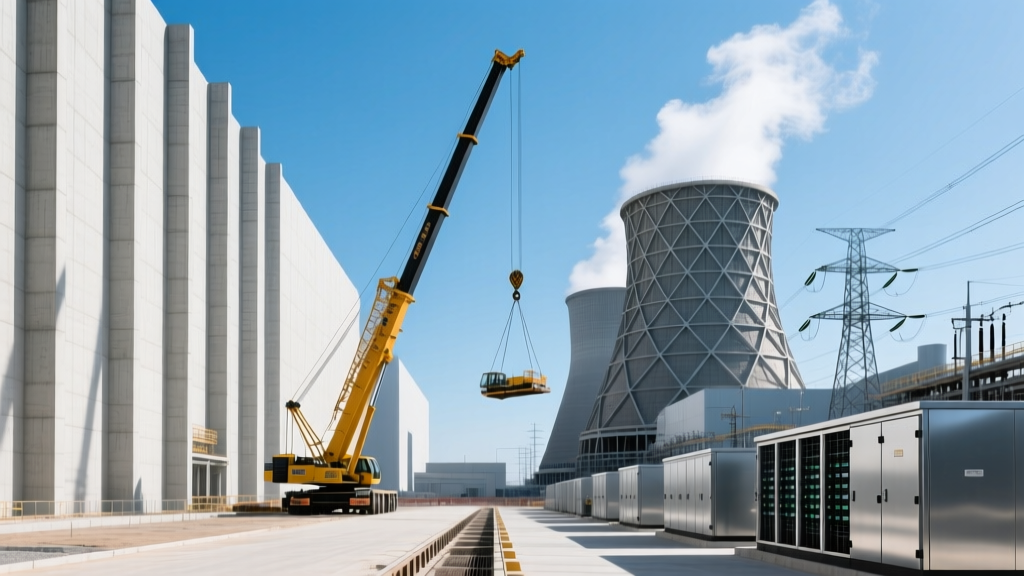
A precise budget allocation requires separating physical construction (hard costs) from engineering, permitting, and commissioning (soft costs). In 2026, soft costs have crept upward, now accounting for 20% to 25% of total CapEx, driven by complex environmental impact studies and grid-interconnection studies.
Hard Cost Allocation (75% - 80% of CapEx)
Electrical (45%)
Medium-voltage switchgear, UPS systems (lithium-ion or flywheel), backup diesel/HVO generators, and busway distribution.
Mechanical (25%)
Chillers, cooling towers, CDUs, CRAH units, and specialized fire suppression (VESDA and pre-action dry pipe).
Architectural/Structural (30%)
Pre-cast concrete tilt-up panels, structural steel roofing, slab-on-grade flooring, and secure loading docks.
Soft Cost Allocation (20% - 25% of CapEx)
- Design & Engineering: 6% - 8% (BIM modeling, MEP coordination, thermal CFD analysis).
- Permitting & Grid Studies: 3% - 5% (Environmental reviews, water rights acquisition, utility substation design).
- Commissioning (Cx): 4% - 6%. Data centers require rigorous Level 1 through Level 5 commissioning, culminating in an Integrated Systems Test (IST) using massive resistive load banks to simulate full IT load before a single server is installed.
Power and Electrical Infrastructure: The Biggest Bottleneck
The U.S. Department of Energy notes that data centers now consume over 4% of total U.S. electricity. Securing power is the primary determinant of project viability and timeline. The physical construction of the electrical infrastructure introduces severe scheduling and budgetary risks.
To mitigate this, Tier III and IV developers are increasingly building dedicated utility substations on-site rather than relying on municipal grid tie-ins. A dedicated 100MVA substation adds $8 million to $15 million to the project budget but guarantees power availability and bypasses municipal distribution bottlenecks. Furthermore, the shift toward lithium-ion UPS systems over traditional VRLA (Valve-Regulated Lead-Acid) batteries reduces the required footprint for battery rooms by 50% and cuts cooling requirements, though it requires specialized fire suppression systems like aerosol or clean agent (Novec 1230 alternatives) to manage thermal runaway risks.
Strategic Cost-Saving Framework for Developers
Value engineering a data center requires balancing upfront CapEx against long-term OpEx and time-to-market. Implement the following decision framework during the schematic design phase:
- Standardize the Shell, Customize the MEP: Utilize pre-cast concrete tilt-up construction for the building envelope. Pre-cast panels can be erected in 12-16 weeks, compared to 24-30 weeks for structural steel and masonry. Leave the interior MEP fit-out modular, allowing you to deploy capital in 2MW or 5MW increments as tenant leases are signed, rather than building out 20MW of unused cooling and power on day one.
- Adopt HVO (Hydrotreated Vegetable Oil) Generators: While municipal regulations are increasingly restricting diesel emissions, specifying HVO-compatible backup generators prevents costly retrofitting and avoids fines in strict air-quality districts, despite a 10% fuel cost premium.
- Implement Water-Side Economization: If building in a climate with sufficient wet-bulb temperature drops (e.g., the Pacific Northwest or Nordics), design the cooling loop to bypass mechanical chillers entirely for 4,000+ hours a year. This reduces the chiller plant CapEx by 30% and drastically cuts annual electricity consumption.
Accurately forecasting how much it costs to build a data center requires treating the facility not as a standard warehouse, but as a massive, interconnected power plant that happens to house computers. By anchoring estimates to the megawatt, planning for high-density liquid cooling, and front-loading electrical procurement, developers can protect their margins in an increasingly constrained construction market.
Written by
Marcus ChenMarcus Chen is a licensed structural engineer (PE) and building materials analyst with over 12 years of experience across residential, commercial, and industrial construction. He holds a Master of Science in Civil Engineering from UC Berkeley and spent six years at Thornton Tomasetti before transitioning to independent consulting and technical writing. Marcus specializes in material selection for seismic-prone regions, concrete reinforcement strategies, and lifecycle cost analysis. His work has been cited by the American Concrete Institute (ACI) and the Structural Engineers Association of California (SEAOC). When he is not on a job site or at his desk, you will find him hiking the Sierra Nevada or restoring a 1920s craftsman bungalow in Oakland, CA.
More from Marcus Chen
View all
Construction Cost
How Much Did the Eiffel Tower Cost to Build?
How much did the Eiffel Tower cost to build in 1889? We adjust for inflation and compare its budget to modern skyscraper construction.
Aug 4, 2026

Fire Resistance
What Is a Fire Resistant Material? Testing & Certification Guide
Discover what is a fire resistant material through ASTM and UL testing. Learn how fire ratings, certifications, and assemblies work in construction.
Aug 4, 2026

Construction Cost
How Much Did the Burj Khalifa Cost to Build?
How much did the Burj Khalifa cost to build? We break down the $1.5B project and extract 5 money-saving strategies for your next build.
Jul 30, 2026