How Much Did MetLife Stadium Cost to Build? Scope & Size Analysis
Discover how much MetLife Stadium cost to build. We break down the $1.6B price tag using a size and scope calculator for 2026 estimation.

The Original $1.6 Billion Price Tag: A 2010 Baseline
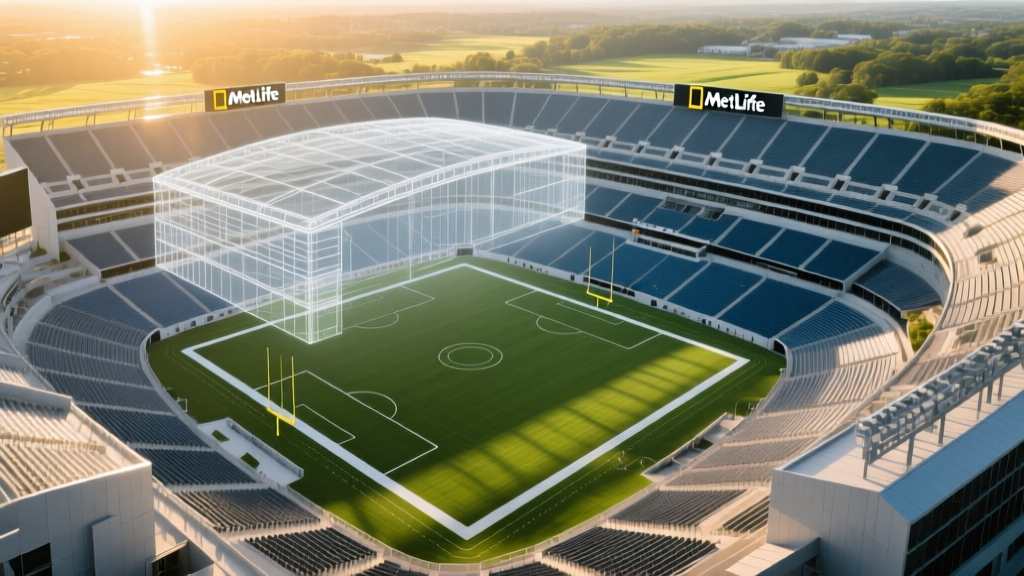
When addressing the question of how much did MetLife Stadium cost to build, the historical baseline is $1.6 billion. Completed in 2010 as a joint venture between the New York Jets and New York Giants, the 2.1 million-square-foot megastructure was the most expensive sports venue ever constructed at the time. Unlike publicly funded arenas, this project was entirely privately financed, requiring rigorous scope management and precise size-to-cost ratio calculations to ensure ROI through premium seating, concessions, and naming rights.
Core Scope Metrics (2010 Baseline)
- Total Gross Area: 2.1 million square feet
- Seating Capacity: 82,500 (expandable to 85,000 for mega-events)
- Total Project Cost: $1.6 billion USD
- Cost Per Square Foot: ~$761.90 / sq. ft.
- Cost Per Seat: ~$19,393 / seat
Adjusting the Scope: What MetLife Would Cost in 2026
Construction economics have shifted dramatically since the stadium's completion. To understand the true scale of this project today, estimators use a Size & Scope Calculator adjusted for the Construction Cost Index (CCI). While consumer inflation is tracked via the Bureau of Labor Statistics CPI Inflation Calculator, commercial mega-projects are subject to specialized material and labor escalations. According to 2026 industry benchmarks from the Dodge Construction Network, heavy commercial and institutional construction costs have surged by approximately 55% to 65% since 2010.
If a contractor were to bid on an exact replica of MetLife Stadium today, the scope calculator outputs a vastly different financial picture. The structural steel market, specialized facade glass, and prevailing wage requirements in the New York/New Jersey corridor would push the estimated 2026 replacement cost between $2.48 billion and $2.64 billion.
| Scope Calculator Metric | 2010 Actual Cost | 2026 Estimated Scope Cost |
|---|---|---|
| Total Project Budget | $1,600,000,000 | $2.56 Billion |
| Cost Per Square Foot | $761.90 | $1,219.00 |
| Cost Per Standard Seat | $19,393 | $30,909 |
| Structural Steel Budget | ~$280 Million | ~$475 Million |
Material Tonnage and Volume Breakdown
A size and scope calculator relies on raw material quantities to generate accurate estimates. MetLife Stadium is a masterclass in heavy civil and structural engineering. The material takeoffs required to execute this 2.1 million-square-foot footprint highlight the sheer density of modern sports venues.
Concrete and Foundation Scope
The stadium sits on a complex foundation system designed to handle the massive dead and live loads of 85,000 spectators and the vibration of synchronized crowd movement. The scope required 160,000 cubic yards of concrete. To put this in perspective, that is enough material to pave a standard two-lane highway for over 60 miles. In 2026, with ready-mix concrete prices in the tri-state area averaging $165 to $195 per cubic yard (including pumping and finishing), the concrete package alone represents a $30+ million line item before rebar and formwork are factored in.
Structural Steel Tonnage
The iconic cantilevered roof sections and the massive bowl structure required 40,000 tons of structural steel. The erection of this steel demanded specialized crane logistics, as the site's proximity to major rail lines and wetlands restricted staging areas. According to guidelines published by the American Society of Civil Engineers, modern stadium steel packages must also account for advanced blast-resistant connections and progressive collapse mitigation, adding roughly 12% to the fabricated steel tonnage compared to 2010 standards.
Applying the Size & Scope Calculator to Mega-Projects
When estimating large-scale commercial or recreational facilities, professionals use capacity-to-cost ratios to validate early-stage budgets. MetLife Stadium provides a critical data point for the "Cost Per Seat" metric, but this metric is highly sensitive to the venue's premium space ratio.
"A standard Cost Per Seat metric is virtually useless without a premium-to-standard seating ratio modifier. MetLife's 2010 cost per seat was roughly $19,400, but over 15% of its footprint is dedicated to luxury suites and club levels that cost upwards of $800 per square foot to finish, heavily skewing the venue-wide average."
Decision Matrix: Stadium Scope vs. Large-Scale Commercial Complex
How does a stadium scope compare to a traditional commercial high-rise? The table below contrasts the estimating variables between an 80,000-seat stadium and a 2.1 million-square-foot Class-A office complex in 2026.
| Estimating Variable | Mega-Stadium Scope | Class-A Office Complex |
|---|---|---|
| MEP Density (per sq. ft.) | Extremely High (Broadcast, Turf Heating, Massive HVAC) | Moderate (Standard VAV, Data Closets) |
| Structural Bay Spacing | Long-span trusses (100ft+ clear spans) | Standard 30x40 ft column grids |
| Facade Complexity | Custom corrugated metal, dynamic lighting | Unitized curtain wall systems |
| Plumbing Fixture Ratio | 1 fixture per 50-75 occupants (Peak flush loads) | 1 fixture per 250-300 occupants |
Hidden Scope Creep Factors in Modern Venues
If you are utilizing a size and scope calculator for a contemporary sports or entertainment venue, you must account for post-2010 regulatory and technological shifts. MetLife Stadium was built just before several major industry pivots. A 2026 scope calculator must include the following hidden cost drivers:
- Enhanced Security Perimeters: Modern venues require anti-ram vehicle barriers, standoff distances, and advanced biometric screening corridors. This adds roughly 40,000 to 60,000 square feet of hardened exterior concourse space not present in older designs.
- Broadcast Infrastructure: The transition to 4K/8K broadcasting and 5G fan connectivity requires massive IT backbone scaling. Cable tray routing and dedicated server rooms now consume 2% to 3% of the total gross square footage.
- Sustainability Mandates: Achieving LEED Gold or WELL certification in 2026 requires greywater recycling systems, photovoltaic canopy integrations, and low-VOC material sourcing, increasing baseline MEP costs by 8% to 12%.
Frequently Asked Questions
Is MetLife Stadium still the most expensive stadium ever built?
No. While it held the record at $1.6 billion in 2010, SoFi Stadium in Inglewood, California, surpassed it by opening in 2020 with a reported construction cost exceeding $5.5 billion, driven by a massive 3.1 million-square-foot scope and an integrated retail district.
How does the cost per square foot of MetLife compare to a standard warehouse?
The disparity is immense. MetLife's 2026 estimated cost of $1,219 per square foot reflects complex architectural finishes, heavy structural spans, and dense MEP systems. In contrast, a standard tilt-up distribution warehouse in 2026 averages between $95 and $140 per square foot, highlighting how building use-case dictates the scope calculator output.
Did the public pay for any of MetLife Stadium's construction?
The $1.6 billion construction cost was entirely privately funded by the Jets and Giants. However, as noted in analyses by the Brookings Institution regarding stadium economics, public subsidies often appear indirectly through infrastructure improvements, tax abatements, or land leases, though MetLife remains a primary example of private mega-project financing.
Written by
Elena RodriguezElena Rodriguez is a civil engineer and technical writer specializing in concrete technology, masonry systems, and ASTM/ACI compliance. She earned her B.S. in Civil Engineering from Texas A&M University and spent a decade at a materials testing laboratory, performing over 2,000 concrete compressive strength tests and masonry prism evaluations. Elena is an ACI-certified Field Testing Technician (Grade I) and a member of ASTM Committee C12 on Natural Building Stone. She currently consults on forensic engineering cases involving concrete failures and moisture intrusion. Based in San Antonio, TX, Elena is a proud member of the Society of Women Engineers (SWE) and coaches her daughter's FIRST Robotics team.
More from Elena Rodriguez
View all
Walls & Panels
Cost Analysis: Light Gauge Steel Framing Advantages and Disadvantages
Evaluate light gauge steel framing advantages and disadvantages through a strict cost analysis lens, comparing material, labor, and lifecycle expenses.
Aug 4, 2026

Walls & Panels
Gypsum Board Types: Exact Specifications, Thickness & Dimensions
Compare standard, Type X, and moisture-resistant gypsum board types. Get exact specifications, thicknesses, dimensions, and ASTM standards for your project.
Aug 4, 2026

Fire Resistance
Best Fire-Resistant Outdoor Decking Materials: 2026 Buyer Guide
Discover the best fire-resistant outdoor decking materials for 2026. Compare Class A PVC, aluminum, and hardwood options for WUI compliance and safety.
Aug 4, 2026