How Much Does a Nuclear Power Station Cost to Build in 2026?
Discover how much a nuclear power station costs to build in 2026. Compare large-scale reactors, SMRs, and overnight capital expenses.

The True Scale of Nuclear Construction Costs
Estimating the cost of a nuclear power station requires separating the Overnight Capital Cost (OCC) from the Total Capital Cost. The OCC represents the hypothetical cost if the plant were built instantly, excluding financing. In 2026, the OCC for large-scale light water reactors (LWRs) ranges drastically by geography: from $2,500 per kilowatt (kW) in China to over $12,000 per kW in Western Europe and the United States. For a standard 2,200-megawatt (MW) twin-unit facility, this translates to a baseline OCC of $5.5 billion to $26 billion.
However, nuclear plants take 6 to 12 years to construct. When factoring in Interest During Construction (IDC)—the cost of servicing debt while the plant generates zero revenue—the final price tag inflates by 20% to 40%. According to the World Nuclear Association, a Western plant with a $10,000/kW OCC and an 8% weighted average cost of capital (WACC) over an 8-year build will see its final all-in cost exceed $14,500/kW.
- Regulatory Compliance: Post-Fukushima seismic and aircraft-impact reinforcements add 15-20% to civil works.
- Supply Chain Atrophy: Western heavy-forging capabilities (e.g., reactor pressure vessels) are bottlenecked, driving up procurement premiums.
- Labor Productivity: Specialized nuclear welders and QA/QC inspectors command 30-50% wage premiums over standard commercial construction.
Large-Scale Reactors vs. SMRs: A Capital Cost Matrix
The industry is currently bifurcated between gigawatt-scale Generation III+ reactors and emerging Small Modular Reactors (SMRs). While SMRs promise lower absolute capital outlays, their per-kW costs remain high for First-of-a-Kind (FOAK) deployments. Below is a comparative matrix of leading reactor designs based on 2026 projected and actualized data.
| Reactor Design | Type | Net Capacity | Est. OCC (per kW) | Total Plant Cost |
|---|---|---|---|---|
| AP1000 (Westinghouse) | Large LWR | 1,117 MW | $7,000 - $14,000 | $8B - $16B |
| EPR (EDF/Areva) | Large LWR | 1,630 MW | $9,000 - $15,000 | $15B - $25B |
| APR1400 (KEPCO) | Large LWR | 1,400 MW | $4,000 - $5,500 | $6B - $8B |
| Hualong One (CNNC) | Large LWR | 1,090 MW | $2,500 - $3,500 | $3B - $4B |
| NuScale VOYGR | SMR | 462 MW (6 modules) | $6,500 - $9,000 | $3B - $4.5B |
Breakdown of Overnight Capital Costs
To understand where the capital goes, we must dissect the EPC (Engineering, Procurement, and Construction) contract. The U.S. Energy Information Administration (EIA) categorizes utility-scale capital costs into direct and indirect expenditures. For a typical Gen III+ pressurized water reactor (PWR), the cost distribution follows a distinct pattern.
Direct Costs (60-65% of OCC)
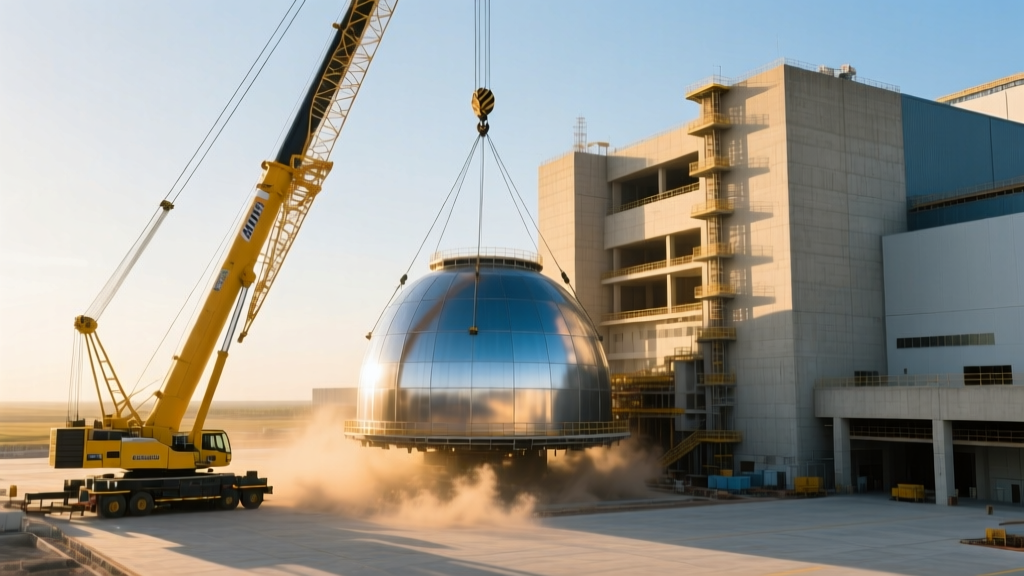
- Civil Works & Site Prep (25%): Nuclear plants require massive seismic basemats. A single reactor building may require 100,000 cubic yards of specialized concrete and 20,000 tons of seismic-grade rebar. Base isolation systems and aircraft-impact shield buildings add significant premiums.
- Nuclear Steam Supply System - NSSS (20%): The reactor pressure vessel, steam generators, and pressurizer. Forging a single 500-ton RPV requires specialized facilities (e.g., Japan Steel Works or China First Heavy Industries), creating a global supply bottleneck.
- Turbine Island & BOP (15%): The conventional steam turbine, condensers, and Balance of Plant (cooling towers, switchyards). This equipment is largely commoditized and shares supply chains with fossil-fuel plants.
Indirect Costs (35-40% of OCC)
- Engineering & Design (15%): Nuclear-grade QA/QC requires exhaustive documentation. Every weld, pipe hanger, and concrete pour must be traceable to NRC (or equivalent) standards, requiring armies of specialized engineers.
- Construction Management & Labor (15%): Maintaining a peak workforce of 4,000 to 6,000 craft workers in remote locations requires extensive temporary infrastructure, per diems, and security protocols.
- Owner's Costs (5-10%): Land acquisition, licensing fees, grid interconnection studies, and initial core fuel loading (which can cost $150M+ for a full core of enriched uranium assemblies).
Global Cost Variations: Why Geography Dictates the Price Tag
The most critical insight in modern nuclear estimating is the "Western Premium." According to MIT's comprehensive energy studies, the divergence in costs is not driven by the reactor technology itself, but by the construction ecosystem.
In South Korea and China, standardized fleet builds (building the same APR1400 or Hualong One design repeatedly) allow for localized supply chains, retained institutional knowledge, and continuous labor optimization. In contrast, Western projects like Vogtle in the US or Flamanville in France suffer from "FOAK penalties"—they are effectively first-of-a-kind prototypes built in regions where the nuclear supply chain has atrophied since the 1990s. This results in severe rework, schedule delays, and compounding IDC.
Levelized Cost of Energy (LCOE) vs. Upfront Capital
While the upfront capital cost of nuclear is staggering, evaluating it solely on OCC is misleading. Nuclear plants operate for 60 to 80 years with marginal operating costs. When calculating the Levelized Cost of Energy (LCOE)—the average net present cost of electricity generation over the plant's life—nuclear becomes highly competitive, provided the capital costs are managed.
Risk Mitigation for Megaproject Overruns
For developers and governments evaluating nuclear investments in 2026, mitigating capital risk requires specific contractual and structural frameworks:
- Standardized Fleet Strategy: Committing to build 4 to 6 identical units sequentially rather than a single bespoke unit. This amortizes the FOAK engineering costs and enables workforce learning curves.
- Off-Site Modularization: Shifting construction from the field to the factory. SMRs utilize this heavily, but large reactors can also modularize the auxiliary building and pipe racks to reduce on-site labor hours.
- Regulatory Asset Base (RAB) Models: Allowing the utility to collect small surcharges from ratepayers during the construction phase to service debt, thereby lowering the WACC and reducing the final IDC burden.
Frequently Asked Questions
How long does it take to build a nuclear power station?
In Western nations, the timeline from first concrete to commercial operation currently averages 9 to 12 years due to regulatory reviews and supply chain constraints. In countries with continuous build programs like China and South Korea, the construction phase is strictly controlled to 5 to 7 years.
Are Small Modular Reactors (SMRs) cheaper to build?
SMRs require a lower absolute capital investment (e.g., $3 billion for a 300 MW plant vs. $15 billion for a 2,200 MW plant), making them easier to finance. However, their per-kW cost is currently higher than large reactors due to the loss of economies of scale. SMRs rely on factory mass production to eventually drive per-kW costs below $5,000/kW.
What is the most expensive component of a nuclear plant?
While the Reactor Pressure Vessel is the most expensive single piece of equipment, the aggregate cost of Civil Works and Concrete typically represents the largest single line-item category in the direct cost breakdown, driven by the sheer volume of seismic-grade materials and specialized labor required for the containment structures.
Written by
David NakamuraDavid Nakamura is a licensed architect (AIA) and construction technology writer focused on sustainable building methods, mass timber engineering, and high-performance building envelopes. He holds a Master of Architecture from the University of Washington and is a certified Passive House Consultant (CPHC). David spent eight years at the Seattle firm Mithun, where he led the design of three LEED Platinum projects, before founding his own practice specializing in net-zero residential design. He serves on the editorial advisory board of GreenBuilder Magazine and has authored peer-reviewed papers on cross-laminated timber (CLT) connections for the Journal of Structural Engineering. In his spare time, David teaches woodworking at Pratt Fine Arts Center and kayaks the Puget Sound.
More from David Nakamura
View all
Construction Cost
Labor Cost to Build a Deck Per Sq Ft: 2026 Installation Guide
Discover the exact labor cost to build a deck per sq ft in 2026. This installation guide breaks down contractor rates, complexity factors, and hidden fees.
Aug 4, 2026

Construction Cost
How Much Does It Cost to Build a 3 Bedroom House? Financing Guide
Learn exactly how much it costs to build a 3 bedroom house and explore 2026 financing options, construction loan types, and budget frameworks for your build.
Aug 4, 2026

Construction Cost
Cost to Build a Tennis Court: 2026 Guide
How much does it cost to build a tennis court in 2026? Breakdowns for asphalt, concrete, and synthetic surfaces plus fencing and lighting.
Jul 30, 2026