Average Cost to Build a Home Per Square Foot in 2026
Discover the true cost to build a home per square foot in 2026. Breakdowns by region, material grade, and build type to budget your custom house.
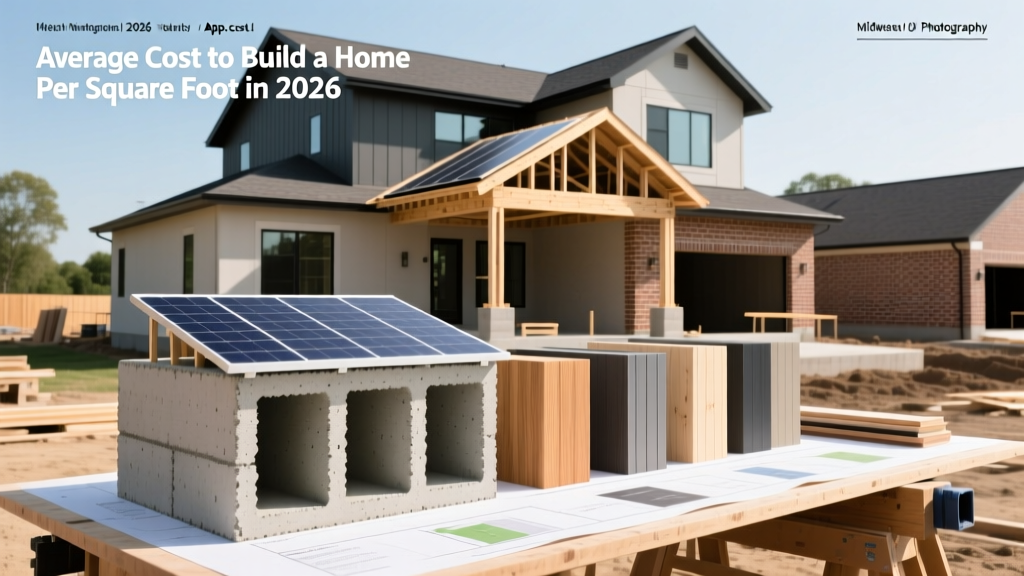
The Real Baseline: National Averages for 2026
When budgeting for new residential construction, the cost to build a home per square foot remains the most common—yet most frequently misunderstood—metric in the industry. For 2026, the national average for standard stick-built construction sits between $155 and $215 per square foot, excluding land acquisition and site-development anomalies. However, relying on a single national average is a critical estimating error. According to the National Association of Home Builders (NAHB), interior finishes and framing consistently account for over 50% of total hard costs, meaning your specific selections in cabinetry, flooring, and engineered lumber will dictate your final metric far more than regional labor baselines.
Construction Phase Breakdown: Where the Money Goes
To accurately forecast your budget, you must deconstruct the per-square-foot metric into its constituent phases. The following table outlines the hard-cost distribution for a mid-tier custom home (approx. 2,400 sq. ft.) built on a relatively flat, accessible lot.
| Construction Phase | Cost Per Sq. Ft. | % of Budget | Primary Cost Drivers |
|---|---|---|---|
| Site Preparation | $12 - $18 | 7% - 9% | Rock blasting, grading, utility trenching |
| Foundation | $18 - $25 | 10% - 12% | Frost-wall depth, post-tension slabs, soil bearing capacity |
| Framing & Shell | $35 - $55 | 20% - 25% | Engineered lumber (LVL/PSL), roof pitch complexity, sheathing |
| Exterior Finishes | $15 - $28 | 9% - 13% | Fiber cement vs. vinyl, standing seam metal vs. asphalt roofing |
| Major Systems (MEP) | $22 - $35 | 14% - 16% | Ducted heat pumps vs. standard splits, PEX vs. copper plumbing |
| Interior Finishes | $45 - $85 | 25% - 35% | Custom millwork, quartz slab grades, hardwood vs. LVP flooring |
Regional Pricing Matrix: Geographic Cost Variations
Data from the U.S. Census Bureau on new residential construction highlights severe geographic disparities in both material logistics and labor scarcity. Building in the Northeast requires deeper frost walls and stricter energy codes, while Western builds demand seismic bracing and wildfire-resistant exterior envelopes.
- Northeast ($185 - $240/sq ft): Driven by deep frost-line foundations (often requiring 4-foot frost walls or full basements), high union labor rates, and stringent IECC energy compliance requiring triple-pane glazing and continuous exterior insulation.
- South ($145 - $190/sq ft): The most cost-effective region. Slab-on-grade foundations are standard, and frost protection is unnecessary. However, coastal zones (e.g., Florida, Gulf Coast) will see a 15% premium for impact-resistant windows and hurricane-strapping requirements.
- Midwest ($155 - $205/sq ft): Balanced costs, though expansive clay soils in states like Texas and Oklahoma frequently necessitate post-tension concrete slabs or drilled pier foundations, adding $4 to $7 per square foot to the foundation phase.
- West ($195 - $265/sq ft): The most expensive region. California and the Pacific Northwest impose heavy impact fees, strict seismic structural requirements (like hold-downs and shear walls), and mandatory solar-ready or all-electric HVAC configurations.
Material Grade Multipliers: How Finishes Skew the Math
The gap between a $155/sq ft build and a $250/sq ft build rarely lies in the structural shell; it lies in the finish schedule. When soliciting bids from general contractors, use these specific material benchmarks to align your expectations with your budget.
1. Exterior Cladding & Roofing
Builder Grade: Vinyl siding and architectural asphalt shingles (e.g., GAF Timberline HDZ). Adds baseline cost.
Custom Grade: James Hardie fiber cement lap siding and premium architectural shingles or synthetic slate. Adds $6 - $9 per sq. ft. to the overall home metric.
Luxury Grade: Natural cedar shingles, brick masonry veneer, or standing seam metal roofing (e.g., 24-gauge galvalume). Adds $14 - $22 per sq. ft.
2. Flooring & Millwork
Builder Grade: Luxury Vinyl Plank (LVP) in main areas, carpet in bedrooms, MDF baseboards.
Custom Grade: Site-finished engineered hardwood (e.g., White Oak 5-inch planks), solid wood casing, and custom-built kitchen cabinetry with soft-close hardware.
Luxury Grade: Wide-plank solid hardwood, natural stone tile (requiring specialized Schluter-Ditra uncoupling membrane installation), and floor-to-ceiling custom millwork.
Hidden Variables That Destroy Per-Square-Foot Estimates
Generic online calculators fail to account for non-linear cost drivers. If your lot or design includes any of the following, your per-square-foot cost will immediately deviate from regional averages.
- Roof Pitch and Complexity: A simple 4/12 pitch gable roof is highly efficient. Upgrading to a 12/12 pitch with multiple valleys, dormers, and hips increases framing labor, sheathing waste, and roofing installation time by up to 35%, drastically inflating the cost per square foot of the footprint.
- Glazing Ratios: Modern architectural trends favor massive window walls. Standard vinyl double-hung windows cost roughly $25 per square foot of glass area. Upgrading to structural aluminum-clad wood or thermally broken steel windows (e.g., Marvin or Andersen E-Series) pushes this to $90 - $140 per square foot of glass area.
- Mechanical Electrification: Transitioning from a standard 16 SEER2 gas furnace and AC split system to a fully ducted cold-climate heat pump system (like the Mitsubishi SVZ or Bosch IDS) requires larger electrical service panels (upgrading from 200A to 320A) and specialized HVAC labor, adding roughly $4 to $6 per square foot to the MEP phase.
Modular vs. Stick-Built: A Per-Square-Foot Comparison
For buyers focused strictly on cost predictability, modular construction offers a distinct advantage. Modern modular homes are built in climate-controlled facilities, eliminating weather delays and reducing material waste by up to 20%.
In 2026, a high-quality modular home typically ranges from $130 to $180 per square foot for the factory-built modules. However, buyers must factor in the "button-up" costs: setting the modules on the foundation with a crane, marrying the rooflines, and finishing the drywall seams. When fully assembled and finished on-site, the total turnkey cost of modular construction usually lands 8% to 12% below equivalent stick-built homes, primarily due to compressed construction timelines (saving 3 to 5 months of construction loan interest and overhead).
Actionable Framework: Calculating Your Specific Build
To generate a highly accurate preliminary budget before speaking with an architect or builder, follow this three-step framework:
- Establish the Base Shell Cost: Multiply your target heated square footage by the regional baseline for your area (e.g., 2,500 sq ft x $165 = $412,500).
- Apply the Kitchen/Bath Premium: Allocate a fixed sum for wet rooms. Budget $35,000 for the primary bath and $55,000 for the kitchen. If your design includes secondary en-suites or a butler's pantry, add $15,000 per additional wet zone.
- Factor in the Site Multiplier: If your lot is heavily wooded, sloped greater than 15%, or lacks municipal sewer/water (requiring a well and aerobic septic system), apply a 12% to 18% multiplier to your base shell cost to cover site development and specialized foundations.
By deconstructing the cost to build a home per square foot into fixed zones, variable finishes, and site-specific anomalies, you transition from relying on misleading internet averages to wielding a precise, data-driven construction budget.
Written by
Priya KapoorPriya Kapoor is a real estate market analyst and construction economics researcher with expertise in housing affordability, development feasibility, and infrastructure investment. She holds a Master of Regional Planning from Cornell University and previously worked as a senior analyst at CBRE's Investment Properties group, where she modeled returns for $4B in mixed-use development pipelines. Priya now runs an independent research practice advising developers, municipalities, and REITs on construction cost forecasting and market timing. She publishes the quarterly "BuildMat Market Pulse" report tracking material price indices across 12 commodity categories. Based in Austin, TX, Priya serves on the board of Habitat for Humanity Austin and is a marathon runner.
More from Priya Kapoor
View all
Construction Cost
Cost to Build a 1600 Sq Ft Home in 2026: Full Breakdown
Accurate 2026 cost to build a 1600 sq ft home—material, labor, and regional pricing breakdowns included. Plan your budget with real-time estimates.
Aug 11, 2026

Wood & Lumber
Name the Types of Wood for Pressure Treatment and Preservation
Learn how to name the types of wood best suited for pressure treatment. Compare species treatability, chemical retention levels, and 2026 preservation costs.
Aug 4, 2026

Stone & Masonry
Stone Veneer Suppliers Lindenhurst: 2026 Cost Analysis
Analyze 2026 stone veneer costs in Lindenhurst, NY. Compare local supplier pricing, delivery fees, and Suffolk County installation labor rates.
Aug 4, 2026