Average Cost to Build In Ground Pool: Concrete vs Fiberglass vs Vinyl
Compare the true cost to build in ground pool structures across concrete, fiberglass, and vinyl. Get 2026 pricing, maintenance data, and ROI insights.

The Baseline: Average Cost to Build In Ground Pool Structures by Material
Calculating the accurate cost to build in ground pool structures requires moving beyond national averages and examining the structural engineering, material science, and site-specific variables of each pool type. In 2026, the baseline price for a standard 14x28-foot (392 square feet) residential pool ranges from $35,000 for a basic vinyl liner setup to over $95,000 for a fully customized gunite installation with premium aggregate finishes.
According to industry data compiled by Forbes Home, the national average sits around $55,000, but this figure obscures the massive cost divergence between materials. Below is the foundational pricing matrix for a standard 14x28-foot footprint, excluding complex site work and high-end landscaping.
| Pool Material | Average Initial Cost (14x28 ft) | Cost Per Sq. Ft. | Typical Installation Time |
|---|---|---|---|
| Vinyl Liner | $35,000 - $50,000 | $89 - $127 | 3 - 5 Weeks |
| Fiberglass Shell | $50,000 - $75,000 | $127 - $191 | 3 - 6 Weeks |
| Gunite / Shotcrete | $65,000 - $95,000+ | $165 - $242+ | 8 - 14 Weeks |
Gunite and Shotcrete: The Premium Custom Route
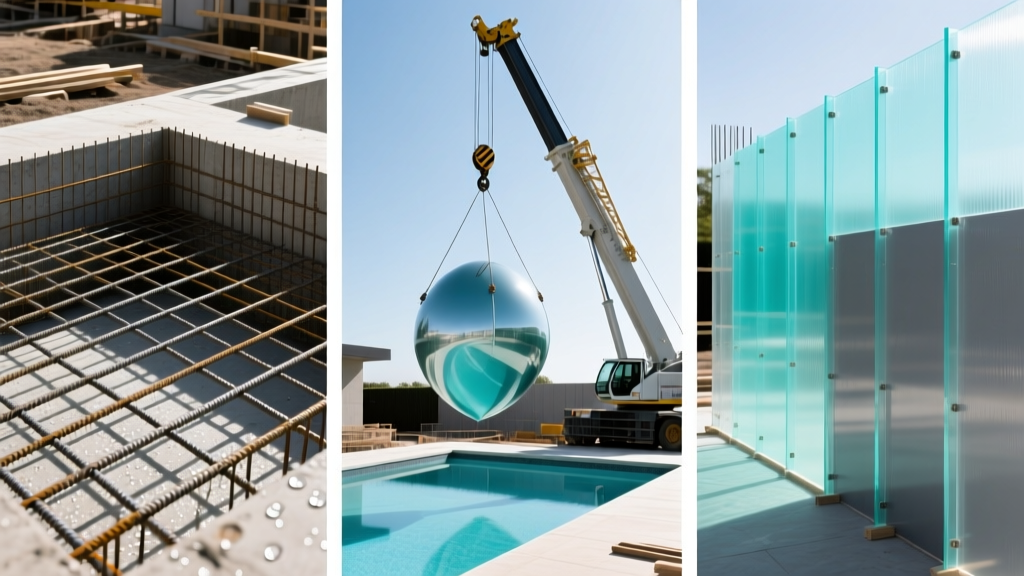
Concrete pools (specifically gunite or shotcrete) represent the highest tier of the cost to build in ground pool projects. These structures are built on-site using a mixture of cement, sand, and water sprayed over a grid of steel rebar.
Structural Specifications and Material Costs
A high-quality concrete pool requires #4 or #5 steel rebar spaced at 10 to 12 inches on center, tied together to form a rigid cage. The concrete shell itself is typically pneumatically applied to a thickness of 8 to 12 inches. The base structural cost for the shell and plumbing rough-in accounts for roughly 40% of the total budget.
The most significant cost variable in concrete pools is the interior finish. Standard white marcite (plaster) costs between $3 and $4 per square foot but is prone to etching and staining within five years. Upgrading to an exposed aggregate finish like PebbleTec or QuartzScapes increases the finish cost to $6 to $9 per square foot but extends the interior lifespan to 15-20 years and drastically reduces long-term maintenance.
Fiberglass Shells: Speed and Predictability
Fiberglass pools are manufactured off-site in controlled factory environments and delivered as a single, monolithic shell. This manufacturing process eliminates the weather delays and curing times associated with concrete, fundamentally altering the cost to build in ground pool timelines and labor budgets.
The Crane and Access Premium
While the shell itself is cost-competitive with concrete, the logistics of installation introduce unique expenses. A standard 14x28 fiberglass shell weighs between 3,500 and 5,000 pounds. If your property lacks the 25-foot wide, unobstructed clearance required for a delivery truck and a 100-ton crane to swing the shell over your house, you will face severe access surcharges. Crane rentals alone cost between $1,200 and $2,500 per day, and specialized boom trucks for tight access can push this higher.
Fiberglass shells feature a non-porous gelcoat finish that inherently resists algae growth, reducing chemical consumption. However, the structural limitation is the water table. If installed in an area with a high water table and the pool is drained for maintenance, the hydrostatic pressure can cause the lightweight shell to 'float' or pop out of the ground, requiring a specialized gravel backfill and sump pump system that adds $2,500 to the excavation budget.
Vinyl Liners: The Budget Entry Point
Vinyl liner pools offer the lowest initial cost to build in ground pool structures, making them the default choice for budget-conscious buyers in colder climates where ground frost heave makes rigid concrete shells risky.
Wall Materials and Liner Thickness
The structural integrity of a vinyl pool relies on prefabricated wall panels. Galvanized steel panels are the traditional choice, but modern builders heavily favor structural polymer panels. Polymer walls cost about 15% more upfront than steel but will never rust, corrode, or conduct cold into the pool water, which reduces heating costs.
The vinyl liner itself is a custom-cut membrane hung from a coping track. Standard liners are 20-mil thick, but upgrading to a 28-mil or 30-mil UV-stabilized liner is highly recommended. A 28-mil liner costs approximately $1,200 to $1,800 more than a 20-mil liner but provides superior puncture resistance against pet claws, tree roots, and sharp toys. The critical financial drawback of vinyl is the replacement cycle: liners degrade from UV exposure and chemical oxidation and must be completely replaced every 7 to 10 years at a cost of $4,500 to $6,500.
Hidden Site Costs That Derail Pool Budgets
The quoted cost to build in ground pool structures rarely includes the 'below-ground' surprises that inflate final invoices. Site preparation is the most volatile line item in any pool contract.
- Rock Excavation: If the excavator hits bedrock or heavy shale, standard digging stops. Mechanical rock breaking or blasting costs between $15 and $35 per cubic yard. Hitting a rock shelf just 3 feet down can add $8,000+ to the project.
- Spoil Haul-Away: A 14x28 pool excavated to an average depth of 5 feet yields roughly 72 cubic yards of dirt. When excavated, dirt expands (fluffs) by about 30%. Hauling away 95 cubic yards of spoil at 2026 dump rates of $50 to $80 per ton (including trucking) will cost between $3,500 and $6,000.
- Utility Rerouting: Discovering a main sewer line, gas line, or primary electrical conduit running through the planned pool footprint requires professional rerouting, which can cost $2,000 to $5,000 depending on the utility.
10-Year Total Cost of Ownership Matrix
Evaluating the true cost to build in ground pool assets requires calculating the Total Cost of Ownership (TCO), which factors in energy, chemicals, and mandatory resurfacing over a decade. According to the U.S. Department of Energy, pool circulation pumps are massive energy consumers, making variable-speed pump upgrades mandatory for long-term savings.
| Cost Category (10 Years) | Concrete (Gunite) | Fiberglass | Vinyl Liner |
|---|---|---|---|
| Initial Installation | $80,000 | $60,000 | $42,000 |
| Resurfacing / Liner Replacement | $0 (if using aggregate) | $0 | $5,500 (at year 8) |
| Chemicals (Algae/Acid) | $4,500 ($450/yr) | $1,800 ($180/yr) | $3,200 ($320/yr) |
| Energy (Variable Speed Pump) | $2,500 | $2,500 | $2,500 |
| 10-Year TCO | $87,000 | $64,300 | $53,200 |
Decision Framework: Which Pool Type Fits Your Project?
Use this framework to align your budget, property constraints, and long-term goals with the correct pool material.
Choose Concrete (Gunite) If:
- You require a highly customized shape, negative edge, or integrated tanning shelf that exceeds standard fiberglass mold dimensions.
- You are building on a steep slope where a monolithic, engineer-stamped structural shell is required to retain the hillside.
- You plan to stay in the home for 15+ years and want the highest potential return on investment and property value appraisal.
Choose Fiberglass If:
- Your property has wide, unobstructed access for a 100-ton crane and flatbed delivery truck.
- You want a predictable, fixed-price installation with minimal risk of weather-related construction delays.
- You prioritize low weekly maintenance and want to minimize chemical usage and brushing time.
Choose Vinyl If:
- Your initial capital budget is strictly capped below $50,000.
- You live in a region with severe frost heave and deep freeze-thaw cycles (e.g., the Northeast US or Canada), where the flexible vinyl walls can shift without cracking.
- You prefer a smooth, non-abrasive pool surface that will not scrape feet or snag swimsuits.
For deeper regional pricing data and localized contractor labor rates, cross-reference your specific zip code with current market reports from HomeGuide before soliciting final bids.
Written by
Sarah WhitfieldSarah Whitfield is a chartered quantity surveyor (MRICS) and construction cost analyst with 15 years of experience in material pricing, procurement strategy, and project budgeting. She earned her degree in Construction Management from the University of Reading (UK) and has worked on projects ranging from $2M custom homes to $180M mixed-use developments across North America and Europe. Sarah currently leads cost estimating for BuildMat Insight, maintaining a proprietary database of 4,000+ material price points updated quarterly. She is a frequent contributor to RSMeans cost data panels and has presented at the International Cost Engineering Council (ICEC) congress. Based in Denver, CO, Sarah is an avid trail runner and volunteer mentor for Women in Construction.
More from Sarah Whitfield
View all
Wood & Lumber
What Are the Different Types of Wood? A Builder's Guide
Compare structural softwoods, finish hardwoods, and engineered lumber. Analyze Janka ratings, MOE values, and 2026 pricing for construction.
Aug 4, 2026

Walls & Panels
Steel Framing vs Wood Framing: Corrosion and Moisture Defense
Compare steel framing vs wood framing for moisture resistance. Learn about galvanized coatings, condensation risks, and corrosion protection strategies.
Jul 21, 2026

Stone & Masonry
How to Cut Stone Veneer: Wet Saw vs Grinder Comparison
Compare the best tools for cutting stone veneer. We review wet saws, angle grinders, and chop saws to help you achieve clean, chip-free cuts.
Jul 21, 2026