The True Cost to Build a House in Kansas (2026 Guide)
Discover the true cost to build a house in Kansas in 2026. Explore regional pricing, tornado-resistant material costs, and line-item budgets.
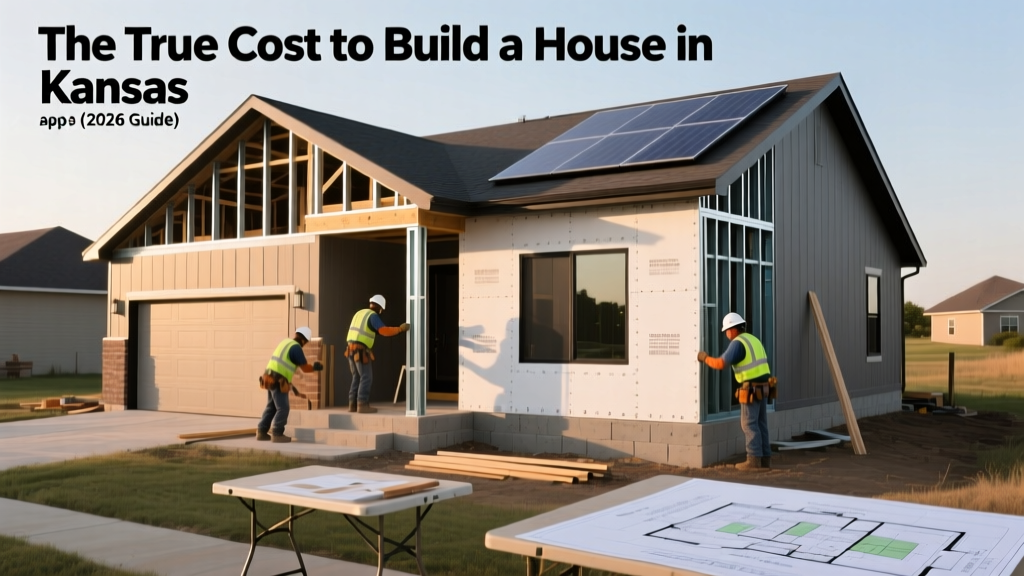
Understanding the Cost to Build a House in Kansas
Calculating the exact cost to build a house in Kansas requires navigating a unique intersection of extreme weather resilience, variable soil conditions, and distinct regional labor markets. As of 2026, the baseline construction cost for a custom, single-family home in Kansas ranges from $165 to $260 per square foot. For a standard 2,000-square-foot residence, this translates to a total hard construction cost between $330,000 and $520,000, excluding land acquisition and site development.
According to the National Association of Home Builders (NAHB) Construction Cost Survey, framing and interior finishes typically consume the largest share of the budget. However, in Kansas, foundation engineering and exterior weatherproofing demand a higher-than-average percentage of capital due to local environmental stressors.
2026 Kansas Construction Snapshot
- Average Cost per Sq. Ft.: $165 - $260
- Total Average Build (2,000 sq. ft.): $330,000 - $520,000
- Typical Build Timeline: 7 to 10 months
- Primary Cost Drivers: Expansive clay foundations, Class 4 impact roofing, high-SEER2 HVAC systems
Regional Cost Variations Across Kansas
Kansas is not a monolith; the cost to build a house in Kansas fluctuates significantly depending on the county. Proximity to metropolitan hubs, local impact fees, and union vs. non-union labor availability heavily influence final pricing.
| Region / City | Avg. Cost / Sq. Ft. | Total (2,000 sq. ft.) | Market Drivers |
|---|---|---|---|
| Johnson County (Overland Park) | $210 - $280+ | $420k - $560k+ | High land costs, strict zoning, premium finish expectations |
| Sedgwick County (Wichita) | $175 - $230 | $350k - $460k | Balanced labor market, moderate permit fees |
| Shawnee County (Topeka) | $165 - $210 | $330k - $420k | Lower land costs, accessible local materials |
| Rural Western KS (e.g., Dodge City) | $150 - $195 | $300k - $390k | Cheaper land, but higher logistics/transport costs for materials |
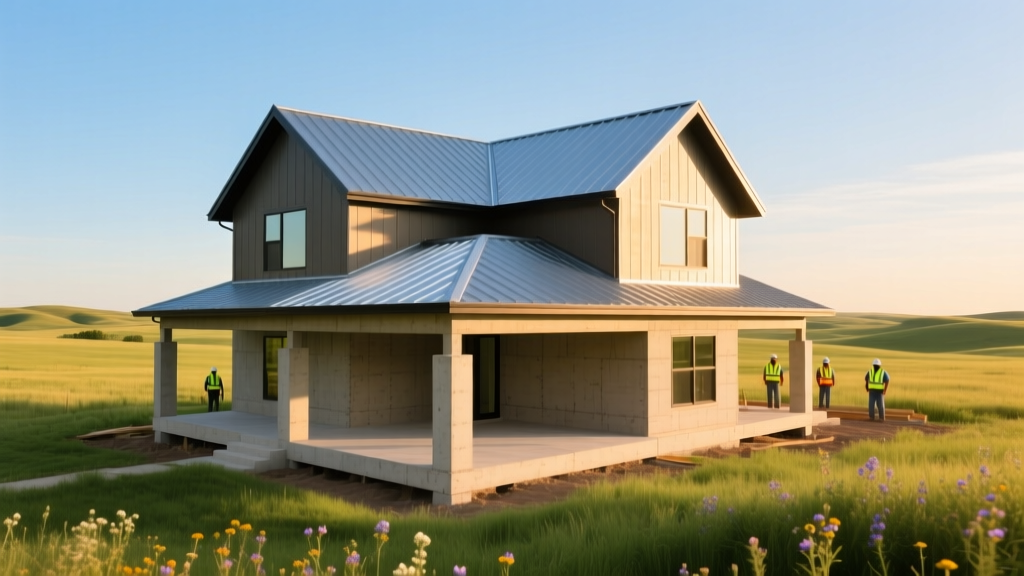
Kansas-Specific Construction Challenges & Material Costs
Building in the Sunflower State requires engineering for three distinct environmental threats: high-velocity winds, severe hail, and expansive soils. Ignoring these factors during the estimating phase will lead to massive change orders and long-term structural failures.
1. Tornado and Hail Resilience (The FORTIFIED Standard)
Kansas sits squarely in Tornado Alley. Standard architectural shingles (ASTM D3161 Class F) are insufficient for long-term durability against Kansas hailstorms. Upgrading to a Class 4 impact-resistant roof—such as Owens Corning Duration Storm or a 26-gauge standing seam metal roof—adds $4,500 to $12,000 to the initial build cost. However, the Insurance Institute for Business & Home Safety (IBHS) FORTIFIED program notes that achieving a FORTIFIED Roof designation can reduce annual homeowners insurance premiums by up to 20%, yielding a return on investment within 5 to 7 years.
2. Expansive Clay Soils and Foundation Engineering
Eastern and Central Kansas are notorious for smectite-rich expansive clay soils. These soils swell significantly when wet and shrink during droughts, exerting thousands of pounds of upward pressure on concrete slabs. A standard slab-on-grade foundation ($8 to $12 per sq. ft.) is a liability in these zones. Builders must utilize waffle slabs, post-tensioned slabs, or drilled concrete piers extending below the active soil layer (often 10 to 15 feet deep). Expect to pay $18 to $28 per square foot for engineered foundations in areas like Olathe or Leavenworth.
3. Extreme Thermal Swings and Insulation
Kansas spans IECC Climate Zones 4 (South) and 5 (North). Summers regularly exceed 100°F with high humidity, while winters plunge below 0°F. The U.S. Department of Energy Building America program recommends a minimum of R-49 in the attic and R-20+ in exterior walls. Upgrading from standard fiberglass batts to closed-cell spray foam (approx. R-6.5 per inch) in the roof deck creates a conditioned attic, reducing HVAC load by 15-20%. This upgrade typically costs $3.50 to $5.00 per square foot of insulated area.
Line-Item Cost Breakdown: 2,000 Sq. Ft. Custom Home
The following breakdown illustrates how a $400,000 construction budget (excluding land) is allocated for a mid-tier custom home in the Wichita metropolitan area.
| Construction Phase | Percentage | Estimated Cost | Key Kansas Considerations |
|---|---|---|---|
| Site Work & Prep | 8% | $32,000 | Soil testing, grading, rural water tap fees |
| Foundation | 12% | $48,000 | Engineered waffle slab for clay soils |
| Framing & Roofing | 22% | $88,000 | 2x6 exterior walls, Class 4 impact shingles |
| Exterior Finishes | 15% | $60,000 | James Hardie fiber cement siding (wind/fire rated) |
| HVAC, Plumbing, Electrical | 18% | $72,000 | Dual-fuel HVAC, PEX-A plumbing, 200A panel |
| Interior Finishes | 20% | $80,000 | Drywall, LVP flooring, semi-custom cabinetry |
| Misc & Contingency | 5% | $20,000 | Cleanup, portable toilets, weather delays |
HVAC Sizing and Selection for the Kansas Climate
HVAC systems in Kansas cannot be sized solely for heating or solely for cooling; they must perform efficiently at both extremes. A standard 80% AFUE gas furnace paired with a 14-SEER air conditioner is no longer sufficient or code-compliant in many jurisdictions.
Permitting, Impact Fees, and Regulatory Costs
Soft costs often catch out-of-state builders and self-builders off guard. In Kansas, municipalities dictate building codes, with most adopting the 2021 International Residential Code (IRC) with local amendments.
- Building Permits: Typically calculated at $0.15 to $0.35 per square foot under roof. A 2,500 sq. ft. structure will incur $375 to $875 in base permit fees.
- Water/Sewer Tap Fees: In rural counties or expanding subdivisions, tap fees can range from $2,500 to over $8,000 per lot, depending on infrastructure distance.
- Windstorm Engineering Stamps: Required in most counties to verify the structural framing can withstand 115+ mph ultimate design wind speeds. Budget $1,500 to $3,000 for a licensed structural engineer to stamp the framing plans.
Actionable Decision Framework: Custom vs. Production Builds
When determining the final cost to build a house in Kansas, your choice of builder type dictates the financial ceiling. Production builders (e.g., in master-planned communities in Johnson County) leverage economies of scale, offering locked-in pricing between $170 and $200 per square foot. However, they restrict material choices, often defaulting to standard asphalt shingles and basic vinyl windows that may underperform during Kansas supercell storms.
Custom builders charge $220 to $280+ per square foot but allow for critical climate-specific upgrades: continuous exterior insulation (ZIP System R-sheathing), safe rooms (FEMA P-361 compliant interior concrete bunkers), and whole-home backup generators (Generac 24kW). If you are building in rural or semi-rural Kansas where grid outages from ice storms or tornadoes can last for days, the custom route is not a luxury; it is a necessary investment in resilience.
Written by
Priya KapoorPriya Kapoor is a real estate market analyst and construction economics researcher with expertise in housing affordability, development feasibility, and infrastructure investment. She holds a Master of Regional Planning from Cornell University and previously worked as a senior analyst at CBRE's Investment Properties group, where she modeled returns for $4B in mixed-use development pipelines. Priya now runs an independent research practice advising developers, municipalities, and REITs on construction cost forecasting and market timing. She publishes the quarterly "BuildMat Market Pulse" report tracking material price indices across 12 commodity categories. Based in Austin, TX, Priya serves on the board of Habitat for Humanity Austin and is a marathon runner.
More from Priya Kapoor
View all
Construction Cost
Cost to Build a 1600 Sq Ft Home in 2026: Full Breakdown
Accurate 2026 cost to build a 1600 sq ft home—material, labor, and regional pricing breakdowns included. Plan your budget with real-time estimates.
Aug 11, 2026

Wood & Lumber
Name the Types of Wood for Pressure Treatment and Preservation
Learn how to name the types of wood best suited for pressure treatment. Compare species treatability, chemical retention levels, and 2026 preservation costs.
Aug 4, 2026

Stone & Masonry
Stone Veneer Suppliers Lindenhurst: 2026 Cost Analysis
Analyze 2026 stone veneer costs in Lindenhurst, NY. Compare local supplier pricing, delivery fees, and Suffolk County installation labor rates.
Aug 4, 2026