Cost to Build a Laundromat: Complete Budget Breakdown
Discover the true cost to build a laundromat. Detailed budget planning guide covering equipment, plumbing trenching, electrical, and hidden utility fees.

The Financial Blueprint: What It Actually Costs
Calculating the accurate cost to build a laundromat requires moving beyond generic square-footage multipliers. While industry averages suggest a range of $200,000 to $500,000 for a standard 2,000 to 3,000-square-foot facility, the actual capital expenditure is dictated by heavy infrastructure requirements. Unlike standard retail build-outs, a coin or card-operated laundry demands industrial-grade plumbing, massive electrical loads, and specialized ventilation.
For budget planning purposes, successful operators follow the 60/30/10 capital allocation rule: 60% of the budget is consumed by commercial laundry equipment, 30% is dedicated to leasehold improvements and utility infrastructure, and 10% covers soft costs, technology, and working capital. Understanding the granular costs within these categories prevents the mid-construction budget shortfalls that derail many first-time laundromat projects.
Capital Expenditure Matrix
The following matrix outlines the projected cost ranges for a 2,500-square-foot laundromat featuring 40 washers and 50 dryers. These figures reflect current 2026 material and labor rates for a standard commercial shell build-out.
| Budget Category | Low-End Estimate | High-End Estimate | Primary Cost Drivers |
|---|---|---|---|
| Commercial Equipment | $180,000 | $320,000 | Brand selection, capacity mix, financing terms |
| Plumbing & Trenching | $35,000 | $65,000 | Concrete saw-cutting depth, cast iron vs. PVC |
| Electrical Upgrades | $15,000 | $40,000 | 3-phase power installation, transformer upgrades |
| HVAC & Make-Up Air | $20,000 | $45,000 | Exhaust ducting, MUA unit capacity |
| Water Heating Systems | $15,000 | $30,000 | Boiler efficiency, recirculation loops |
| Tech, Security & Finishes | $15,000 | $25,000 | Card readers, cameras, impact-resistant flooring |
| Soft Costs & Impact Fees | $10,000 | $50,000+ | Municipal sewer tap fees, permits, architectural plans |
Infrastructure Build-Out: Where Budgets Bleed
The most severe budget overruns in laundromat construction occur in the 'invisible' infrastructure: the systems buried in the floor or mounted on the roof. Standard retail contractors often underestimate these requirements, leading to devastating change orders.
Plumbing and Concrete Trenching
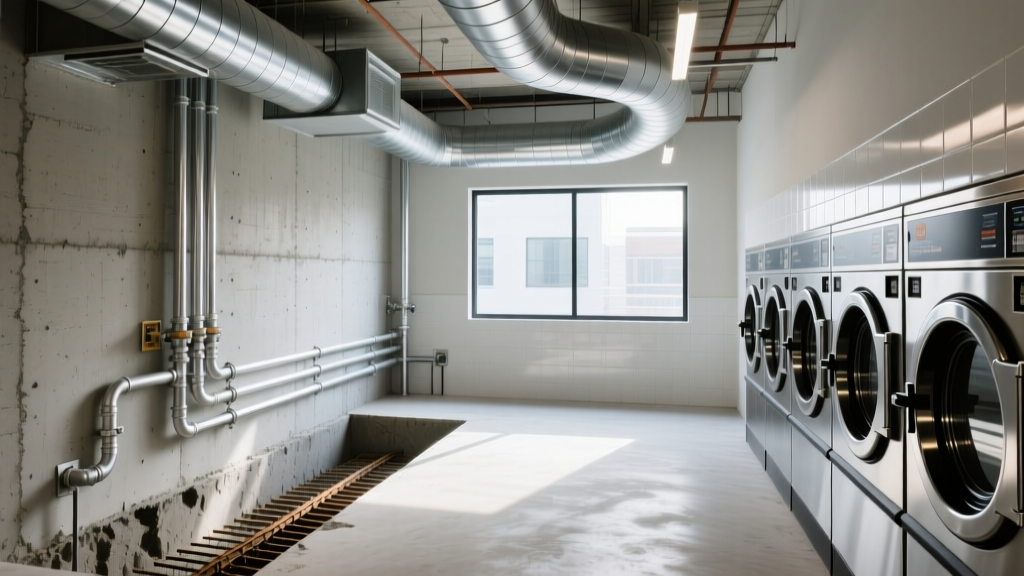
Commercial washers discharge water at a massive volume and velocity. A standard 1.5-inch residential drain will instantly flood a laundromat. You must install a 4-inch (or larger) cast iron or heavy-duty PVC main drain line. This requires saw-cutting the existing concrete slab, trenching 12 to 18 inches deep, laying the pipe with precise grading, and backfilling with engineered soil.
- Trenching Costs: Expect to pay $65 to $110 per linear foot for saw-cutting, excavation, pipe laying, and concrete backfill.
- Water Supply Lines: A 2-inch or 3-inch cold water main and a dedicated hot water recirculation loop are mandatory to maintain adequate water pressure when multiple 60-pound washers fill simultaneously.
- Failure Mode: Using standard schedule 40 PVC for the main drain instead of cast iron or heavy-wall PVC can lead to pipe collapse under the vibration of 40 high-speed extractors, requiring a complete floor teardown to fix.
Electrical Service and 3-Phase Power
Most retail strip centers are equipped with 200-amp, single-phase electrical panels. A modern laundromat requires 208V/240V 3-phase power to run high-efficiency commercial motors and electric dryers. A typical 2,500-square-foot store will draw between 400 and 800 amps.
Upgrading the electrical service involves coordinating with the local utility company to install a new transformer, running heavy-gauge underground or overhead conduit, and installing multiple 3-phase distribution panels. If the local utility requires a new pad-mounted transformer and trenching from the street, electrical costs can easily exceed $35,000.
HVAC and Make-Up Air (MUA) Systems
Dryers are essentially massive exhaust fans. A single commercial dryer exhausts 200 to 300 cubic feet per minute (CFM) of air. A store with 50 dryers will exhaust up to 15,000 CFM. If you do not install a dedicated Make-Up Air (MUA) unit to replace this exhausted air, the building will experience severe negative pressure.
Equipment Procurement: Financing and Selection
Equipment represents the largest single line item in your budget. The market is dominated by two primary manufacturers: Dexter Laundry and Speed Queen (Alliance Laundry Systems). Both offer highly reliable, commercial-grade machinery, but their financing and distribution models differ.
When evaluating the ENERGY STAR commercial clothes washer specifications, prioritize models with high G-Force extraction ratings (300+ G-Force). Higher extraction speeds remove more water in the washer, drastically reducing the time and gas required in the dryer, which accelerates customer turnover and lowers utility overhead.
Funding the Equipment
Few operators pay cash for $250,000 in laundry equipment. The industry standard is to utilize equipment leasing or government-backed loans. The Small Business Administration (SBA) 7(a) loan program is highly favored for laundromat build-outs because it allows owners to finance both the equipment and the leasehold improvements under one umbrella, typically requiring a 10% to 20% down payment with terms extending up to 10 years for equipment and 25 years for real estate.
"According to the Coin Laundry Association, properly capitalized laundromats that utilize SBA financing or structured equipment leases maintain healthier cash flow during the critical first 18 months of operation, allowing them to absorb marketing and utility stabilization costs without defaulting."
Three Hidden Budget Killers
First-time investors frequently overlook municipal and structural requirements that can add tens of thousands of dollars to the final ledger.
- Sewer Tap and Impact Fees: Municipalities charge capacity fees based on the size of your water meter. Upgrading a retail space from a standard 5/8-inch meter to a 2-inch or 3-inch meter triggers commercial sewer impact fees. Depending on the city, these tap fees can range from $10,000 to over $60,000. Always verify utility impact fees with the local water authority before signing a lease.
- ADA Compliance and Sloping: The Americans with Disabilities Act (ADA) requires specific aisle widths (minimum 36 inches, preferably 48 inches for turning radiuses) and accessible countertops. If the existing concrete slab is not perfectly level, you may need to pour self-leveling compound or build custom ADA-compliant ramps, adding $3,000 to $8,000 to the finish budget.
- Commercial Water Heating: Residential 80-gallon water heaters will fail within months under laundromat demands. You must install a commercial boiler system, such as a Lochinvar Knight XL or a Raypak condensing boiler, paired with a 120-gallon commercial storage tank and a recirculation pump. This system ensures 140°F water is instantly available at every machine, costing between $15,000 and $25,000 fully installed.
Decision Framework: New Build vs. Second-Generation Remodel
When planning your budget, the physical state of the real estate dictates your infrastructure costs. Choosing between a vanilla shell (new build) and a second-generation space (an existing laundromat) fundamentally alters your financial model.
The Vanilla Shell (Higher CapEx, Lower Maintenance)
Building out an empty retail space requires maximum capital for trenching, electrical upgrades, and ductwork. However, you benefit from modern, code-compliant infrastructure, new equipment warranties, and the ability to design an optimized customer flow. Total build-out costs typically sit at the higher end of the spectrum ($350,000 - $500,000+).
The Second-Generation Remodel (Lower CapEx, Hidden Risks)
Taking over an existing laundromat allows you to utilize the existing plumbing trenches, water meters, and 3-phase electrical panels, potentially cutting infrastructure costs by 60%. However, you inherit the previous owner's maintenance deferred liabilities.
Accurate budget planning for a laundromat requires treating the project as an industrial manufacturing facility rather than a standard retail store. By securing precise utility impact quotes, engineering the plumbing and MUA systems correctly, and leveraging favorable SBA financing structures, operators can build a highly profitable, resilient facility that withstands the operational demands of the modern laundry industry.
Written by
David NakamuraDavid Nakamura is a licensed architect (AIA) and construction technology writer focused on sustainable building methods, mass timber engineering, and high-performance building envelopes. He holds a Master of Architecture from the University of Washington and is a certified Passive House Consultant (CPHC). David spent eight years at the Seattle firm Mithun, where he led the design of three LEED Platinum projects, before founding his own practice specializing in net-zero residential design. He serves on the editorial advisory board of GreenBuilder Magazine and has authored peer-reviewed papers on cross-laminated timber (CLT) connections for the Journal of Structural Engineering. In his spare time, David teaches woodworking at Pratt Fine Arts Center and kayaks the Puget Sound.
More from David Nakamura
View all
Construction Cost
Labor Cost to Build a Deck Per Sq Ft: 2026 Installation Guide
Discover the exact labor cost to build a deck per sq ft in 2026. This installation guide breaks down contractor rates, complexity factors, and hidden fees.
Aug 4, 2026

Construction Cost
How Much Does It Cost to Build a 3 Bedroom House? Financing Guide
Learn exactly how much it costs to build a 3 bedroom house and explore 2026 financing options, construction loan types, and budget frameworks for your build.
Aug 4, 2026

Construction Cost
Cost to Build a Tennis Court: 2026 Guide
How much does it cost to build a tennis court in 2026? Breakdowns for asphalt, concrete, and synthetic surfaces plus fencing and lighting.
Jul 30, 2026