Building Materials Price News: 2026 Scope Calculator Adjustments
Track the latest building materials price news to calibrate your size and scope calculator. Learn 2026 forecasting strategies to prevent budget overruns.
The Fallacy of Static Estimating in 2026
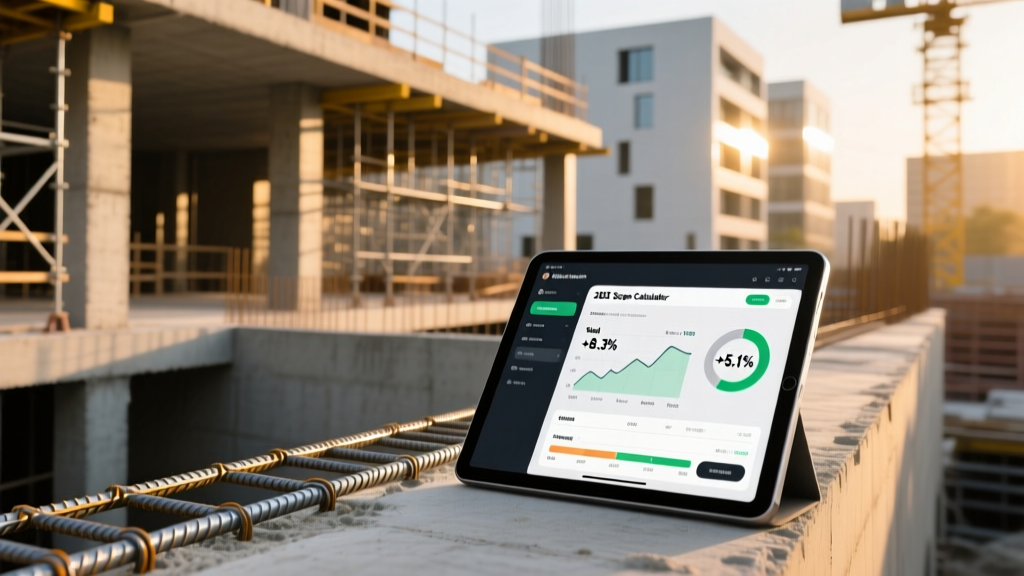
Historically, contractors and estimators built size and scope calculators using static, annualized unit costs. In the current construction economy, relying on a fixed price book is a guaranteed path to margin erosion. The continuous churn of building materials price news—driven by localized energy surcharges, shifting tariff policies, and supply chain re-routing—requires a fundamental shift in how project scope is quantified. To protect profitability in 2026, estimators must transition from static spreadsheets to dynamic size and scope calculators that ingest real-time market indices and automatically trigger value-engineering protocols when material thresholds are breached.
Decoding Current Building Materials Price News by Sector
Integrating market news into your calculator requires understanding the specific cost drivers for major structural and envelope materials. General inflation metrics are useless for construction; you must track sector-specific producer indices.
Dimensional Lumber and Engineered Wood
The Random Lengths framing lumber composite index remains the benchmark for wood-framed scope calculations. Recent building materials price news highlights a stabilization in Southern Yellow Pine (SYP) but sustained volatility in Spruce-Pine-Fir (SPF) due to Canadian rail logistics and beetle-kill timber quotas. For your size calculator, baseline SYP 2x4 framing at $390 to $420 per thousand board feet (MBF). If news reports indicate a Canadian softwood lumber duty adjustment, your calculator must immediately apply a 12% multiplier to all SPF line items and trigger a scope review for engineered wood alternatives like LSL (Laminated Strand Lumber) studs.
Portland Cement and Ready-Mix Concrete
Concrete pricing is hyper-localized, but the baseline cost of Type I/II Portland cement is heavily influenced by natural gas prices required for kiln firing. Current market data places cement between $145 and $165 per ton, translating to ready-mix delivered costs of $140 to $165 per cubic yard. When energy markets fluctuate, cement manufacturers issue 30-day escalation notices. A robust scope calculator will link foundation volume calculations directly to the latest energy sector news, automatically adjusting the cubic yardage cost and prompting a scope reduction (such as optimizing footing depths or switching to post-tensioned slabs) if the per-yard cost breaches the $170 threshold.
Rigid Insulation and Petrochemical Ties
Envelope scope calculations are highly sensitive to petrochemical news. XPS (Extruded Polystyrene) and Polyiso board prices track closely with crude oil and natural gas liquid (NGL) derivatives. When building materials price news reports refinery outages or feedstock shortages, insulation costs can spike 15% to 20% within weeks. Estimators must program their calculators to swap XPS specifications for EPS (Expanded Polystyrene) or mineral wool batts when the petrochemical volatility index exceeds predetermined limits.
| Material Category | 2026 Baseline Cost | Price News Trigger | Automated Scope Adjustment |
|---|---|---|---|
| SPF Dimensional Lumber | $410 / MBF | Softwood duty increases or rail strikes | Switch to 24' O.C. advanced framing |
| Ready-Mix Concrete | $150 / Cu. Yard | Natural gas kiln surcharges | Optimize slab thickness, use fly ash |
| Polyiso Insulation | $1.15 / Sq. Ft. (1 inch) | Petrochemical feedstock shortages | Swap to mineral wool or EPS board |
| Copper Domestic Water | $4.80 / Linear Ft. (Type L) | Global mining output constraints | Transition to PEX-A (Uponor Wirsbo) |

The Dynamic Size & Scope Calculator Framework
To build a calculator that actually responds to building materials price news, you must move beyond simple multiplication (Quantity x Unit Cost). A dynamic calculator utilizes a three-variable framework:
- Base Geometric Quantity: The raw takeoff derived from the architectural plans (e.g., 14,500 sq ft of exterior wall area, 320 cubic yards of foundation concrete). This is your fixed physical scope.
- Real-Time Index Multiplier: A variable tied to an API or manual weekly input reflecting the latest building materials price news. If the Bureau of Labor Statistics Producer Price Index (PPI) for structural steel rises 4% this month, the multiplier for all W-shape and HSS tubing line items becomes 1.04.
- Scope Substitution Threshold (SST): The financial breaking point. If the Real-Time Index Multiplier pushes the total material cost beyond the SST (typically set at 85% of the total hard cost budget), the calculator automatically generates a 'Value Engineering Report' suggesting specific material swaps or dimensional reductions.
Scope Substitution Triggers and Value Engineering
When your calculator flags a budget breach based on adverse price news, you must execute scope substitutions that maintain structural and code integrity while reducing material volume. Below is a decision matrix for common 2026 substitutions.
Original Scope (High Volatility)
- 2x6 Exterior Studs @ 16' O.C.
- Open-web steel joists for commercial roofing
- Copper Type L for domestic water distribution
- 100% Portland cement mix design for flatwork
Dynamic Scope Adjustment (Stabilized)
- 2x4 Advanced Framing @ 24' O.C. with continuous exterior insulation
- Parallel chord wood trusses or LVL beams
- PEX-A (e.g., Uponor ProPEX) with brass fittings
- 30% Fly ash or slag cement substitution (SCM)
By programming these specific substitutions into your size and scope calculator, the moment building materials price news indicates a spike in copper or steel, the software instantly recalculates the project using the stabilized alternatives, presenting the client with a guaranteed maximum price (GMP) that protects your margin.
'Estimators who treat the scope as a rigid, unchangeable document are effectively gambling with their company's capital. The scope must be a living algorithm that breathes in response to macro-economic price news, shrinking or shifting materials to maintain the financial equilibrium of the build.'
— Senior Chief Estimator, Commercial Sector
Sourcing Authoritative Price News Data
Your size and scope calculator is only as accurate as the data feeding it. Relying on anecdotal supplier quotes is insufficient for long-term forecasting. To properly calibrate your calculator, integrate data from the following authoritative sources:
- Bureau of Labor Statistics (BLS) Producer Price Index: The BLS PPI data provides the most objective, lagging-indicator view of wholesale material cost shifts. Track the specific indices for softwood lumber (WPU0811), cement (WPU1322), and steel mill products.
- Associated General Contractors of America (AGC): The AGC regularly publishes construction market data and alerts that synthesize raw data into actionable intelligence regarding regional material shortages and tariff impacts.
- Engineering News-Record (ENR): ENR's weekly material price reports and city-specific cost indexes are critical for calibrating the geographic modifiers within your scope calculator, ensuring that a build in Seattle reflects different concrete baselines than a build in Dallas.
Mastering the integration of building materials price news into your size and scope calculations transforms estimating from a reactive administrative task into a proactive risk-management strategy. By defining precise volatility triggers and pre-programming value-engineering substitutions, contractors can lock in profitable margins regardless of the macro-economic headlines dominating the 2026 construction cycle.
Written by
David NakamuraDavid Nakamura is a licensed architect (AIA) and construction technology writer focused on sustainable building methods, mass timber engineering, and high-performance building envelopes. He holds a Master of Architecture from the University of Washington and is a certified Passive House Consultant (CPHC). David spent eight years at the Seattle firm Mithun, where he led the design of three LEED Platinum projects, before founding his own practice specializing in net-zero residential design. He serves on the editorial advisory board of GreenBuilder Magazine and has authored peer-reviewed papers on cross-laminated timber (CLT) connections for the Journal of Structural Engineering. In his spare time, David teaches woodworking at Pratt Fine Arts Center and kayaks the Puget Sound.
More from David Nakamura
View all
Construction Cost
Labor Cost to Build a Deck Per Sq Ft: 2026 Installation Guide
Discover the exact labor cost to build a deck per sq ft in 2026. This installation guide breaks down contractor rates, complexity factors, and hidden fees.
Aug 4, 2026

Construction Cost
How Much Does It Cost to Build a 3 Bedroom House? Financing Guide
Learn exactly how much it costs to build a 3 bedroom house and explore 2026 financing options, construction loan types, and budget frameworks for your build.
Aug 4, 2026

Construction Cost
Cost to Build a Tennis Court: 2026 Guide
How much does it cost to build a tennis court in 2026? Breakdowns for asphalt, concrete, and synthetic surfaces plus fencing and lighting.
Jul 30, 2026