2026 Cost to Build Pool: Concrete vs Fiberglass vs Vinyl Compared
Compare the 2026 cost to build pool options. We break down concrete, fiberglass, and vinyl liner prices, installation times, and long-term maintenance.

The 2026 Baseline Cost Matrix
Estimating the cost to build pool structures requires moving beyond national averages, which often obscure the massive price deltas between shell materials. In 2026, supply chain stabilization has normalized material costs, but specialized labor rates for steel tying, plumbing, and crane operation continue to drive regional variances. The following matrix establishes the baseline turnkey costs for a standard rectangular footprint, excluding premium site-work anomalies.
| Pool Shell Type | 14x28 ft. Baseline Cost | 16x32 ft. Baseline Cost | Typical Install Time | Structural Lifespan |
|---|---|---|---|---|
| Vinyl Liner (Steel/Polymer Wall) | $42,000 - $55,000 | $48,000 - $65,000 | 3 - 5 Weeks | Shell: 30+ yrs / Liner: 7-12 yrs |
| Fiberglass (One-Piece Gelcoat) | $58,000 - $75,000 | $65,000 - $85,000 | 2 - 4 Weeks | 25 - 30+ Years |
| Concrete (Gunite/Shotcrete) | $75,000 - $95,000 | $85,000 - $120,000+ | 8 - 12 Weeks | 50+ Years (with replastering) |
Vinyl Liner Pools: Upfront Savings vs. Lifecycle Reality
Vinyl pools represent the lowest initial cost to build pool installations, primarily due to the elimination of heavy masonry labor and the use of prefabricated wall panels. Modern vinyl pools utilize either 27-gauge galvanized steel or structural polymer framing. Polymer walls cost approximately 15% more upfront but are immune to the galvanic corrosion that plagues steel walls in high-salinity or high-moisture soils.
The Liner Replacement Factor
The critical financial consideration for vinyl pools is the liner lifecycle. Standard 20-mil overlap liners degrade under UV exposure and chemical oxidation within 5 to 7 years. Upgrading to a 30-mil beaded liner with UV-inhibitors extends this to 10 to 12 years. When budgeting, you must factor in a replacement cost of $4,500 to $6,500 every decade. Over a 30-year ownership period, a vinyl pool will require two to three complete liner replacements, effectively erasing its initial price advantage over fiberglass.
Fiberglass Pools: The Speed and Surface Advantage
Fiberglass pools bridge the gap between the affordability of vinyl and the durability of concrete. The shell is manufactured off-site using multi-layered fiberglass mats and ISO-resin, finished with a non-porous gelcoat that inherently resists algae adhesion. This non-porous surface drastically reduces the chemical and brushing labor required over the pool's lifespan.
Logistics and Access Limitations
The primary constraint dictating the cost to build pool structures with fiberglass is site access. A 16x32 fiberglass shell weighs between 5,000 and 7,000 pounds and requires an 8.5-foot wide clearance path for delivery. If overhead power lines, mature trees, or the house itself block the backyard, a crane lift is mandatory.
- Standard Crane (50-ton): $1,200 to $1,800 per day for lifts under 80 feet.
- Heavy Crane (90+ ton): $2,500+ per day for extended reach over two-story homes.
Furthermore, fiberglass pools are limited to manufacturer molds. While modern molds offer integrated tanning ledges and swim-outs, you cannot alter the fundamental dimensions or create truly custom freeform shapes without resorting to concrete.
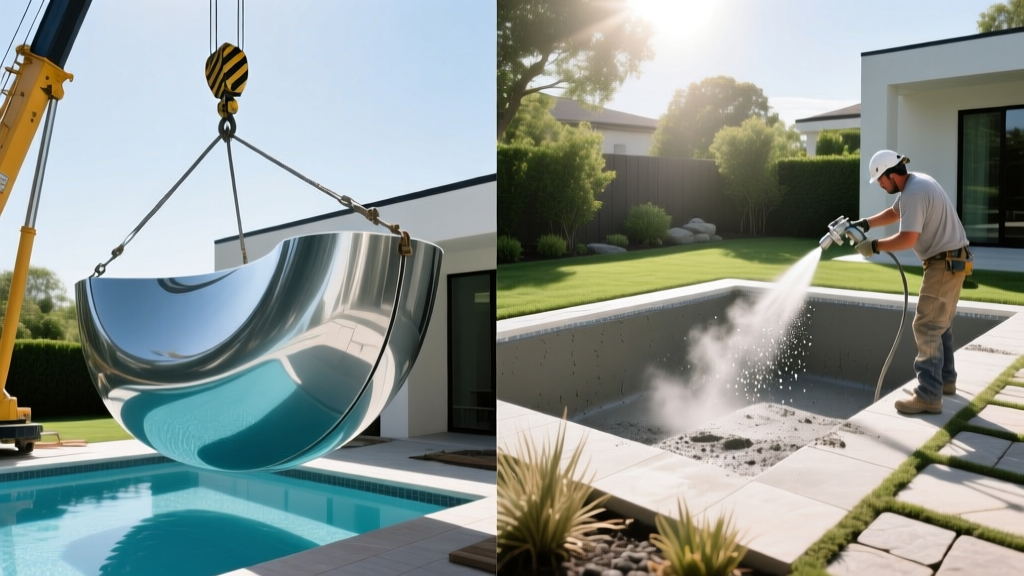
Gunite and Shotcrete: The Premium Custom Standard
Concrete pools—specifically pneumatically applied shotcrete (wet-mix) or gunite (dry-mix)—are the industry standard for high-end, custom estates. The structural integrity relies on a grid of #4 (1/2-inch) steel rebar tied on 10-inch to 12-inch centers, encased in a minimum 8-inch thick shell of 4,000 PSI concrete.
Interior Finish Dictates Long-Term Costs
The concrete shell itself is merely a structural vessel; the interior finish determines the aesthetic and the maintenance burden. Standard white marcite (a blend of white cement and marble dust) is the cheapest option at $5,000 to $7,000 for an average pool, but it is highly porous, prone to calcium scaling, and requires acid washing and replastering every 7 to 10 years.
"Upgrading to an exposed aggregate finish like PebbleTec or QuartzScapes increases the initial plaster cost by $8,000 to $12,000, but extends the interior lifespan to 15-20 years and provides superior slip resistance on tanning ledges."
The 10-Year Total Cost of Ownership (TCO)
Focusing solely on the initial cost to build pool structures ignores the compounding operational expenses. According to the U.S. Department of Energy, pool pumping and heating represent a massive percentage of residential energy use. The table below projects the 10-year TCO for a 16x32 pool in a moderate climate, assuming standard usage.
| Expense Category (10 Yrs) | Vinyl Liner | Fiberglass | Concrete (Pebble Finish) |
|---|---|---|---|
| Initial Build Cost | $55,000 | $75,000 | $100,000 |
| Liner Replastering/Replacement | $5,500 (1 new liner) | $0 | $0 (Pebble lasts 15+ yrs) |
| Chemicals & Algaecides | $3,200 | $1,800 | $4,500 |
| Energy (Pump & Heater) | $6,000 | $6,000 | $6,000 |
| Routine Maintenance/Labor | $2,500 | $1,200 | $3,500 |
| 10-Year Total TCO | $72,200 | $84,000 | $114,000 |
To mitigate the energy costs across all three types, installing an Energy Star-certified variable-speed pump is non-negotiable. These pumps operate at lower RPMs for filtration cycles, reducing electrical consumption by up to 70% compared to single-speed models.
Site-Specific Variables That Destroy Budgets
The most volatile component of any pool estimate is the dirt. Before signing a contract, require a geotechnical soil analysis or at least a comprehensive site evaluation. The following variables routinely trigger change orders that add $5,000 to $20,000 to the final invoice:
1. Rock Excavation and Blasting
If the excavator hits bedrock or massive boulders below the frost line, standard digging halts. Mechanical chipping with a hydraulic hammer costs $150 to $250 per cubic yard. In severe cases requiring controlled blasting, costs can exceed $10,000. Ensure your contract includes a 'rock clause' with a predefined per-yard overage rate rather than an open-ended time-and-materials blank check.
2. Expansive Soils and Over-Excavation
Regions with heavy clay or expansive soils require over-excavation. The builder must dig 12 to 18 inches beyond the pool shell dimensions and backfill with clean, crushed gravel (typically 3/4-inch washed stone) to create a capillary break and allow for soil expansion without cracking the pool shell.
3. Safety Barriers and Permitting
Local municipalities enforce strict barrier codes to prevent drowning incidents. The Centers for Disease Control and Prevention (CDC) outlines that residential pool barriers must be at least 4 feet high with self-closing, self-latching gates. If your existing backyard fence does not meet these specifications, installing 150 linear feet of aluminum or wrought-iron pool fencing will add $4,500 to $7,500 to your project total.
4. Decking and Coping Overages
Base pool quotes typically include only 2 feet of standard brushed concrete decking and basic precast concrete coping. Upgrading to cantilevered natural stone coping (like travertine or bluestone) and stamped or exposed-aggregate concrete decking will easily add $12,000 to $25,000 to the hardscape budget. According to lifespan data from InterNACHI, while natural stone coping lasts a lifetime, standard precast concrete coping may spall and require replacement within 15 to 20 years in freeze-thaw climates.
Final Decision Framework
Choose vinyl if your absolute maximum budget is $60,000, you have a strict timeline, and you accept the inevitability of future liner replacement costs. Choose fiberglass if you want the lowest weekly maintenance burden, have adequate crane or driveway access, and are satisfied with pre-engineered dimensions. Choose concrete if you require a highly customized freeform shape, specific depth profiles (like a diving well), and possess the budget to absorb the highest initial and long-term chemical maintenance costs.
Written by
David NakamuraDavid Nakamura is a licensed architect (AIA) and construction technology writer focused on sustainable building methods, mass timber engineering, and high-performance building envelopes. He holds a Master of Architecture from the University of Washington and is a certified Passive House Consultant (CPHC). David spent eight years at the Seattle firm Mithun, where he led the design of three LEED Platinum projects, before founding his own practice specializing in net-zero residential design. He serves on the editorial advisory board of GreenBuilder Magazine and has authored peer-reviewed papers on cross-laminated timber (CLT) connections for the Journal of Structural Engineering. In his spare time, David teaches woodworking at Pratt Fine Arts Center and kayaks the Puget Sound.
More from David Nakamura
View all
Construction Cost
Labor Cost to Build a Deck Per Sq Ft: 2026 Installation Guide
Discover the exact labor cost to build a deck per sq ft in 2026. This installation guide breaks down contractor rates, complexity factors, and hidden fees.
Aug 4, 2026

Construction Cost
How Much Does It Cost to Build a 3 Bedroom House? Financing Guide
Learn exactly how much it costs to build a 3 bedroom house and explore 2026 financing options, construction loan types, and budget frameworks for your build.
Aug 4, 2026

Construction Cost
Cost to Build a Tennis Court: 2026 Guide
How much does it cost to build a tennis court in 2026? Breakdowns for asphalt, concrete, and synthetic surfaces plus fencing and lighting.
Jul 30, 2026