How Much Does It Cost to Build an Outdoor Kitchen? 2026 Guide
Discover exactly how much it costs to build an outdoor kitchen in 2026. Detailed pricing tiers, utility costs, material specs, and hidden budget traps.
The True Cost Spectrum: Basic, Mid-Range, and Luxury
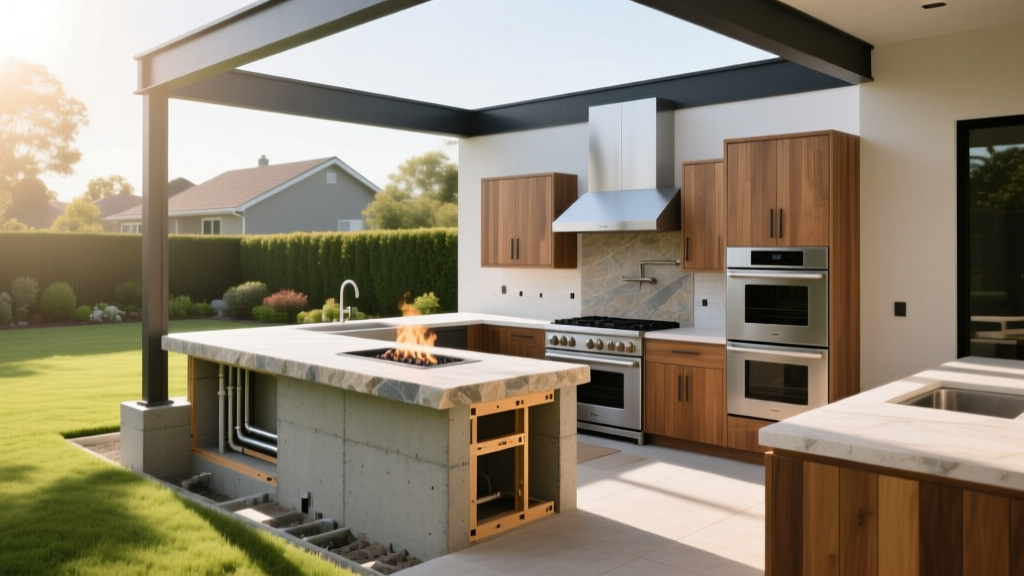
When homeowners research how much does it cost to build an outdoor kitchen, they quickly discover that pricing is rarely one-size-fits-all. In 2026, the national average for a professionally installed outdoor kitchen sits between $18,000 and $45,000. However, the final invoice is dictated by your approach to framing, countertop materials, appliance tiers, and the complexity of utility trenching. Understanding these variables is the only way to prevent budget overruns.
2026 Cost Breakdown by Build Tier
| Build Tier | Estimated Cost Range | Framing & Structure | Appliance Grade | Countertop Material |
|---|---|---|---|---|
| Prefab / Modular | $5,000 - $15,000 | Powder-coated steel or polymer cabinets | Entry-level (e.g., Char-Broil, basic Bull) | Poured concrete or basic tile |
| Mid-Range Masonry | $15,000 - $40,000 | CMU block with stone veneer or stucco | Mid-tier (e.g., Coyote, Lynx Sedona) | Granite or quartzite |
| Custom Luxury | $45,000 - $120,000+ | Reinforced CMU, steel stud, custom cedar | Premium (e.g., Kalamazoo, Hestan) | Sintered stone (Dekton) or porcelain |
Hidden Utility Costs That Derail Budgets
The most frequent point of failure in outdoor kitchen estimating is underpricing the utility runs. Running gas, water, and electrical lines from your main house to a backyard pad involves more than just digging a trench.
If your kitchen is located across an existing concrete patio or paved driveway, contractors must either saw-cut and patch the hardscape (adding $1,500 - $3,500 for concrete restoration) or use directional boring (adding $2,000 - $5,000). Always map your utility route before finalizing your kitchen placement.
- Gas Lines: A standard 1/2-inch black iron or CSST (Corrugated Stainless Steel Tubing) line costs $500 to $1,500 if the run is under 50 feet. High-BTU premium grills (100,000+ BTUs) often require a 3/4-inch dedicated line and an upgraded meter, which can add $2,500+ if your local utility company requires a main line upgrade.
- Electrical: You will need dedicated 20-amp GFCI circuits for standard outlets and refrigeration. If you are installing a high-end hybrid grill or ceramic kamado with digital controllers, a dedicated 50-amp circuit may be required. Expect to pay $1,200 to $3,500 for trenching and panel tie-ins.
- Plumbing: Installing a hot and cold water line with a frost-proof sillcock and a proper P-trap vent for the sink drain typically runs $1,500 to $4,000. Skipping the vent is a common code violation that leads to slow drainage and sewer gas odors.
Material Selection: Weathering the Elements
Outdoor environments subject materials to UV degradation, freeze-thaw cycles, and high humidity. According to design trend reports from the National Kitchen & Bath Association (NKBA), homeowners are increasingly moving away from porous natural stones in favor of ultra-compact, weather-proof surfaces.
Countertop Comparison Matrix
| Material | Cost per Sq. Ft. (Installed) | UV Stability | Freeze-Thaw Resistance | Maintenance Required |
|---|---|---|---|---|
| Granite | $80 - $150 | Moderate (can fade) | Poor (spalls if unsealed) | Annual sealing required |
| Dekton / Sintered Stone | $150 - $250 | Excellent | Excellent | Zero maintenance |
| Poured Concrete | $100 - $175 | Good | Poor (prone to micro-cracking) | Frequent sealing & waxing |
| Glazed Porcelain Tile | $60 - $120 | Excellent | Good (depends on grout) | Grout sealing required |
Appliance Pricing and Performance Tiers
Appliances represent 30% to 50% of your total budget. When selecting stainless steel equipment, the alloy composition is critical. Standard 430 stainless steel is magnetic and prone to rusting in coastal or high-humidity environments. You must specify 304-grade stainless steel for any property within 10 miles of a saltwater coastline.
Grill and Cooking Equipment Tiers
- Entry-Level ($1,500 - $3,500): Brands like Bull (e.g., the Outlaw model) or Napoleon offer solid 304 or 430 steel construction with basic rotary burners. Good for weekend use, but burner trays may degrade in 5-7 years.
- Mid-Tier Luxury ($4,000 - $9,000): Coyote C-Series and Lynx Sedona feature heavy-duty 304 stainless steel, ceramic briquette heat distribution, and integrated LED lighting. These offer the best balance of longevity and cost.
- Ultra-Premium ($12,000 - $25,000+): Kalamazoo Hybrid Fire grills and Hestan built-ins offer laser-cut grill grates, variable infrared zones, and the ability to burn wood, charcoal, and gas simultaneously. These are commercial-grade units built to last decades.
If you are building your kitchen island using combustible materials (like wood framing or certain composite panels), you must install a manufacturer-approved stainless steel insulation jacket around the grill. This prevents heat transfer and structural fires. Even with CMU block construction, an insulation jacket protects the masonry mortar from thermal degradation over time.
Climate-Specific Failure Modes and Prevention
Building an outdoor kitchen in Arizona requires entirely different specifications than building one in Minnesota. Ignoring regional climate data is the primary reason outdoor kitchens fail prematurely.
Freeze-Thaw Environments (Northern US & Canada)
Water infiltration is the enemy of masonry. If moisture enters the pores of your stone veneer or brick and freezes, it expands and causes spalling (surface flaking).
- Solution: Specify facing materials that pass ASTM C67 freeze-thaw testing. Ensure your countertop has a minimum 1.5-inch overhang with a drip edge to prevent water from running down the cabinet faces. Install a breathable, weather-resistant barrier (WRB) behind the lath and scratch coat.
Coastal and High-Humidity Environments
Salt air accelerates galvanic corrosion, especially when dissimilar metals touch (e.g., aluminum cabinet frames against stainless steel screws).
- Solution: Use marine-grade polymer cabinets (like NatureKast) or 316-grade stainless steel. Never use standard galvanized screws; specify hot-dipped galvanized or stainless steel fasteners for all framing and hardware.
ROI and Resale Value Considerations
While an outdoor kitchen enhances lifestyle value, its financial return on investment (ROI) varies. Industry data from the Hearth, Patio & Barbecue Association (HPBA) indicates that outdoor living spaces remain a top priority for homebuyers. However, real estate appraisers rarely value an outdoor kitchen at 100% of its construction cost.
On average, a well-integrated mid-range outdoor kitchen yields a 50% to 70% ROI at resale. To maximize this return, ensure the kitchen's architectural style matches the primary residence, and avoid over-improving for the neighborhood. A $90,000 luxury outdoor kitchen in a neighborhood where homes sell for $400,000 will not recoup its cost, whereas a $20,000 functional setup will significantly boost the home's marketability.
Frequently Asked Questions
Do I need a permit to build an outdoor kitchen?
Yes, in most municipalities. While the masonry island itself might not always require a structural permit, the utility tie-ins (gas, electric, and plumbing) absolutely do. Unpermitted utility work can void your homeowner's insurance in the event of a fire or gas leak.
Can I use standard indoor kitchen cabinets outside?
No. Indoor cabinets are typically made of MDF or particleboard, which will swell, warp, and disintegrate when exposed to outdoor humidity and temperature fluctuations. Always use marine-grade polymer, powder-coated aluminum, or CMU block framing.
How long does construction take?
A modular or prefab kitchen can be assembled in 1 to 3 days. A custom masonry build, including utility trenching, concrete footings, block laying, stone veneer application, and countertop templating, typically takes 4 to 8 weeks from groundbreaking to final appliance installation.
Written by
Priya KapoorPriya Kapoor is a real estate market analyst and construction economics researcher with expertise in housing affordability, development feasibility, and infrastructure investment. She holds a Master of Regional Planning from Cornell University and previously worked as a senior analyst at CBRE's Investment Properties group, where she modeled returns for $4B in mixed-use development pipelines. Priya now runs an independent research practice advising developers, municipalities, and REITs on construction cost forecasting and market timing. She publishes the quarterly "BuildMat Market Pulse" report tracking material price indices across 12 commodity categories. Based in Austin, TX, Priya serves on the board of Habitat for Humanity Austin and is a marathon runner.
More from Priya Kapoor
View all
Construction Cost
Cost to Build a 1600 Sq Ft Home in 2026: Full Breakdown
Accurate 2026 cost to build a 1600 sq ft home—material, labor, and regional pricing breakdowns included. Plan your budget with real-time estimates.
Aug 11, 2026

Wood & Lumber
Name the Types of Wood for Pressure Treatment and Preservation
Learn how to name the types of wood best suited for pressure treatment. Compare species treatability, chemical retention levels, and 2026 preservation costs.
Aug 4, 2026

Stone & Masonry
Stone Veneer Suppliers Lindenhurst: 2026 Cost Analysis
Analyze 2026 stone veneer costs in Lindenhurst, NY. Compare local supplier pricing, delivery fees, and Suffolk County installation labor rates.
Aug 4, 2026