How Much Does an F1 Car Cost to Build? A 2026 Material Comparison
Discover how much an F1 car costs to build under 2026 regulations. We compare its carbon fiber and power unit costs to luxury residential construction.

The Ultimate Bespoke Construction Project
When engineers, motorsport enthusiasts, and procurement specialists ask, "how much does an f1 car cost to build," the answer requires looking at the vehicle not merely as a race car, but as a highly specialized, ultra-compact construction project. With the sweeping FIA technical regulations taking effect in 2026, the physical architecture of a Formula 1 car has undergone its most radical transformation in a decade. The shift to a 50/50 power split between the internal combustion engine (ICE) and electrical systems, combined with the introduction of active aerodynamics, has fundamentally altered the bill of materials.
To understand the true build cost, we must separate the physical manufacturing of the car from the research and development (R&D) overhead. While a top-tier team operates under a strict cost cap, the raw material, machining, and assembly cost to physically construct a single 2026 F1 chassis from raw composites and billets sits between $15 million and $20 million. Below, we break down this cost by comparing the car's structural and mechanical systems to traditional high-end commercial and residential construction.
Physical Build Cost vs. R&D Overhead
In traditional construction, the architectural design and engineering phase typically accounts for 8% to 15% of the total project cost. In Formula 1, this ratio is inverted. The physical parts that make up the car represent a fraction of the team's expenditure. According to Formula 1 financial disclosures, the FIA cost cap for 2026 hovers around $135 million per team. However, this cap covers wind tunnel operations, computational fluid dynamics (CFD) supercomputing, personnel salaries, and logistics.
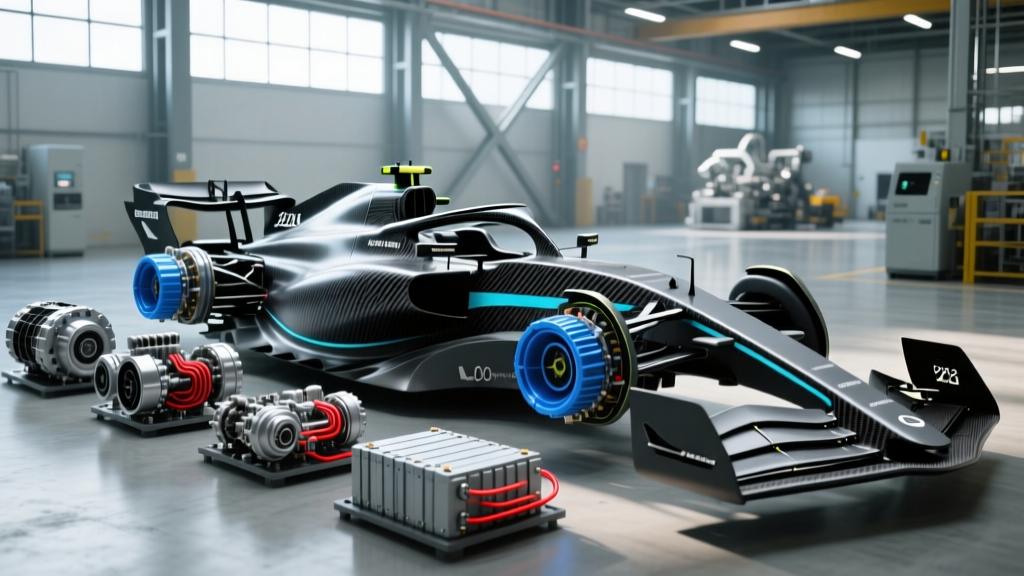
The 2026 Power Unit: MEP Systems on Steroids
In building construction, Mechanical, Electrical, and Plumbing (MEP) systems often consume 25% to 35% of a commercial building's hard costs. The 2026 F1 Power Unit (PU) serves the same function but at an astronomical cost density. The 2026 regulations mandate the removal of the Motor Generator Unit-Heat (MGU-H) while drastically increasing the output of the Motor Generator Unit-Kinetic (MGU-K) to 350kW (nearly 470 horsepower).
Building this hybrid system requires exotic metallurgy. The ICE block and cylinder heads are machined from proprietary aluminum alloys, while the turbocharger and exhaust manifolds utilize Inconel and titanium aluminide to withstand exhaust gas temperatures exceeding 1,000°C. The 350kW MGU-K requires aerospace-grade copper windings and advanced silicon-carbide (SiC) inverters to manage the massive electrical loads without thermal degradation.
- ICE and Turbocharger Assembly: ~$4.5 million
- MGU-K and Energy Store (Battery): ~$5.5 million
- Control Electronics and Wiring Looms: ~$1.2 million
- Total Power Unit Build Cost: ~$11.2 million
To put this in perspective, $11.2 million is roughly the equivalent of the complete MEP rough-in and finish-out for a 75,000-square-foot Class A commercial office building or a state-of-the-art hospital wing.
Carbon Fiber Monocoque vs. Structural Framing
The survival cell (monocoque) is the foundation and structural framing of the F1 car. It must pass rigorous FIA crash tests, including a 15G frontal impact and a 40kN side intrusion test. The 2026 chassis is constructed primarily from Toray T1100G intermediate modulus carbon fiber, reinforced with Zylon anti-intrusion panels to protect the driver from debris.
Unlike traditional construction where structural steel is bolted or welded on-site, the monocoque is laid up by hand in a cleanroom and cured in an autoclave at 120°C under 6 bar of pressure. The material cost per square foot is staggering compared to traditional building materials.
| Structural Component | F1 Car Material | Approx. F1 Cost | Construction Equivalent | Approx. Construction Cost |
|---|---|---|---|---|
| Primary Framing | T1100G Carbon Composite | $750,000 | Structural Steel (W-Shapes) | $18 - $24 per sq. ft. |
| Impact Protection | Zylon / Kevlar Weave | $150,000 | Reinforced Concrete Shear Walls | $8 - $12 per sq. ft. |
| Suspension Mounts | Titanium 3D Printed (DMLS) | $120,000 | Heavy Steel Gusset Plates | $2 - $4 per lb. |
Aerodynamics and Active Aero: The Building Envelope
In architecture, the building envelope (roofing, siding, glazing) dictates the structure's thermal and aerodynamic efficiency. For a 2026 F1 car, the aerodynamic surfaces serve this exact purpose. The 2026 regulations introduce active front and rear wing elements designed to reduce drag on straits and increase downforce in corners.
Building these active systems requires miniature, high-torque hydraulic actuators, carbon fiber flap elements machined to a tolerance of 0.05mm, and complex sensor arrays. While the raw carbon fiber for the wings might only cost $80,000, the micro-hydraulics, wiring, and assembly of the active aero system push the total build cost of the aerodynamic package to approximately $2.5 million. This is comparable to the cost of installing an automated, kinetic sun-shading facade on a modern corporate headquarters.
Cost Comparison Matrix: F1 Car vs. Luxury Custom Home
To contextualize how much an F1 car costs to build, let us compare the $18 million average physical build cost of a 2026 grid car to the construction of an $18 million luxury custom estate (approximately 12,000 square feet at $1,500 per square foot).
2026 F1 Car ($18M Build)
- Power Unit & Drivetrain: $11.2M (62%)
- Aerodynamics & Active Systems: $2.5M (14%)
- Monocoque & Chassis: $1.5M (8%)
- Transmission & Hydraulics: $1.2M (7%)
- Sensors, Telemetry & Assembly: $1.6M (9%)
$18M Luxury Estate
- Sitework & Foundation: $2.1M (12%)
- Framing & Exterior Envelope: $3.6M (20%)
- MEP Systems & Smart Home: $4.5M (25%)
- Interior Finishes & Millwork: $5.4M (30%)
- Landscaping & Outdoor Structures: $2.4M (13%)
The most striking difference is the cost concentration. In residential construction, costs are distributed relatively evenly across trades. In F1 manufacturing, the power unit alone accounts for nearly two-thirds of the physical build cost, highlighting the extreme engineering density required to achieve 1,000+ horsepower from a 1.6L displacement.
Navigating the FIA Cost Cap and Listed Components
A critical factor in F1 build economics is the FIA's Listed Team Components (LTC) regulations. Unlike spec racing series where teams purchase identical parts from a single supplier, F1 teams are mandated to design and manufacture their own survival cells, aerodynamic surfaces, and suspension geometries. According to industry analyses reported by Motorsport.com, this prevents teams from simply buying a "customer car" and forces every constructor to maintain expensive autoclaves, CNC machine parks, and cleanrooms.
"The cost cap limits how much a team can spend on R&D and operations, but it does not cap the capital expenditure (CapEx) required to build the factory infrastructure necessary to manufacture the car. Teams are spending upwards of $30 million on facility upgrades just to handle the new 2026 power unit assembly requirements."
Frequently Asked Questions
How much does an F1 car cost to build for a midfield team versus a top team?
While the physical materials (carbon fiber, titanium, Inconel) cost roughly the same regardless of the team, top teams like Red Bull and Ferrari utilize more expensive, proprietary manufacturing processes, such as advanced 3D printing (DMLS) for complex cooling channels and higher-grade composite weaves. Consequently, a top-tier physical build might cost $20 million, while a midfield team's physical build might be closer to $14 million, relying more on outsourced standard components where regulations permit.
What is the most expensive single part on a 2026 F1 car?
The Energy Store (the high-voltage battery pack integrated into the survival cell) combined with the 350kW MGU-K is the most expensive single assembly. Due to the extreme energy density required and the bespoke silicon-carbide inverters needed to manage the electrical deployment, this single hybrid subsystem can exceed $6 million to manufacture.
Do teams reuse the same physical car for the whole 2026 season?
No. While the monocoque (survival cell) is often reused and repaired, components like the gearbox, suspension elements, and aerodynamic surfaces are replaced frequently due to fatigue, crash damage, and continuous development. A team will physically build and assemble at least 4 to 6 complete chassis tubs per driver over the course of a 24-race season to account for attrition and upgrades.
Written by
David NakamuraDavid Nakamura is a licensed architect (AIA) and construction technology writer focused on sustainable building methods, mass timber engineering, and high-performance building envelopes. He holds a Master of Architecture from the University of Washington and is a certified Passive House Consultant (CPHC). David spent eight years at the Seattle firm Mithun, where he led the design of three LEED Platinum projects, before founding his own practice specializing in net-zero residential design. He serves on the editorial advisory board of GreenBuilder Magazine and has authored peer-reviewed papers on cross-laminated timber (CLT) connections for the Journal of Structural Engineering. In his spare time, David teaches woodworking at Pratt Fine Arts Center and kayaks the Puget Sound.
More from David Nakamura
View all
Construction Cost
Labor Cost to Build a Deck Per Sq Ft: 2026 Installation Guide
Discover the exact labor cost to build a deck per sq ft in 2026. This installation guide breaks down contractor rates, complexity factors, and hidden fees.
Aug 4, 2026

Construction Cost
How Much Does It Cost to Build a 3 Bedroom House? Financing Guide
Learn exactly how much it costs to build a 3 bedroom house and explore 2026 financing options, construction loan types, and budget frameworks for your build.
Aug 4, 2026

Construction Cost
Cost to Build a Tennis Court: 2026 Guide
How much does it cost to build a tennis court in 2026? Breakdowns for asphalt, concrete, and synthetic surfaces plus fencing and lighting.
Jul 30, 2026