How to Finance the Cost to Build a Custom Luxury Home in 2026
Discover how to finance the cost to build a custom luxury home. Explore jumbo construction loans, draw schedules, and interest reserve strategies.
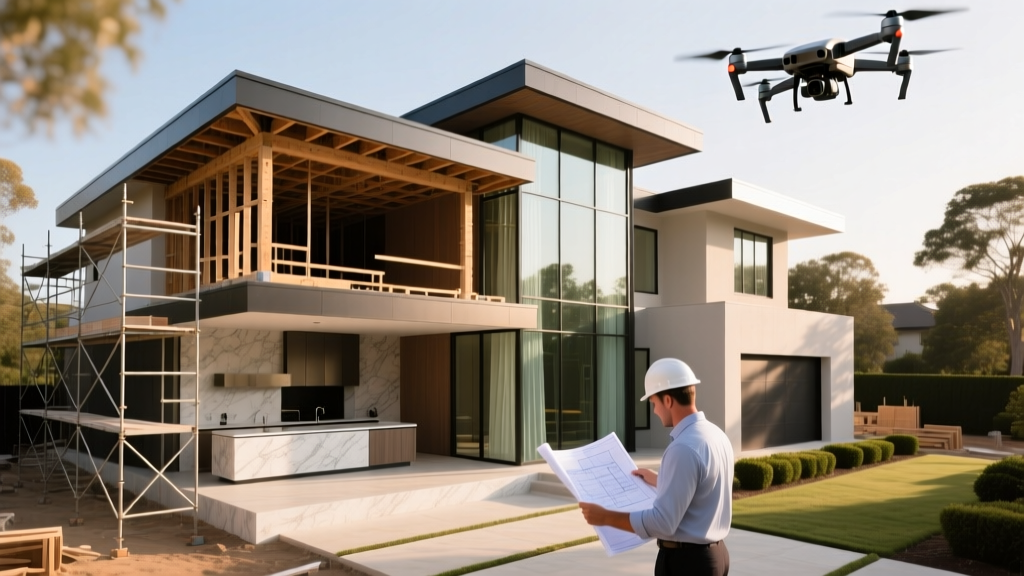
The Capital Stack: Understanding Luxury Construction Finance
Financing a custom luxury home—typically defined as a build exceeding $1.5 million in total project cost—requires a fundamentally different capital strategy than purchasing an existing tract home. When evaluating the cost to build luxury home custom projects, borrowers must navigate complex liquidity requirements, builder risk assessments, and specialized debt instruments. Unlike standard mortgages, construction loans are short-term, interest-only facilities that disburse funds in stages, exposing the borrower to rate volatility and draw-schedule delays.
According to the National Association of Home Builders (NAHB), custom builds account for a significant premium in material and labor costs, driven by high-end finishes, complex site engineering, and extended architectural timelines. Consequently, lenders treat these projects as high-risk commercial ventures rather than standard residential purchases.
Choosing the Right Construction Loan Vehicle
Selecting the correct debt instrument depends heavily on your lot status, risk tolerance, and long-term rate outlook. Below is a comparison matrix of the primary financing vehicles used for luxury custom builds.
| Feature | Single-Close (C2P) | Two-Close Construction | Lot Equity / HELOC Bridge |
|---|---|---|---|
| Closing Costs | Paid once at inception | Paid twice (construction + perm) | Minimal (uses existing equity) |
| Rate Lock | Locked at initial closing (12-18 mo) | Floating until permanent conversion | N/A (Self-funded build phase) |
| Down Payment | 20% - 30% of total project cost | 20% - 25% of total project cost | 100% cash outlay during build |
| Best For | Rate-sensitive borrowers | Borrowers expecting rate drops | High-net-worth, land owners |
For most luxury borrowers, the Single-Close Construction-to-Permanent (C2P) loan is the optimal choice. As detailed by Investopedia's construction loan guidelines, a C2P loan locks in your permanent mortgage rate before ground is broken, shielding you from macroeconomic rate hikes during a 12-to-18-month build cycle. However, lenders will charge a premium (typically 0.25% to 0.50% higher than a standard 30-year fixed) for this rate-lock extension.
The Jumbo Underwriting Gauntlet
When the cost to build a luxury custom home pushes your loan amount into jumbo territory, underwriting shifts from automated algorithms to intense manual scrutiny. Private banks and specialized jumbo lenders enforce rigid financial profiles.
Liquidity and Reserve Requirements
Standard conforming loans might require 2 to 6 months of Principal, Interest, Taxes, and Insurance (PITI) in reserves. Jumbo construction loans routinely demand 12 to 24 months of PITI in liquid assets post-closing. If your projected monthly payment on a $2.5M loan is $18,000, you must prove you have $216,000 to $432,000 in liquid reserves (cash, stocks, or highly liquid bonds) that are completely separate from your down payment and construction contingency funds.
Debt-to-Income (DTI) Restrictions
While FHA or conventional loans may stretch DTI ratios to 50%, jumbo construction lenders typically cap the back-end DTI at 43% to 45%. Furthermore, if you are carrying debt on the lot (e.g., a land loan), that payment is factored into your DTI during the construction phase, which can severely restrict your borrowing power for the actual build.
'Lenders do not just underwrite the borrower; they underwrite the builder. For luxury custom homes, we require the general contractor to carry a minimum $2M general liability policy, provide a verified track record of at least three similar-tier completions in the last 24 months, and submit a fully itemized SWOT analysis of the site.' — Senior VP of Jumbo Lending, Regional Private Bank
Structuring the Draw Schedule and Interest Reserves
Unlike a traditional mortgage where the lender wires the full amount to the seller on day one, construction funds are held in escrow and released via a draw schedule. The lender will only disburse funds for work completed and verified by a third-party inspector.
Typical Luxury Draw Schedule (6-Phase)
- Draw 1 (15%): Site clearing, excavation, utility trenching, and foundation pouring.
- Draw 2 (20%): Framing, roof trusses, and exterior sheathing (Dry-in phase).
- Draw 3 (20%): Rough plumbing, HVAC, electrical, and exterior cladding (stone, stucco, or premium siding).
- Draw 4 (20%): Insulation, drywall, interior trim, and cabinet installation.
- Draw 5 (15%): Flooring, countertops, fixtures, appliances, and interior paint.
- Draw 6 (10%): Final grading, landscaping, driveway, and Certificate of Occupancy (CO) issuance.
Calculating the Interest Reserve
During the build, you only pay interest on the funds actually drawn. However, most luxury borrowers do not want to make out-of-pocket interest payments while simultaneously paying rent or a mortgage on their current residence. To solve this, lenders build an Interest Reserve into the total loan amount.
The Math: Assume a $2,000,000 construction loan at a 7.5% annual interest rate over a 12-month build. Because funds are drawn incrementally, the average outstanding balance is roughly 50% ($1,000,000).
Annual Interest = $1,000,000 × 0.075 = $75,000.
This $75,000 is added to your total loan balance, meaning you are financing your interest payments. If the build is delayed by 3 months due to supply chain issues or architectural review board (ARB) disputes, that reserve will deplete, forcing you to make out-of-pocket interest payments or request a costly loan modification.
Hidden Financing Costs That Derail Luxury Builds
When calculating the true cost to build a luxury custom home, borrowers frequently overlook soft costs and contingency shortfalls. Ensure your financing package accounts for the following:
- Architectural Review Board (ARB) Delays: High-end neighborhoods and HOAs often require multiple design submissions. A 4-month delay in approval extends your construction loan interest reserve and may require paying for a rate-lock extension (typically 0.125% to 0.25% of the loan amount per month).
- Geotechnical and Soil Remediation: Luxury estates often feature expansive footprints, infinity pools, or subterranean wine cellars. If soil borings reveal expansive clay or high water tables, engineering costs for deep pier foundations can add $50,000 to $150,000 to the site-work budget.
- Contingency Reserves: While standard builds require a 5% to 10% contingency, luxury custom builds with imported materials (e.g., Italian marble, custom European cabinetry) demand a 15% to 20% contingency. Lenders will not approve the loan if the budget lacks this buffer.
Your 90-Day Pre-Approval Action Plan
Securing financing for a luxury custom build is a marathon, not a sprint. Execute this framework before finalizing your land purchase or signing a builder contract.
Phase 1: Days 1-30 (Financial Audit)
Compile 24 months of tax returns, W-2s, and K-1s. Liquidate any restricted stock units (RSUs) or private equity holdings that will be used for the down payment to ensure they are seasoned in your bank accounts for at least 60 days. Calculate your exact post-closing liquidity to ensure it meets the 12-to-24-month PITI reserve requirement.
Phase 2: Days 31-60 (Builder & Plan Alignment)
Select your architect and general contractor. The lender will require a fully executed, fixed-price construction contract (cost-plus contracts are rarely accepted for jumbo builds without a strict Guaranteed Maximum Price cap). Submit the architectural plans and the builder's itemized budget to the lender's appraisal team.
Phase 3: Days 61-90 (Appraisal & Commitment)
The lender will order a 'subject-to-completion' appraisal. In the luxury sector, finding comparable properties (comps) for a highly customized home is notoriously difficult. Work with your architect to provide the appraiser with a detailed 'cost-approach' breakdown and material specifications to justify the projected valuation. Once the appraisal clears, the lender issues the final loan commitment, and you can close on the construction facility.
By treating the financing process with the same rigor as the architectural design, you insulate your project from capital shortfalls, ensuring the cost to build your luxury custom home remains predictable from groundbreaking to the final certificate of occupancy.
Written by
Sarah WhitfieldSarah Whitfield is a chartered quantity surveyor (MRICS) and construction cost analyst with 15 years of experience in material pricing, procurement strategy, and project budgeting. She earned her degree in Construction Management from the University of Reading (UK) and has worked on projects ranging from $2M custom homes to $180M mixed-use developments across North America and Europe. Sarah currently leads cost estimating for BuildMat Insight, maintaining a proprietary database of 4,000+ material price points updated quarterly. She is a frequent contributor to RSMeans cost data panels and has presented at the International Cost Engineering Council (ICEC) congress. Based in Denver, CO, Sarah is an avid trail runner and volunteer mentor for Women in Construction.
More from Sarah Whitfield
View all
Wood & Lumber
What Are the Different Types of Wood? A Builder's Guide
Compare structural softwoods, finish hardwoods, and engineered lumber. Analyze Janka ratings, MOE values, and 2026 pricing for construction.
Aug 4, 2026

Walls & Panels
Steel Framing vs Wood Framing: Corrosion and Moisture Defense
Compare steel framing vs wood framing for moisture resistance. Learn about galvanized coatings, condensation risks, and corrosion protection strategies.
Jul 21, 2026

Stone & Masonry
How to Cut Stone Veneer: Wet Saw vs Grinder Comparison
Compare the best tools for cutting stone veneer. We review wet saws, angle grinders, and chop saws to help you achieve clean, chip-free cuts.
Jul 21, 2026