Financing the Cost to Build a House in San Diego: 2026 Guide
Discover how to finance the cost to build a house in San Diego. Explore 2026 construction loan rates, land equity strategies, and hidden fees.
The True Baseline: Calculating the Cost to Build a House in San Diego
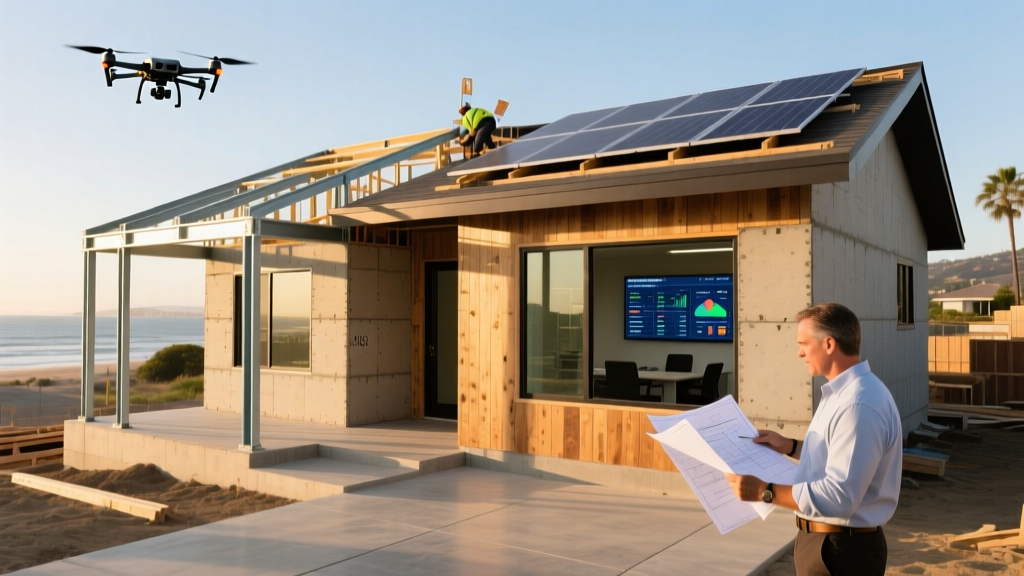
Securing financing begins with an uncompromisingly accurate budget. The cost to build a house in San Diego varies drastically depending on whether you are building in the coastal overlay zone, the urban infill corridors, or the rural backcountry. As of 2026, hard construction costs for a custom, architect-designed home in San Diego County range from $425 to $650 per square foot. For a standard 2,500-square-foot residence, the hard costs alone will fall between $1,062,500 and $1,625,000.
However, hard costs (lumber, concrete, labor, finishes) only represent 75% to 80% of your total capital requirement. To properly size your construction loan, you must underwrite the soft costs: architectural fees (typically 8% to 12% of hard costs), structural engineering, soil reports, and San Diego-specific impact fees. If you are building in fire-prone backcountry areas like Ramona or Alpine, you must also factor in Wildland-Urban Interface (WUI) compliance, which mandates fire-rated materials, ember-resistant vents, and sometimes private fire sprinkler systems, adding $25,000 to $45,000 to your baseline.
Construction Loan Structures for Southern California Builders
Unlike a traditional mortgage that funds a completed asset, a construction loan funds a liability in progress. Lenders disburse capital in tranches (draws) as milestones are met. According to the Consumer Financial Protection Bureau, construction loans carry higher interest rates and stricter underwriting requirements because the collateral does not yet exist. For San Diego custom builds, three primary loan structures dominate the market.
| Loan Type | Min Down Payment | 2026 Max Loan Limit (Approx) | Best Use Case | Primary Drawback |
|---|---|---|---|---|
| Conventional Construction-to-Permanent (C2P) | 20% - 25% | $1,250,000 (Jumbo limits apply) | High-net-worth borrowers building luxury custom homes. | Strict debt-to-income (DTI) limits; high jumbo rates. |
| FHA One-Time Close (OTC) | 3.5% | $1,149,825 (San Diego FHA Limit) | First-time builders or those with lower cash reserves. | Rigid appraisal rules; limits on custom architectural complexity. |
| Standalone Construction Loan | 25% - 30% | Varies by private lender | Investors or those planning to refinance into a specialized mortgage post-build. | Requires two separate closings and two sets of closing costs. |
The Land Equity Advantage
If you already own the lot in San Diego outright, or have significant equity in it, most lenders will allow you to use that land equity as your entire down payment. For example, if you purchased a lot in North Park for $450,000 in 2022 and your total construction loan is $1,200,000, the lender will view your $450,000 land equity as a 37.5% down payment, easily satisfying the 20% requirement and potentially allowing you to avoid private mortgage insurance (PMI) or jumbo loan premiums.
Navigating San Diego's Hidden Soft Costs and Impact Fees
The most common reason construction loans fall short in San Diego is the underestimation of municipal soft costs. When calculating the cost to build a house in San Diego, you must line-item the following jurisdictional fees:
- School Facilities Fees: San Diego Unified School District (SDUSD) and surrounding districts charge developer fees to offset the impact of new residential units. In 2026, expect to pay approximately $5.00 to $5.50 per square foot of livable space. For a 3,000-square-foot home, this is a non-negotiable $15,000 to $16,500 cash outlay required before permits are issued.
- Water and Sewer Tie-Ins: The San Diego Public Utilities Department charges hefty meter and capacity fees. A new 1-inch water meter and sewer lateral connection can cost between $12,000 and $18,000, depending on the distance to the main line and street restoration requirements.
- Title 24 Solar Mandates: The California Energy Commission mandates that all new low-rise residential buildings include solar photovoltaic (PV) systems. For a 2,500-square-foot home, a code-compliant 5.5kW to 7kW solar array will add $16,000 to $22,000 to your electrical budget.
The Coastal Overlay Zone Premium
If your build site is located west of the I-5 freeway or in designated coastal communities (La Jolla, Point Loma, Ocean Beach, Del Mar), you are subject to the Coastal Development Permit (CDP) process. This requires specialized environmental consultants, view-corridor studies, and public hearing notices. Budget an additional $15,000 to $30,000 in soft costs and add 6 to 14 months to your pre-construction timeline. Lenders will require proof of CDP approval before funding the first draw.
Executing the Draw Schedule and Interest Reserves
Construction loans do not disburse funds upfront. The lender holds the capital in an escrow account and releases it based on a pre-approved draw schedule, verified by a third-party inspector. A typical San Diego custom home build utilizes a 5-to-6 draw schedule over 12 to 18 months:
- Draw 1 (15%): Site prep, grading, and foundation pouring.
- Draw 2 (25%): Framing, roof trusses, and structural shear walls.
- Draw 3 (20%): "Dry-in" phase (roofing, windows, exterior stucco/siding) and rough MEP (mechanical, electrical, plumbing).
- Draw 4 (25%): Insulation, drywall, interior trim, and cabinet installation.
- Draw 5 (15%): Finish flooring, paint, fixtures, landscaping, and final Certificate of Occupancy (CO).
Calculating Your Interest Reserve
During construction, you only pay interest on the money actually drawn. However, most San Diego builders roll an "interest reserve" into the total loan amount to avoid out-of-pocket monthly payments during the build. To calculate this, use the following formula:
(Total Loan Amount × Interest Rate × Construction Months) ÷ 12 ÷ 2
We divide by 2 because the average outstanding balance is roughly half the total loan amount (since funds are drawn incrementally). If your total loan is $1,500,000 at a 9.5% interest rate over a 14-month build, your interest reserve calculation is: ($1,500,000 × 0.095 × 14) ÷ 12 ÷ 2 = $83,125. This amount must be added to your total loan request to prevent cash-flow shortages in month 10.
Frequently Asked Questions
Can I act as my own general contractor to lower the cost to build a house in San Diego?
While California law allows owner-builders to pull permits, most institutional construction lenders (like Chase, Bank of America, or local credit unions like SDCCU) will not fund an owner-builder project. They require a licensed, bonded General Contractor with a proven track record and a minimum of three completed custom builds in the last five years. If you want to act as your own GC, you will likely need to self-fund or secure a private hard-money loan at significantly higher rates (12% to 15%).
How do San Diego's new ADU laws affect my construction financing?
If you plan to build an Accessory Dwelling Unit (ADU) alongside your primary residence, you must include it in the initial construction loan appraisal. Lenders will appraise the property as a single-family home with an ADU, which typically increases the appraised value by 15% to 25% compared to a standalone home. However, building both simultaneously requires a larger upfront draw for utility trenching and dual-meter setups. Consult the San Diego Development Services Department for current ADU zoning and setback waivers before finalizing your architectural plans.
What happens if material costs spike during the 14-month build?
Standard fixed-price construction contracts in San Diego often include a 10% to 15% contingency allowance specifically for material volatility. If lumber or concrete prices spike beyond this contingency, the borrower is responsible for the overage out-of-pocket. To mitigate this, savvy builders pre-purchase and store high-volatility materials (like engineered lumber and windows) in a bonded warehouse before the first draw, locking in 2026 pricing and shielding the loan budget from supply chain shocks.
Written by
Sarah WhitfieldSarah Whitfield is a chartered quantity surveyor (MRICS) and construction cost analyst with 15 years of experience in material pricing, procurement strategy, and project budgeting. She earned her degree in Construction Management from the University of Reading (UK) and has worked on projects ranging from $2M custom homes to $180M mixed-use developments across North America and Europe. Sarah currently leads cost estimating for BuildMat Insight, maintaining a proprietary database of 4,000+ material price points updated quarterly. She is a frequent contributor to RSMeans cost data panels and has presented at the International Cost Engineering Council (ICEC) congress. Based in Denver, CO, Sarah is an avid trail runner and volunteer mentor for Women in Construction.
More from Sarah Whitfield
View all
Wood & Lumber
What Are the Different Types of Wood? A Builder's Guide
Compare structural softwoods, finish hardwoods, and engineered lumber. Analyze Janka ratings, MOE values, and 2026 pricing for construction.
Aug 4, 2026

Walls & Panels
Steel Framing vs Wood Framing: Corrosion and Moisture Defense
Compare steel framing vs wood framing for moisture resistance. Learn about galvanized coatings, condensation risks, and corrosion protection strategies.
Jul 21, 2026

Stone & Masonry
How to Cut Stone Veneer: Wet Saw vs Grinder Comparison
Compare the best tools for cutting stone veneer. We review wet saws, angle grinders, and chop saws to help you achieve clean, chip-free cuts.
Jul 21, 2026