Wind Power Cost to Build: Residential vs. Commercial 2026
Compare the wind power cost to build for residential small turbines versus commercial utility-scale projects in 2026, including LCOE and site prep.

The True Wind Power Cost to Build: A 2026 Benchmark
The wind power cost to build varies exponentially based on project scale, site topology, and grid proximity. In 2026, supply chain normalization and updated Inflation Reduction Act (IRA) tax credit monetizations have fundamentally shifted the capital expenditure (CapEx) landscape. While raw material costs for steel and concrete have stabilized compared to the early 2020s, the divergence in economies of scale between residential micro-wind and utility-scale commercial wind remains stark. Understanding these cost structures is critical for developers, rural landowners, and commercial investors evaluating renewable energy portfolios.
Residential Small Wind (5kW - 20kW): $5,200 - $7,800 per kW
Commercial Utility-Scale (2MW - 5MW+): $1,250 - $1,450 per kW
Note: Commercial costs reflect heavily subsidized supply chains and massive economies of scale in logistics and foundation pouring.
Residential vs. Utility-Scale: Cost Comparison Matrix
To accurately compare the wind power cost to build, we must isolate a standard residential setup against a modern commercial utility turbine. The following matrix contrasts a 10kW residential system with a 3.5MW commercial turbine, reflecting 2026 market averages.
| Metric | Residential (10kW Class) | Commercial Utility (3.5MW Class) |
|---|---|---|
| Representative Model | Bergey Excel 10 or similar | Vestas V162-6.2 MW (operating at 3.5MW site limit) or Siemens Gamesa SG 3.4-132 |
| Total Estimated CapEx | $55,000 - $78,000 | $4.37M - $5.07M |
| Cost per Kilowatt (kW) | $5,500 - $7,800 / kW | $1,250 - $1,450 / kW |
| Tower / Hub Height | 120 ft (Guyed or Freestanding) | 330 ft - 390 ft (Tubular Steel Sections) |
| Foundation Type | Concrete pier (approx. 4-6 cubic yards) | Reinforced gravity base (600-900 cubic yards) |
| Estimated LCOE | $0.09 - $0.15 / kWh | $0.026 - $0.038 / kWh |
Deconstructing the Residential Wind Power Cost to Build
Small wind turbines (under 100kW) are typically deployed for rural homesteads, agricultural operations, or off-grid facilities. The high per-watt cost is driven by a lack of manufacturing scale and the fixed costs of site preparation, which do not shrink proportionally with turbine size.
Hardware and Tower Logistics
For a standard 10kW system like the Bergey Excel 10, the turbine hardware (rotor, alternator, tail vane) accounts for roughly 40% of the total budget, or about $22,000 to $28,000. However, the tower is often the most underestimated expense. A 120-foot guyed tower kit costs between $8,000 and $12,000, but requires significant land clearance for the guy wire anchors (typically a radius of 150 feet). Freestanding monopole towers eliminate the need for guy wires but require massive concrete foundations and heavy steel, pushing the tower cost upward of $25,000.
Electrical and Interconnection
Residential systems require a grid-tie inverter (such as the SMA Sunny Boy series) and a specialized wind charge controller if battery backup is integrated. Budget $6,000 to $9,000 for the balance of system (BOS) electrical components, trenching, and the local utility interconnection application, which can incur fees ranging from $500 to $2,500 depending on the local cooperative or municipal utility.
Deconstructing Commercial Utility-Scale Costs
Utility-scale wind projects benefit from industrial logistics and bulk purchasing, driving the wind power cost to build down to roughly $1,350 per kW. According to data tracked by the National Renewable Energy Laboratory (NREL), modern onshore wind CapEx has stabilized as global shipping routes for oversized nacelles and blade transport have normalized post-2024.
The Heavy Civil Engineering Reality
Building a 3.5MW commercial turbine is primarily a heavy civil engineering project. The foundation alone requires excavating up to 2,500 cubic yards of soil, installing a rebar cage weighing 40 tons, and pouring 700+ cubic yards of high-strength concrete in a single continuous lift to prevent cold joints. This foundation work costs between $250,000 and $350,000 per pad.
Crane Mobilization and Assembly
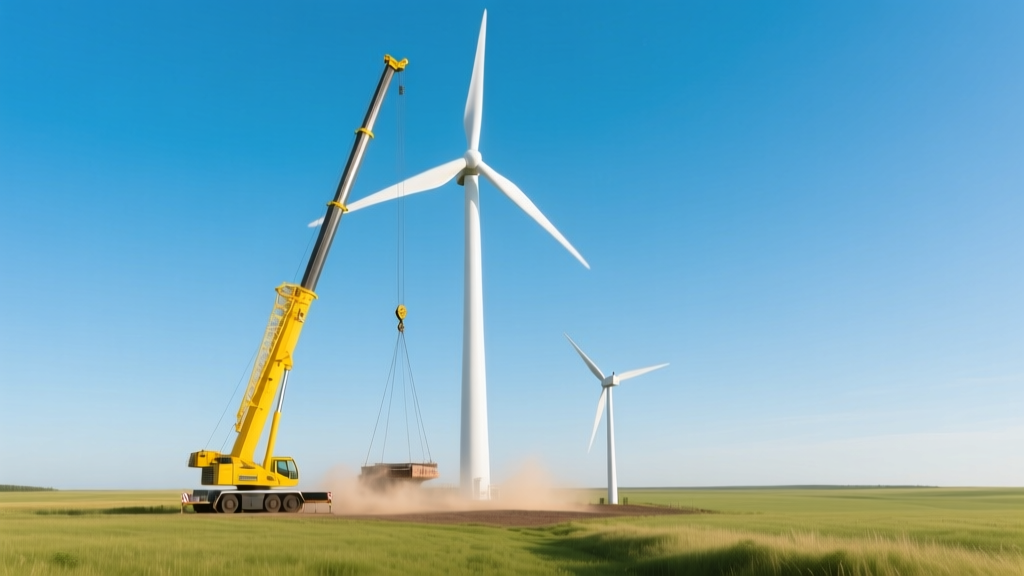
Erecting a 360-foot tower requires a 600-ton to 800-ton crawler crane. Mobilizing, assembling, and demobilizing these cranes costs upwards of $150,000 per site. Developers mitigate this by batching construction—building 20 to 50 turbines in a single campaign to amortize the crane and heavy-haul transport costs across multiple units.
Hidden Construction Variables That Inflate Budgets
Both residential and commercial projects frequently encounter hidden site-prep costs that are omitted from basic hardware quotes. When estimating your wind power cost to build, factor in these critical variables:
- Geotechnical Drilling and Soil Testing: Commercial gravity bases require proof of bedrock depth and soil bearing capacity. A full geotech survey costs $15,000 - $30,000 per site. Residential projects may skip this but risk foundation settling in expansive clay soils.
- Access Road Construction: Utility blades can exceed 230 feet in length. Transporting them requires specialized trailers and access roads with massive turning radii, crushed aggregate bases, and 20-foot widths. Road building can add $100,000 to $250,000 per mile to a commercial project.
- Avian and Environmental Studies: Commercial sites require 12 to 24 months of pre-construction avian radar and acoustic monitoring to comply with the Migratory Bird Treaty Act and local wildlife regulations. Budget $50,000+ for environmental compliance.
- Grid Interconnection Upgrades: If the local substation lacks the capacity to handle a new 50MW wind farm injection, the developer may be forced to pay for transformer upgrades or miles of new transmission lines. The U.S. Energy Information Administration (EIA) notes that interconnection queue delays and upgrade costs are currently the largest financial bottleneck for utility-scale wind.
LCOE Analysis: The Ultimate Financial Metric
CapEx only tells half the story. The Levelized Cost of Energy (LCOE) measures the lifetime cost of building, operating, and maintaining the turbine divided by the total energy produced. Because commercial turbines operate at hub heights of 350+ feet, they access stronger, less turbulent wind shear, resulting in capacity factors of 40% to 55%. Residential turbines, restricted to 120-foot towers by zoning and budget, often operate in turbulent boundary layers with capacity factors of 15% to 25%.
"A 10kW residential turbine in a Class 3 wind zone might produce 15,000 kWh annually, yielding an LCOE of $0.12/kWh. A 3.5MW utility turbine in the same macro-region, utilizing a taller tower and advanced aerodynamics, will produce over 12,000,000 kWh annually, driving the LCOE down to $0.03/kWh. The physics of the wind profile power law dictates the economics."
— Wind Energy Engineering Handbook, 2025 Edition
For residential builders, the financial justification rarely relies on competing with utility grid rates. Instead, the ROI is calculated based on energy independence, resilience against grid outages, and avoidance of rural line-extension fees (which can exceed $50,000 per mile to run new utility poles to a remote property).
Decision Framework: Which Wind Project Fits Your Portfolio?
Use this framework to determine which scale of wind construction aligns with your capital and site constraints:
Scenario A: The Remote Agricultural or Off-Grid Homestead
Condition: You own rural acreage, the nearest utility three-phase line is over 2 miles away, and you have consistent 12+ mph average wind speeds at 100ft.
Action: Build a 5kW - 15kW residential wind system paired with a lithium-iron-phosphate (LiFePO4) battery bank and a backup diesel generator. Expect to spend $65,000 - $90,000 total. The high per-watt cost is justified by avoiding $100,000+ in utility line-extension fees.
Scenario B: The Commercial Landowner with Lease Agreements
Condition: You control 5,000+ contiguous acres in the Midwest or Great Plains, possess high-voltage transmission access within 10 miles, and can secure a Power Purchase Agreement (PPA).
Action: Partner with a utility-scale developer. Do not self-fund the construction. The developer will absorb the $4M+ per turbine CapEx and the massive soft costs (interconnection studies, environmental permitting). Your role is to negotiate a land lease ($8,000 - $12,000 per turbine annually) and a production royalty (1% - 4% of gross revenues).
Scenario C: The Mid-Sized Manufacturing Facility
Condition: You operate a factory with high daytime energy loads, possess 5-10 acres of unused land, and want to hedge against commercial rate hikes.
Action: Investigate 'distributed wind' (100kW - 500kW class turbines). This middle-ground sector bridges the gap between residential and utility. Turbines like the Endurance E-3120 (500kW) cost roughly $2,500 - $3,200 per kW to install. With the 30% Investment Tax Credit (ITC) and accelerated MACRS depreciation, the payback period for industrial distributed wind in high-rate states (like California or New York) can drop below 6 years.
Accurately forecasting the wind power cost to build requires moving beyond simple hardware quotes. By mapping the geotechnical, logistical, and electrical interconnection realities of your specific site against the 2026 benchmark data, you can engineer a financially viable wind energy asset that withstands both market fluctuations and extreme weather events.
Written by
Marcus ChenMarcus Chen is a licensed structural engineer (PE) and building materials analyst with over 12 years of experience across residential, commercial, and industrial construction. He holds a Master of Science in Civil Engineering from UC Berkeley and spent six years at Thornton Tomasetti before transitioning to independent consulting and technical writing. Marcus specializes in material selection for seismic-prone regions, concrete reinforcement strategies, and lifecycle cost analysis. His work has been cited by the American Concrete Institute (ACI) and the Structural Engineers Association of California (SEAOC). When he is not on a job site or at his desk, you will find him hiking the Sierra Nevada or restoring a 1920s craftsman bungalow in Oakland, CA.
More from Marcus Chen
View all
Construction Cost
How Much Did the Eiffel Tower Cost to Build?
How much did the Eiffel Tower cost to build in 1889? We adjust for inflation and compare its budget to modern skyscraper construction.
Aug 4, 2026

Fire Resistance
What Is a Fire Resistant Material? Testing & Certification Guide
Discover what is a fire resistant material through ASTM and UL testing. Learn how fire ratings, certifications, and assemblies work in construction.
Aug 4, 2026

Construction Cost
How Much Did the Burj Khalifa Cost to Build?
How much did the Burj Khalifa cost to build? We break down the $1.5B project and extract 5 money-saving strategies for your next build.
Jul 30, 2026