How to Finance the Cost to Build a Shipping Container Home
Discover how to finance the cost to build a shipping container home. Compare construction loans, FHA options, and hidden budget factors for 2026.
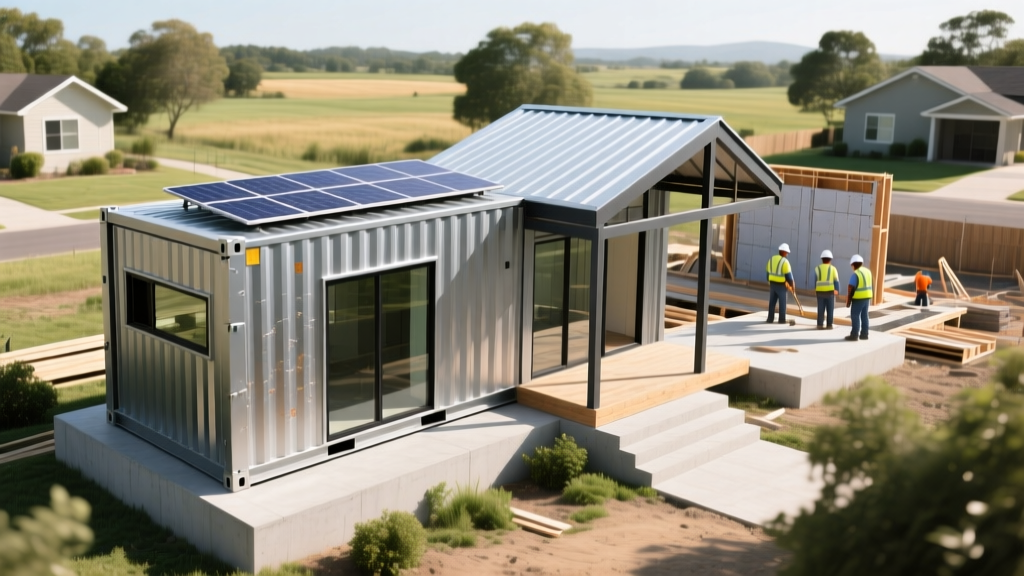
The Real Cost to Build a Shipping Container Home
Before approaching a lender, you must establish an accurate baseline. The cost to build shipping container home projects typically ranges from $180 to $280 per square foot for a turnkey, site-finished residence. While the raw steel boxes are relatively cheap, the modification, engineering, and site-work expenses quickly multiply. Lenders will scrutinize your budget for completeness; missing line items will result in immediate loan denial due to 'incomplete scope' risks.
| Construction Phase | Estimated Cost (2026) | Key Variables |
|---|---|---|
| Raw Materials (2x 40ft High Cube) | $9,000 - $13,000 | Corten steel condition, one-trip vs. wind/watertight |
| Site Prep & Foundation | $15,000 - $35,000 | Pier, stem wall, or slab; soil bearing capacity |
| Fabrication & Structural Welding | $25,000 - $45,000 | Number of cutouts, steel reinforcement tubing |
| Insulation & Framing | $12,000 - $18,000 | Closed-cell spray foam thickness, interior stud walls |
| MEP (Mechanical, Electrical, Plumbing) | $35,000 - $55,000 | Trenching distance, municipal vs. well/septic |
| Interior Finishes & Exterior Cladding | $40,000 - $70,000 | Cabinet grade, flooring type, exterior wood/metal panels |
| Total (Approx. 1,600 sq ft) | $136,000 - $236,000 | Excludes land acquisition and heavy crane mobilization |
The Appraisal Hurdle: Why Traditional Mortgages Fail
The primary barrier to financing alternative architecture is the appraisal process. Standard mortgage underwriters rely on the 'sales comparison approach,' which requires three to five recent sales of nearly identical homes within a one-mile radius. Because container homes are highly localized and custom, comparable sales (comps) rarely exist.
When comps are absent, appraisers must pivot to the 'cost approach'—calculating the land value plus the depreciated cost of improvements. If your lender's assigned appraiser lacks experience with non-standard modular or steel-frame construction, they will conservatively undervalue the property, creating a massive appraisal gap that kills the loan.
To bypass this, you must secure a lender who allows you to select an appraiser with specific modular or commercial steel-frame experience, or one who holds an MAI (Member of the Appraisal Institute) designation.
4 Viable Financing Routes for Container Construction
1. Construction-to-Permanent (C2P) Loans
How it works: A single-close loan that funds the build and automatically converts to a standard 30-year mortgage upon certificate of occupancy. As outlined by the Consumer Financial Protection Bureau, you only pay closing costs once.
Best for: Borrowers with 20% down and excellent credit (720+) building on a permanent foundation.
Watch out for: Strict draw schedules. The lender will only release funds after an inspector verifies completed milestones (e.g., foundation poured, roof dried-in).
2. FHA One-Time Close Construction Loan
How it works: Backed by the government, this allows down payments as low as 3.5%. The U.S. Department of Housing and Urban Development (HUD) mandates that the structure must be classified as real estate, meaning the container must be permanently affixed to a HUD-approved foundation system.
Best for: First-time buyers or those with limited cash reserves.
Watch out for: FHA loan limits cap the maximum borrowable amount, which may not cover high-end custom container builds in expensive zip codes.
3. Home Equity Line of Credit (HELOC) / Cash-Out Refi
How it works: If you already own land or a primary residence with substantial equity, you can borrow against it to fund the container build as a secondary home or ADU (Accessory Dwelling Unit).
Best for: Landowners building an off-grid cabin or backyard rental unit.
Watch out for: Variable interest rates on HELOCs can make monthly payments unpredictable during a 12-to-18-month build cycle.
4. Chattel or RV Loans (For Non-Permanent Builds)
How it works: If your container home is built on a trailer chassis or rests on temporary screw piles without a permanent concrete foundation, it is legally classified as personal property, not real estate.
Best for: Tiny homes on wheels or temporary site offices.
Watch out for: Interest rates are significantly higher (often 8% to 12%), and terms are shorter (10 to 15 years) compared to traditional mortgages.
Step-by-Step Loan Approval Strategy
Securing capital requires proving to the underwriter that the asset will hold its value. Follow this exact sequence to prepare your loan package:
- Secure the Land First: Lenders view land equity as 'skin in the game.' If you own the land free and clear, that equity can often serve as your down payment for the construction loan.
- Choose Factory-Modular over Site-Built: Underwriters heavily favor containers modified in a climate-controlled factory that carry a state Modular Insignia or third-party engineering stamp (e.g., IAPMO or ICC-ES). Site-cut containers carry too much weather and structural risk for conservative banks.
- Commission Architectural & Engineering (A/E) Plans: Your plans must include structural calculations showing how the Corten steel load-bearing walls are reinforced after cutting openings for windows and doors. Standard 2x4 framing plans will not suffice.
- Pre-Appraisal Meeting: Before officially applying, have your loan officer arrange a desk review with a specialized appraiser to confirm the 'cost approach' methodology will be accepted for your specific county.
Hidden Budget Killers Lenders Won't Warn You About
When calculating the cost to build shipping container home projects, amateur builders frequently omit critical line items, leading to mid-build cash shortfalls. Ensure your loan budget includes these specific expenses:
- Closed-Cell Spray Foam Insulation: Steel conducts heat and cold rapidly. You must use closed-cell polyurethane foam (minimum 2.5 inches, R-18) on the interior corrugated walls to create a vapor barrier. Failure to do so causes catastrophic interior condensation. Budget $2.50 to $3.50 per board foot.
- Crane Mobilization and Rigging: Placing a 9,000 lb 40ft High Cube container requires a 50-ton to 100-ton mobile crane. If your site has tight access or overhead power lines, crane companies will charge 'boom truck' premiums. Expect $1,500 to $3,500 per lift day.
- AWS Certified Welding: Structural modifications (like removing an entire side wall to join two containers) require welding that meets American Welding Society (AWS) D1.1 standards. General contractors cannot do this; you must hire specialized steel fabricators, which commands a 30% labor premium.
- Thermal Bridging Mitigation: Steel studs placed directly against the steel container walls will transfer exterior temperatures inside. You must budget for exterior continuous insulation or interior furring strips with thermal break pads.
Frequently Asked Questions
Do banks consider shipping container homes 'modular'?
Only if they are assembled in an off-site factory and carry a state-issued modular certification label. If you buy raw containers and modify them on your land, banks classify them as 'site-built alternative construction,' which triggers much stricter underwriting and appraisal requirements.
Can I use a VA loan to build a container home?
Yes, but the VA requires a one-time construction loan that converts to a permanent VA mortgage. The home must meet the VA's Minimum Property Requirements (MPRs), which include permanent foundation standards and strict energy efficiency mandates that require high-R insulation packages.
What happens if my container home fails the final inspection?
If the local building department denies the Certificate of Occupancy (CO) due to structural or electrical code violations, the construction loan will not convert to a permanent mortgage. You will be stuck with a short-term, high-interest construction loan that requires immediate payoff or refinancing, which is impossible without a legal CO.
Written by
Elena RodriguezElena Rodriguez is a civil engineer and technical writer specializing in concrete technology, masonry systems, and ASTM/ACI compliance. She earned her B.S. in Civil Engineering from Texas A&M University and spent a decade at a materials testing laboratory, performing over 2,000 concrete compressive strength tests and masonry prism evaluations. Elena is an ACI-certified Field Testing Technician (Grade I) and a member of ASTM Committee C12 on Natural Building Stone. She currently consults on forensic engineering cases involving concrete failures and moisture intrusion. Based in San Antonio, TX, Elena is a proud member of the Society of Women Engineers (SWE) and coaches her daughter's FIRST Robotics team.
More from Elena Rodriguez
View all
Walls & Panels
Cost Analysis: Light Gauge Steel Framing Advantages and Disadvantages
Evaluate light gauge steel framing advantages and disadvantages through a strict cost analysis lens, comparing material, labor, and lifecycle expenses.
Aug 4, 2026

Walls & Panels
Gypsum Board Types: Exact Specifications, Thickness & Dimensions
Compare standard, Type X, and moisture-resistant gypsum board types. Get exact specifications, thicknesses, dimensions, and ASTM standards for your project.
Aug 4, 2026

Fire Resistance
Best Fire-Resistant Outdoor Decking Materials: 2026 Buyer Guide
Discover the best fire-resistant outdoor decking materials for 2026. Compare Class A PVC, aluminum, and hardwood options for WUI compliance and safety.
Aug 4, 2026