Financing the Cost to Build Single Car Garage Additions
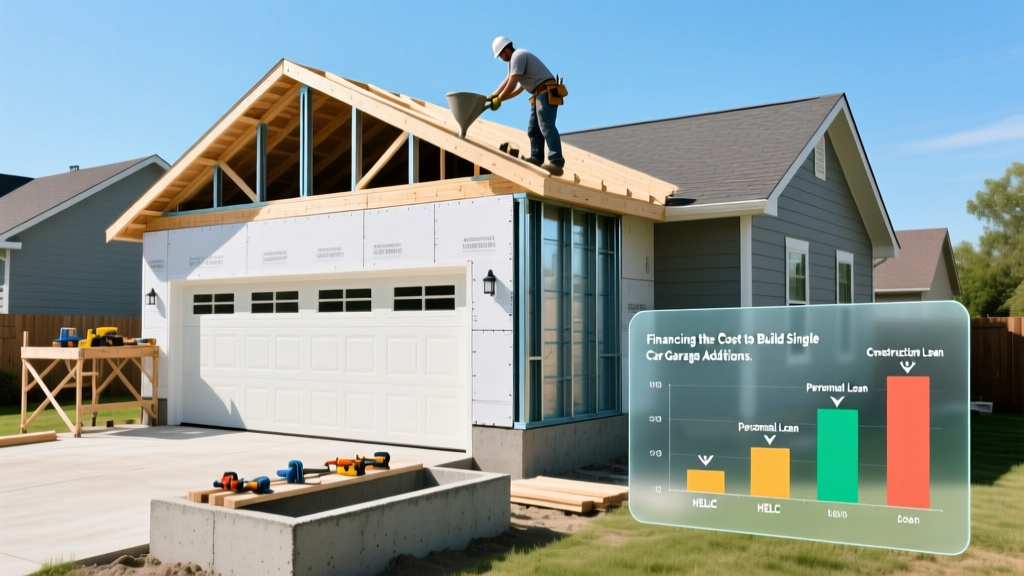
Discover how to finance the cost to build single car garage projects. Compare HELOCs, personal loans, and construction loans to fund your build.
The True Cost Baseline: What Lenders Need to See
Before approaching a lender, you must establish a precise construction budget. The cost to build single car garage structures varies wildly based on attachment status, foundation engineering, and electrical requirements. In 2026, a standard 14x24-foot (336 square feet) detached single-car garage with a monolithic concrete slab, basic framing, and an insulated sectional door ranges from $28,000 to $42,000. Attached units typically cost 15% to 20% less ($22,000 to $35,000) due to shared wall framing and easier utility tie-ins.
• Basic Detached (12x20): $22,000 - $28,000
• Standard Detached (14x24) with EV wiring: $32,000 - $45,000
• Attached (14x24) with drywall: $24,000 - $36,000
Lenders underwriting a construction or renovation loan will require a line-item bid from a licensed contractor. Handshake estimates or self-build material lists are rarely accepted for secured financing unless you qualify for a specialized owner-builder construction loan, which requires a 20% to 30% down payment and proven construction experience.
Top 4 Financing Vehicles for Garage Construction
Selecting the right capital source depends on your current equity position, credit score, and how quickly you need to break ground.
| Financing Method | Typical APR (2026) | Term / Structure | Best Use Case | Collateral |
|---|---|---|---|---|
| HELOC | 7.5% - 9.5% | 10-yr draw / 20-yr repay | Staged contractor payments | Home Equity |
| Home Equity Loan | 7.0% - 8.5% | 5 to 20-year fixed | Single lump-sum builder payout | Home Equity |
| Unsecured Personal Loan | 9.0% - 16.0% | 2 to 7-year fixed | Low equity / fast funding | None |
| Cash-Out Refinance | 6.5% - 7.5% | 15 to 30-year fixed | Consolidating high-rate debt + build | Home Equity |
Deep Dive: Home Equity Line of Credit (HELOC)
A HELOC is the most capital-efficient method for funding the cost to build single car garage projects when your contractor requires milestone payments. According to the Consumer Financial Protection Bureau (CFPB), a HELOC functions as a revolving credit line secured by your home. You only pay interest on the funds actually drawn. If your garage build costs $35,000, but you only need $10,000 for the foundation and framing phase, your interest accrues solely on that $10,000.
Crucial Underwriting Detail: Ensure your combined loan-to-value (CLTV) ratio remains below 80% after drawing the HELOC. Exceeding 80% CLTV on a conventional first mortgage can trigger private mortgage insurance (PMI) requirements or violate your primary mortgage's subordination clauses.
Deep Dive: Unsecured Personal Loans
If you lack sufficient home equity or want to avoid placing a lien on your property, an unsecured personal loan is the alternative. The Federal Trade Commission (FTC) notes that these loans are approved based strictly on creditworthiness and debt-to-income (DTI) ratios. While rates are higher, funding can occur in as little as 48 hours. This is ideal for smaller, prefabricated single-car garage kits ($15,000 - $20,000) where the vendor requires 100% upfront payment before shipping.
Hidden Costs That Derail Garage Financing
Borrowers frequently underfinance their projects by budgeting only for the vertical structure. When calculating the total cost to build single car garage additions, you must secure an additional 15% to 25% contingency for site-specific variables.
- Utility Trenching and Electrical Drops: Running a dedicated 60-amp subpanel to a detached garage requires trenching. Expect to pay $50 to $100 per linear foot for underground conduit and wiring. If you are installing a Level 2 EV charger, the main house panel may require a 200-amp to 400-amp service upgrade, adding $2,500 to $4,500 to the electrical budget.
- Frost Walls vs. Monolithic Slabs: In northern climates with deep frost lines, a monolithic slab is insufficient. You must excavate below the frost line and pour a continuous concrete footing and frost wall, which increases foundation costs by $4,000 to $7,000 compared to a simple slab-on-grade.
- Site Preparation and Grading: If your backyard has a slope greater than 5%, a retaining wall or extensive cut-and-fill grading is required before pouring the slab. This easily adds $2,000 to $6,000.
- Impact Fees and Permitting: Municipalities charge permit fees based on valuation. Furthermore, some zoning boards require drainage impact studies or impervious surface mitigation, which can cost $1,500 in engineering fees before a shovel hits the dirt.

Calculating ROI: Will the Garage Appraise?
Financing a garage is only a sound financial decision if the structure retains value. Appraisers use the cost approach and the sales comparison approach to value additions. A single-car garage rarely appraises at 100% of its construction cost. Industry data suggests a 60% to 80% recoup rate upon resale.
Appraisers value functional utility over raw square footage. A finished single-car garage with an EV charging port and integrated storage systems will appraise significantly higher in suburban markets than a bare-stud structure, effectively narrowing the gap between construction cost and appraised value.
For example, if you spend $40,000 building a detached single-car garage with a loft space, an appraiser may only assign $25,000 to $30,000 in added market value. However, the velocity of sale—how quickly the home sells—often increases dramatically, which is a non-quantifiable financial benefit.
If you are bundling the garage with a larger primary suite or kitchen renovation, look into a Fannie Mae HomeStyle Renovation loan. This allows you to finance the purchase or refinance of the home alongside the construction costs in a single first mortgage, based on the future appraised value of the property post-construction.
Step-by-Step Funding Execution Plan
- Secure the Line-Item Bid: Obtain a fixed-price contract from a licensed general contractor. Ensure the bid separates site prep, foundation, framing, and electrical. Lenders will not finance allowances or vague estimates.
- Order a Subject-To Appraisal: If using a HELOC or Home Equity Loan, your lender will order an appraisal to determine current market value. Ensure the appraiser notes any recent upgrades to the primary home to maximize your equity baseline.
- Establish the Draw Schedule: Work with your lender and contractor to create a 3-to-4 phase draw schedule (e.g., 25% at foundation, 35% at dry-in, 30% at finishes, 10% at final inspection). This protects your capital if the contractor defaults.
- Lock Your Rate or Index: If utilizing a HELOC, inquire about fixed-rate lock options for specific draws. Many modern HELOCs allow you to lock in a fixed rate on the $35,000 garage draw while leaving the rest of the credit line variable.
- Fund the Contingency in Cash: Do not finance the 15% contingency buffer. Keep this in a high-yield savings account and only deploy it if site conditions (like hitting bedrock during excavation) demand it.
Written by
David NakamuraDavid Nakamura is a licensed architect (AIA) and construction technology writer focused on sustainable building methods, mass timber engineering, and high-performance building envelopes. He holds a Master of Architecture from the University of Washington and is a certified Passive House Consultant (CPHC). David spent eight years at the Seattle firm Mithun, where he led the design of three LEED Platinum projects, before founding his own practice specializing in net-zero residential design. He serves on the editorial advisory board of GreenBuilder Magazine and has authored peer-reviewed papers on cross-laminated timber (CLT) connections for the Journal of Structural Engineering. In his spare time, David teaches woodworking at Pratt Fine Arts Center and kayaks the Puget Sound.
More from David Nakamura
View all
Construction Cost
Labor Cost to Build a Deck Per Sq Ft: 2026 Installation Guide
Discover the exact labor cost to build a deck per sq ft in 2026. This installation guide breaks down contractor rates, complexity factors, and hidden fees.
Aug 4, 2026

Construction Cost
How Much Does It Cost to Build a 3 Bedroom House? Financing Guide
Learn exactly how much it costs to build a 3 bedroom house and explore 2026 financing options, construction loan types, and budget frameworks for your build.
Aug 4, 2026

Construction Cost
Cost to Build a Tennis Court: 2026 Guide
How much does it cost to build a tennis court in 2026? Breakdowns for asphalt, concrete, and synthetic surfaces plus fencing and lighting.
Jul 30, 2026