How Much Did It Cost to Build Allegiant Stadium? Full Breakdown
A detailed construction cost breakdown of Allegiant Stadium, analyzing its $1.94B price tag, material costs, and comparisons to other NFL venues.

The Final Ledger: Answering the $1.94 Billion Question
When evaluating mega-structure budgets, the query of how much did it cost to build Allegiant Stadium yields a final audited figure of $1.94 billion. Originally projected at $1.8 billion during the 2016 legislative approval phase, the 65,000-seat venue for the Las Vegas Raiders experienced a 7.7% budget expansion by its 2020 completion. This final price tag equates to approximately $29,846 per seat and roughly $1,021 per gross square foot based on the facility's 1.9 million square foot footprint.
Allegiant Stadium Core Financial Metrics
- Total Final Cost: $1.94 Billion (Nominal 2020)
- Gross Floor Area: ~1,900,000 sq ft
- Cost Per Square Foot: $1,021 (2020) / ~$1,315 (2026 Inflation-Adjusted)
- Public Contribution: $750 Million (38.6% via hotel room tax)
- Private Contribution: $1.19 Billion (61.4% via Raiders, NFL, and debt)
Hard Cost Allocation: Concrete, Steel, and the Envelope
Breaking down the $1.94 billion requires isolating the hard construction costs from land acquisition, architectural fees (MANICA Architecture), and financing. The physical build was dominated by three massive material categories: structural concrete, structural steel, and the specialized exterior envelope.
The foundation and superstructure required 350,000 cubic yards of concrete and 14,000 tons of structural steel. Because Las Vegas lacks the heavy industrial manufacturing base required to fabricate specialized stadium-grade steel trusses, a significant portion of the steel was fabricated in the Midwest and Southwest, then shipped via heavy-haul rail and truck. This logistics chain added an estimated 8% to 12% premium to standard structural steel framing costs compared to stadiums built in traditional industrial hubs like Pittsburgh or Chicago.
The Black Glass and ETFE Premium
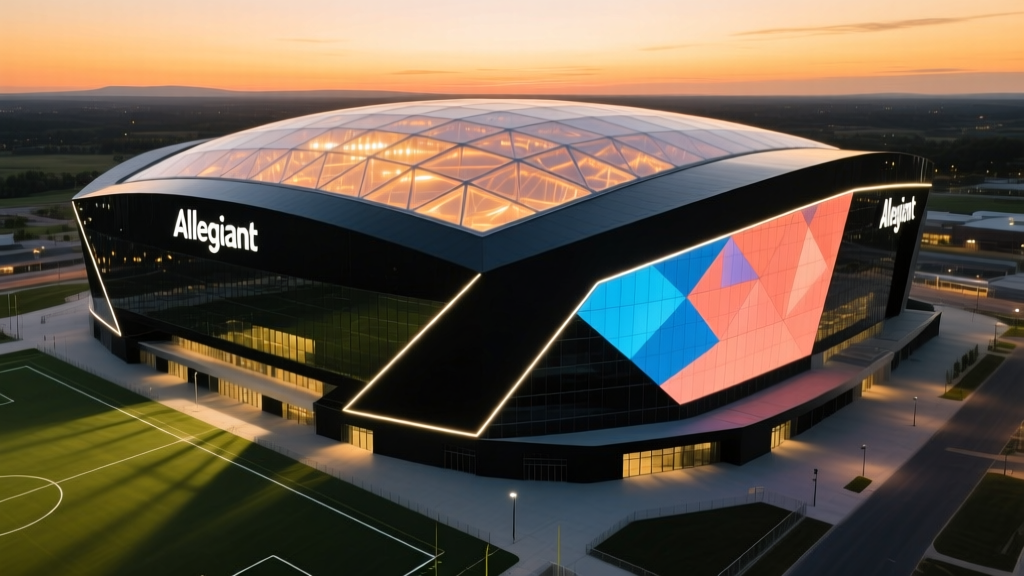
The most visually striking and financially demanding aspects of the stadium are its exterior and roof. The facade is clad in 27,000 custom-manufactured black reflective glass panels. This specific glazing was chosen to mirror the surrounding desert and the Las Vegas Strip, but it required specialized low-emissivity (Low-E) coatings to prevent the glass from acting as a magnifying lens and superheating the surrounding pedestrian plazas. According to StadiumDB's architectural profiles, the custom glazing and aluminum mullion systems accounted for nearly $110 million of the envelope budget.
The roof utilizes 97,000 square feet of ETFE (ethylene tetrafluoroethylene) plastic cushions. While lighter and cheaper than a fully retractable glass-and-steel mechanical roof (which can add $200M+ to a project), the ETFE system required complex tensioning cables and large mechanized roll-up doors to allow natural ventilation. The engineering required to anchor these lightweight cushions against Mojave Desert wind shears pushed the roof assembly cost to approximately $85 per square foot.
The Las Vegas Multiplier: Logistics and Labor Realities
Construction estimators analyzing this project must account for the 'Vegas Multiplier'—a combination of localized labor dynamics and environmental constraints that inflate baseline costs.
- Heat Mitigation and Shift Work: Pouring 350,000 cubic yards of concrete in a climate where summer daytime temperatures regularly exceed 110°F (43°C) requires strict thermal management. Ice was mixed into the concrete slurry to prevent premature curing during transit, and massive ice-melting plants were erected on-site. Furthermore, a significant percentage of exterior and steel erection work was shifted to night shifts, which incur a 10% to 15% labor premium for lighting, safety oversight, and shift differentials.
- Labor Competition: During the 2017-2020 construction window, Allegiant competed for skilled trades with the MSG Sphere, the Las Vegas Convention Center expansion, and multiple resort renovations. This hyper-competition drove union prevailing wages and overtime costs up by an estimated 14% above initial 2016 estimates.
- Water Scarcity Constraints: Dust control and concrete curing in a severe drought environment required the construction of dedicated water reclamation systems on-site, adding $4.2 million in temporary environmental compliance infrastructure.
Cost Comparison Matrix: Allegiant vs. Modern NFL Venues
To understand the $1.94 billion price tag, it must be contextualized against other recent NFL stadium projects. The table below adjusts historical nominal costs to 2026 estimated dollars using the Engineering News-Record (ENR) Building Cost Index to provide an apples-to-apples comparison for modern estimators.
| Stadium | Location | Year | Nominal Cost | 2026 Adj. Cost | Cost / Seat |
|---|---|---|---|---|---|
| SoFi Stadium | Inglewood, CA | 2020 | $5.50 B | $6.65 B | $95,000 |
| Allegiant Stadium | Las Vegas, NV | 2020 | $1.94 B | $2.34 B | $36,000 |
| Mercedes-Benz | Atlanta, GA | 2017 | $1.50 B | $1.92 B | $25,600 |
| U.S. Bank Stadium | Minneapolis, MN | 2016 | $1.10 B | $1.44 B | $21,800 |
As the data indicates, Allegiant represents a highly efficient build when compared to SoFi Stadium, which featured a vastly more complex dual-bowl excavation and a massive cantilevered roof spanning 70,000 seats. However, Allegiant's cost-per-seat is notably higher than cold-weather domed stadiums like U.S. Bank, primarily due to the premium finishes, the Las Vegas labor multiplier, and the specialized ETFE/glass envelope designed for a high-luxury tourism market.
Public vs. Private Funding: The Las Vegas Model
From a development and feasibility standpoint, the funding mechanism is just as critical as the hard costs. The $750 million public subsidy was generated not through general municipal taxes, but via a specialized 0.88% hotel room tax increase implemented by the Las Vegas Convention and Visitors Authority (LVCVA). This mechanism is highly relevant for estimators and developers working on sports-anchored entertainment districts in tourism-heavy municipalities. By tying the debt service to transient lodging taxes rather than resident property taxes, the project bypassed significant local political friction, accelerating the approval timeline by an estimated 18 to 24 months—a delay that would have cost upwards of $80 million in inflation and carrying costs.
2026 Estimating Framework: Applying Allegiant Data Today
For construction estimators, project managers, and developers modeling new sports venues or massive entertainment complexes in 2026, Allegiant Stadium provides a critical baseline. If you are pricing a 65,000-seat enclosed venue today, apply the following framework derived from this project's actuals:
- Baseline Shell and Core: Allocate $450 to $525 per gross square foot for the concrete and steel superstructure, adjusting for local seismic and wind load requirements.
- Envelope Multipliers: If utilizing ETFE or custom Low-E glazing, expect envelope costs to consume 12% to 15% of the total hard budget, up from the historical 8% for standard metal cladding and insulated roofing.
- MEP Systems for High-Occupancy: HVAC and life-safety systems for 70,000+ occupant loads in extreme heat climates now require $90 to $110 per square foot, driven by 2026 energy code compliance and advanced air-filtration standards.
- Logistics Contingency: For projects located outside traditional heavy-manufacturing corridors (e.g., the Rust Belt), add a mandatory 9% freight and logistics contingency to all structural steel and specialized glazing packages.
Understanding the precise material allocations, labor dynamics, and funding structures of Allegiant Stadium allows modern estimators to move beyond generic square-footage averages and build highly accurate, defensible budgets for the next generation of mega-structures.
Written by
Marcus ChenMarcus Chen is a licensed structural engineer (PE) and building materials analyst with over 12 years of experience across residential, commercial, and industrial construction. He holds a Master of Science in Civil Engineering from UC Berkeley and spent six years at Thornton Tomasetti before transitioning to independent consulting and technical writing. Marcus specializes in material selection for seismic-prone regions, concrete reinforcement strategies, and lifecycle cost analysis. His work has been cited by the American Concrete Institute (ACI) and the Structural Engineers Association of California (SEAOC). When he is not on a job site or at his desk, you will find him hiking the Sierra Nevada or restoring a 1920s craftsman bungalow in Oakland, CA.
More from Marcus Chen
View all
Construction Cost
How Much Did the Eiffel Tower Cost to Build?
How much did the Eiffel Tower cost to build in 1889? We adjust for inflation and compare its budget to modern skyscraper construction.
Aug 4, 2026

Fire Resistance
What Is a Fire Resistant Material? Testing & Certification Guide
Discover what is a fire resistant material through ASTM and UL testing. Learn how fire ratings, certifications, and assemblies work in construction.
Aug 4, 2026

Construction Cost
How Much Did the Burj Khalifa Cost to Build?
How much did the Burj Khalifa cost to build? We break down the $1.5B project and extract 5 money-saving strategies for your next build.
Jul 30, 2026